QUESTION IMAGE
Question
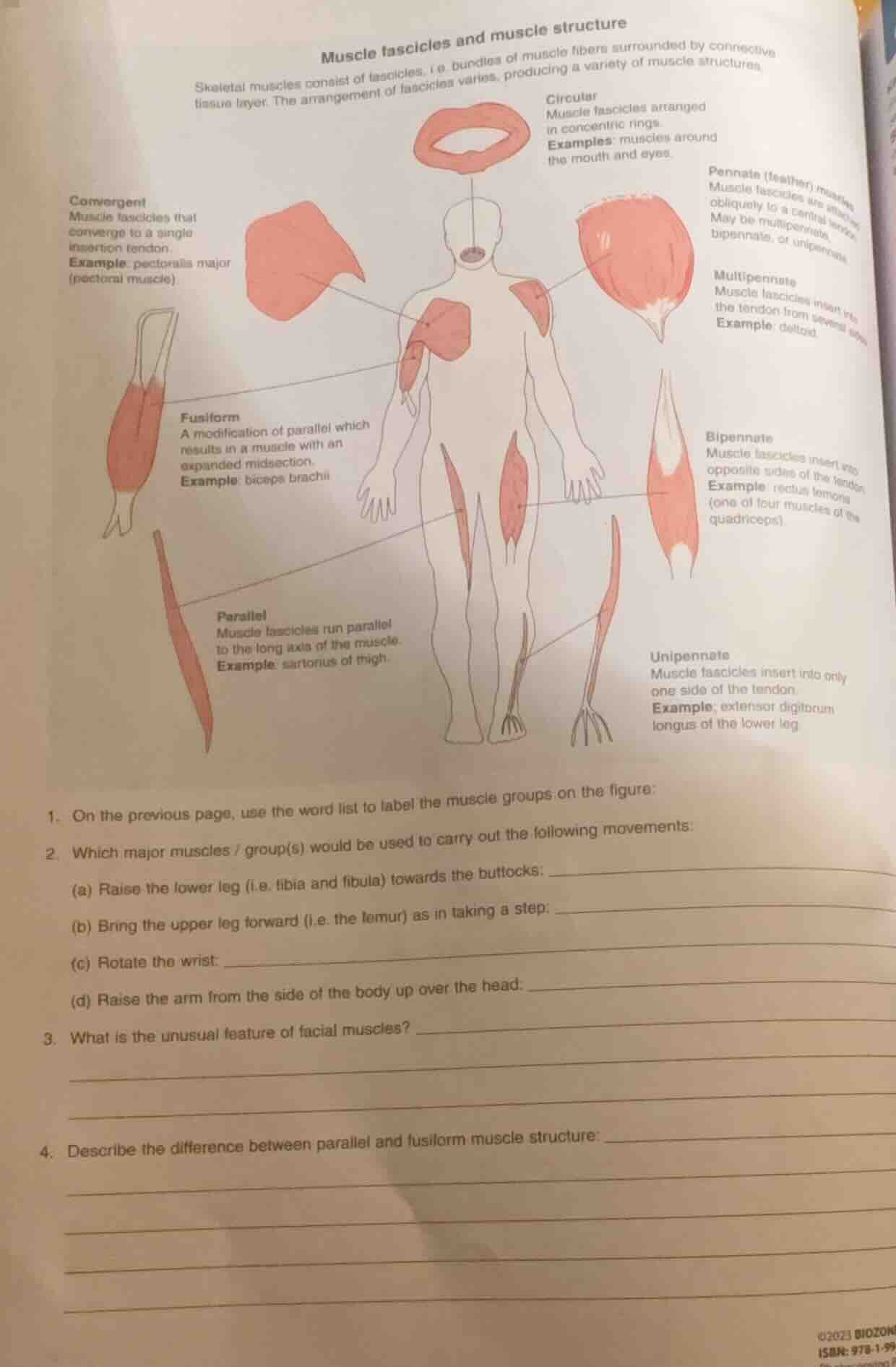
muscle fascicles and muscle structure
skeletal muscles consist of fascicles, i.e. bundles of muscle fibers surrounded by connective
tissue layer. the arrangement of fascicles varies, producing a variety of muscle structures.
convergent
muscle fascicles that
converge to a single
insertion tendon.
example: pectoralis major
(pectoral muscle)
fusiform
a modification of parallel which
results in a muscle with an
expanded midsection.
example: biceps brachii
parallel
muscle fascicles run parallel
to the long axis of the muscle.
example: sartorius of thigh.
circular
muscle fascicles arranged
in concentric rings.
examples: muscles around
the mouth and eyes.
pennate (feather) musc
muscle fascicles are attac
obliquely to a central tendor
may be multipennate,
bipennate, or unipennate.
multipennate
muscle fascicles insert into
the tendon from several side
example: deltoid
bipennate
muscle fascicles insert into
opposite sides of the tendon
example: rectus femoris
(one of four muscles of the
quadriceps).
unipennate
muscle fascicles insert into only
one side of the tendon.
example: extensor digitorum
longus of the lower leg
- on the previous page, use the word list to label the muscle groups on the figure:
- which major muscles / group(s) would be used to carry out the following movements:
(a) raise the lower leg (i.e. tibia and fibula) towards the buttocks:
(b) bring the upper leg forward (i.e. the femur) as in taking a step:
(c) rotate the wrist:
(d) raise the arm from the side of the body up over the head:
- what is the unusual feature of facial muscles?
- describe the difference between parallel and fusiform muscle structure:
©2023 biozon
isbn: 978-1-99
Question 2 (a)
To raise the lower leg (tibia and fibula) towards the buttocks, the hamstring muscles (biceps femoris, semitendinosus, semimembranosus) or more specifically, the gastrocnemius (calf muscle) and soleus work in conjunction with the hamstrings? Wait, no—actually, the movement of flexing the knee (bringing lower leg to buttocks) is primarily done by the hamstring group (biceps femoris, semitendinosus, semimembranosus) and also the gastrocnemius (but gastrocnemius is more for plantar flexion). Wait, correct muscle: the hamstrings (biceps femoris, semitendinosus, semimembranosus) are the primary knee flexors, which perform this movement. Alternatively, the gastrocnemius (part of calf) also assists, but the main muscle group for knee flexion (lower leg to buttocks) is the hamstrings. Wait, let's recall: knee flexion (angle between thigh and lower leg decreases) is done by hamstrings (posterior thigh muscles) and also the gastrocnemius (since it crosses the knee joint). But the most direct answer here is likely the hamstring muscles or specifically, the biceps femoris, semitendinosus, semimembranosus—but maybe the answer expected is "hamstrings" or "gastrocnemius and hamstrings"? Wait, no, the primary knee flexors are the hamstrings. Wait, another thought: the movement of bringing lower leg to buttocks is knee flexion, so the muscles involved are the hamstring group (biceps femoris, semitendinosus, semimembranosus) and the gastrocnemius (calf muscle) also contributes. But maybe the answer here is the hamstrings or the biceps femoris, semitendinosus, semimembranosus. Alternatively, the gastrocnemius (but that's more for ankle movement, but it does cross the knee). Wait, perhaps the answer is the hamstring muscles (biceps femoris, semitendinosus, semimembranosus) or the popliteus? No, popliteus is for unlocking the knee. So the main muscles for knee flexion (lower leg to buttocks) are the hamstrings. So the answer should be the hamstring group (biceps femoris, semitendinosus, semimembranosus) or simply "hamstrings".
Bringing the upper leg forward (femur) as in taking a step is hip flexion. The primary muscles for hip flexion are the iliopsoas (iliacus and psoas major), the rectus femoris (part of quadriceps), the sartorius, and the tensor fasciae latae. So the main muscle group here is the iliopsoas, rectus femoris, sartorius, or tensor fasciae latae. The most common answer for hip flexion (stepping forward) is the iliopsoas (iliacus + psoas major) and the rectus femoris (quadriceps). Alternatively, the sartorius (the longest muscle in the body) also assists in hip flexion. So the answer would be the iliopsoas, rectus femoris, sartorius, or tensor fasciae latae. The primary one is iliopsoas.
Rotating the wrist involves the supinator (for supination, turning palm up) and the pronator teres and pronator quadratus (for pronation, turning palm down). Additionally, the extensor carpi radialis longus/brevis and flexor carpi radialis also assist in wrist rotation. But the main muscles for wrist rotation (supination/pronation) are the supinator (supination) and pronator teres/quadratus (pronation). So the answer would be the supinator, pronator teres, and pronator quadratus.

Snap & solve any problem in the app
Get step-by-step solutions on Sovi AI
Photo-based solutions with guided steps
Explore more problems and detailed explanations
Hamstring muscles (biceps femoris, semitendinosus, semimembranosus) (or gastrocnemius also assists, but primary is hamstrings)