QUESTION IMAGE
Question
mutations worksheet
name vincent
mutations worksheet - deletion, insertion & substitution
there are several types of mutations:
deletion (a base is lost/deleted)
insertion (an extra base is added/inserted)
--- deletion & insertion may cause whats called a frameshift mutation, meaning the reading \frame\ changes, thus changing the amino acid sequence from this point forward
substitution (one base is substituted for another)
--- if a substitution changes the amino acid, its called a missense mutation
--- if a substitution does not change the amino acid, its called a silent mutation
--- if a substitution changes the amino acid to a \stop,\ its called a nonsense mutation
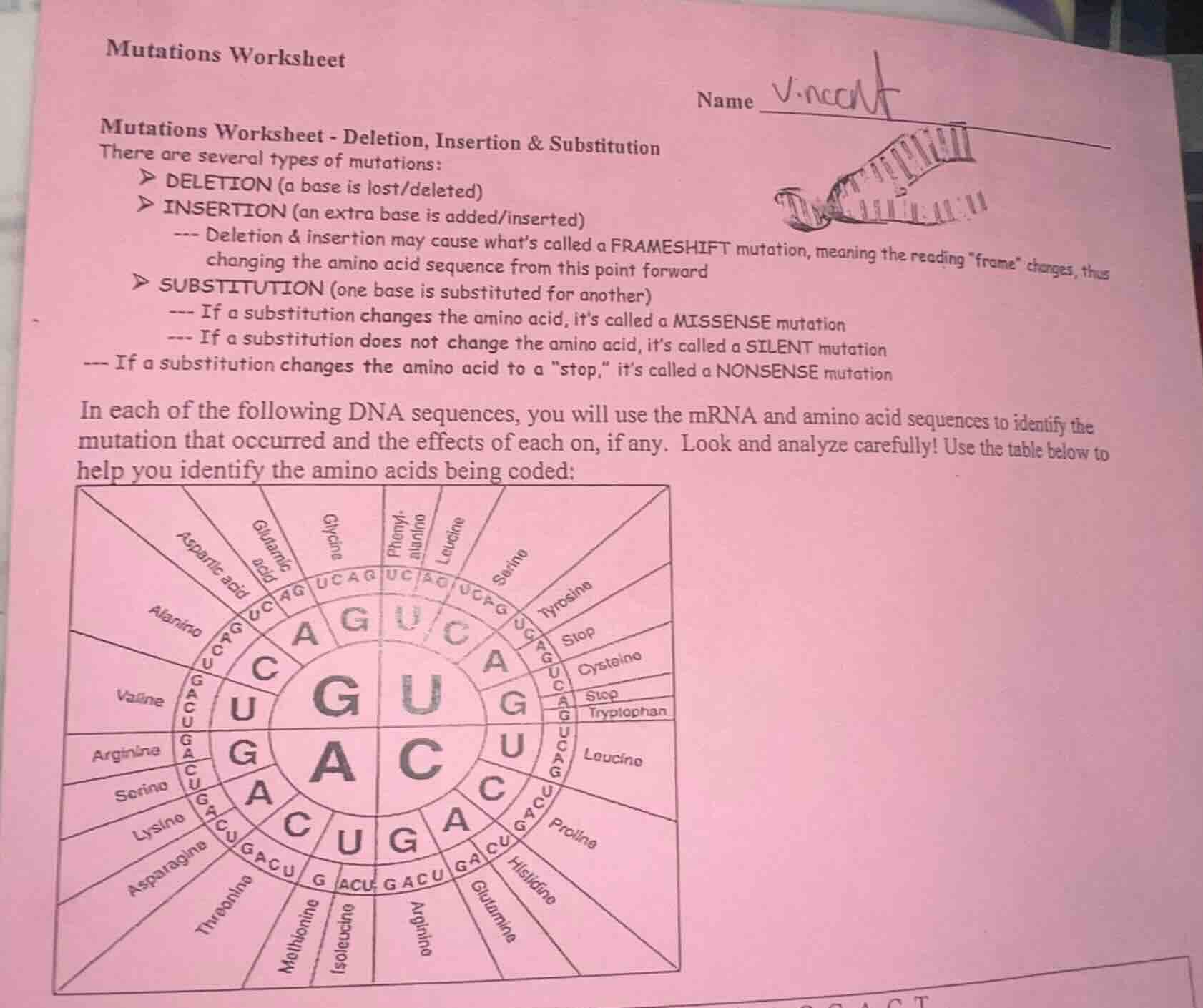
in each of the following dna sequences, you will use the mrna and amino acid sequences to identify the mutation that occurred and the effects of each on, if any. look and analyze carefully! use the table below to help you identify the amino acids being coded:
chart of amino acid codon wheel
Since the specific DNA sequences for mutation analysis are not fully provided (the bottom part with DNA sequences is cut off), we can't proceed with the mutation analysis directly. However, here's the general step - by - step process for such a mutation worksheet:
Step 1: Transcribe DNA to mRNA
For a given DNA sequence, remember that in transcription, adenine (A) pairs with uracil (U), thymine (T) pairs with adenine (A), cytosine (C) pairs with guanine (G), and guanine (G) pairs with cytosine (C). For example, if the DNA sequence is "ATG", the mRNA sequence will be "AUG".
Step 2: Translate mRNA to amino acids
Use the provided codon wheel (or a standard codon table). The codon wheel is used by taking the first base of the codon (the one in the center), then the second base (the middle ring), and finally the third base (the outer ring) to find the corresponding amino acid. For example, the mRNA codon "AUG" corresponds to the amino acid Methionine (start codon).
Step 3: Identify the type of mutation
- Deletion: Check if a base is removed from the original DNA sequence. Then, transcribe and translate the mutated sequence and compare it with the original to see the effect (especially if it causes a frameshift).
- Insertion: Check if an extra base is added to the original DNA sequence. Transcribe and translate the mutated sequence and compare it with the original (frameshift may occur).
- Substitution: Check if one base is replaced by another. Then, transcribe and translate the mutated sequence. If the amino acid changes, it's a missense mutation; if it doesn't change, it's a silent mutation; if it changes to a stop codon, it's a nonsense mutation.
If you can provide the complete DNA sequences (the ones that are cut off at the bottom of the worksheet), we can perform the detailed analysis for each mutation case.

Snap & solve any problem in the app
Get step-by-step solutions on Sovi AI
Photo-based solutions with guided steps
Explore more problems and detailed explanations
Since the specific DNA sequences for mutation analysis are not fully provided (the bottom part with DNA sequences is cut off), we can't proceed with the mutation analysis directly. However, here's the general step - by - step process for such a mutation worksheet:
Step 1: Transcribe DNA to mRNA
For a given DNA sequence, remember that in transcription, adenine (A) pairs with uracil (U), thymine (T) pairs with adenine (A), cytosine (C) pairs with guanine (G), and guanine (G) pairs with cytosine (C). For example, if the DNA sequence is "ATG", the mRNA sequence will be "AUG".
Step 2: Translate mRNA to amino acids
Use the provided codon wheel (or a standard codon table). The codon wheel is used by taking the first base of the codon (the one in the center), then the second base (the middle ring), and finally the third base (the outer ring) to find the corresponding amino acid. For example, the mRNA codon "AUG" corresponds to the amino acid Methionine (start codon).
Step 3: Identify the type of mutation
- Deletion: Check if a base is removed from the original DNA sequence. Then, transcribe and translate the mutated sequence and compare it with the original to see the effect (especially if it causes a frameshift).
- Insertion: Check if an extra base is added to the original DNA sequence. Transcribe and translate the mutated sequence and compare it with the original (frameshift may occur).
- Substitution: Check if one base is replaced by another. Then, transcribe and translate the mutated sequence. If the amino acid changes, it's a missense mutation; if it doesn't change, it's a silent mutation; if it changes to a stop codon, it's a nonsense mutation.
If you can provide the complete DNA sequences (the ones that are cut off at the bottom of the worksheet), we can perform the detailed analysis for each mutation case.