QUESTION IMAGE
Question
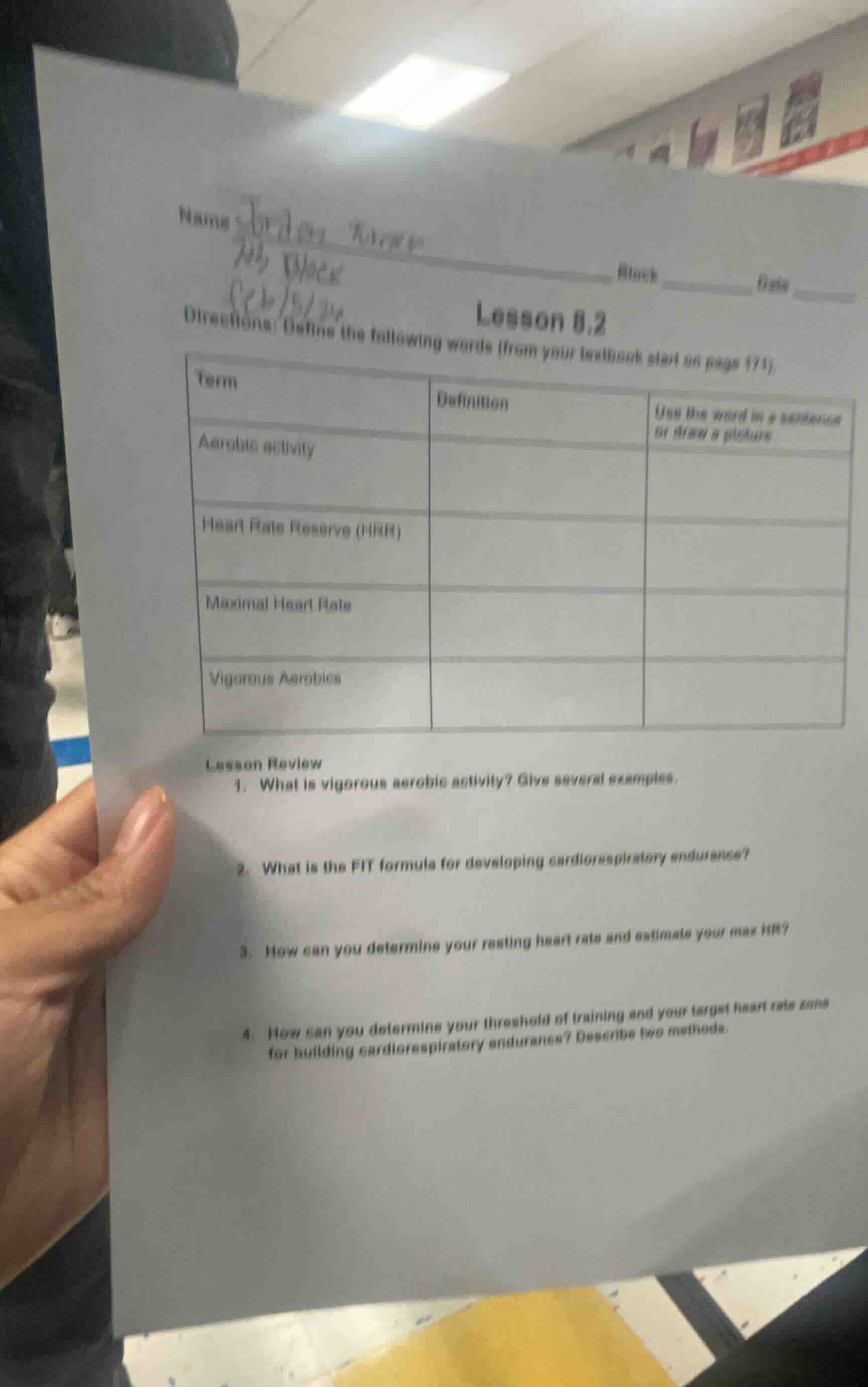
name
block
date
lesson 8.2
directions: define the following words (from your textbook start on page 171).
| term | definition | use the word in a sentence or draw a picture |
|---|---|---|
| heart rate reserve (hrr) | ||
| maximal heart rate | ||
| vigorous aerobics |
lesson review
- what is vigorous aerobic activity? give several examples.
- what is the fit formula for developing cardiorespiratory endurance?
- how can you determine your resting heart rate and estimate your max hr?
- how can you determine your threshold of training and your target heart rate zone for building cardiorespiratory endurance? describe two methods.
Brief Explanations
Term Definitions & Sentences
- Aerobic activity: Sustained physical exercise that uses oxygen to produce energy, improving cardiovascular health.
- Heart Rate Reserve (HRR): The difference between maximum and resting heart rate, used to calculate exercise intensity.
- Maximal Heart Rate: The highest number of times the heart can beat in one minute during intense exercise.
- Vigorous Aerobics: High-intensity aerobic exercise that pushes the heart rate to 70-85% of maximum.
Lesson Review Answers
- Defined vigorous aerobic activity as high-intensity, oxygen-dependent exercise, then provided common examples.
- Outlined the FIT formula components specific to cardiorespiratory endurance.
- Explained practical methods to measure resting heart rate and estimate maximum heart rate.
- Covered calculation of training threshold/target heart rate zone, then described two standard cardio endurance building methods.

Snap & solve any problem in the app
Get step-by-step solutions on Sovi AI
Photo-based solutions with guided steps
Explore more problems and detailed explanations
Term Table
| Term | Definition | Use in a sentence |
|---|---|---|
| Heart Rate Reserve (HRR) | The difference between a person's maximal heart rate and resting heart rate, used to gauge safe exercise intensity. | "My trainer used my heart rate reserve to set my workout intensity." |
| Maximal Heart Rate | The highest number of times the heart can contract in one minute during peak physical exertion. | "A common estimate for maximal heart rate is 220 minus your age." |
| Vigorous Aerobics | High-intensity aerobic exercise that elevates the heart rate to 70-85% of a person's maximal heart rate. | "Running uphill and jump rope are forms of vigorous aerobics I enjoy." |
---
Lesson Review
- Vigorous aerobic activity is high-intensity, oxygen-dependent exercise that elevates the heart rate to 70-85% of a person's maximum heart rate, causing noticeable increases in breathing and heart rate. Examples include running, high-intensity interval training (HIIT), swimming laps, and jumping rope.
- The FIT formula for cardiorespiratory endurance stands for:
- Frequency: 3-5 days per week
- Intensity: 60-85% of maximum heart rate, or 50-85% of heart rate reserve
- Time: 20-60 minutes of continuous or intermittent (with at least 10-minute bouts) aerobic activity
- - Resting Heart Rate: Measure your pulse (wrist or neck) after waking up and before getting out of bed, count beats for 60 seconds (or count for 10 seconds and multiply by 6 for an estimate).
- Estimated Max HR: Use the standard formula: $\text{Max HR} = 220 - \text{your age}$
- - Threshold of Training & Target Heart Rate Zone: First calculate heart rate reserve ($\text{HRR} = \text{Max HR} - \text{Resting HR}$). The lower threshold is $\text{Resting HR} + (0.50 \times \text{HRR})$, and the target zone is typically $\text{Resting HR} + (0.60 \times \text{HRR})$ to $\text{Resting HR} + (0.85 \times \text{HRR})$.
- Two methods to build cardiorespiratory endurance:
- Continuous Training: Sustained, moderate-intensity aerobic activity (e.g., 40 minutes of steady brisk walking or cycling) 3-4 days per week.
- Interval Training: Alternating short bursts of high-intensity exercise (e.g., 1 minute of sprinting) with periods of low-intensity recovery (e.g., 2 minutes of walking) for 20-30 minutes per session.