QUESTION IMAGE
Question
name
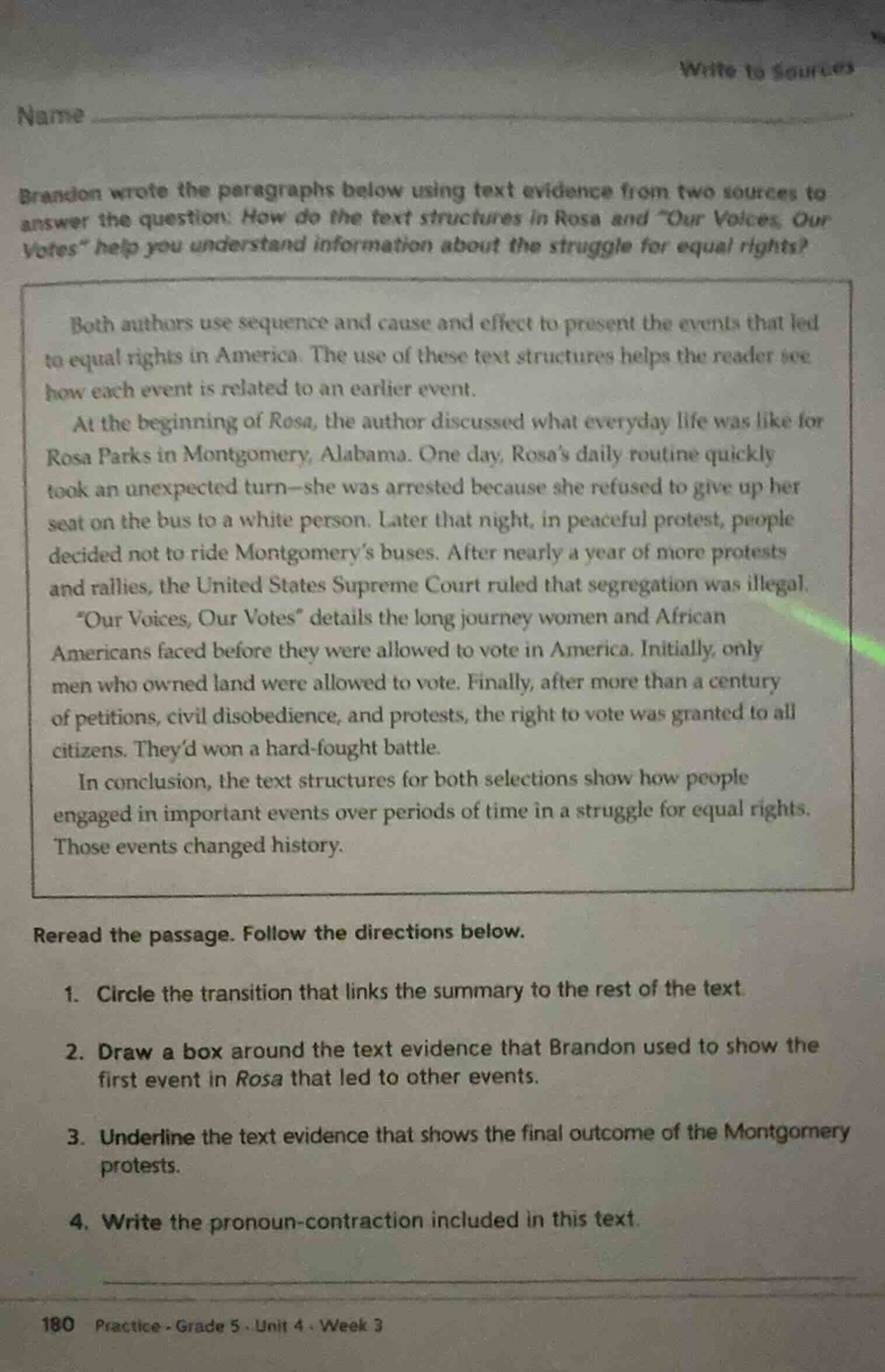
brandon wrote the paragraphs below using text evidence from two sources to answer the question: how do the text structures in rosa and “our voices, our votes” help you understand information about the struggle for equal rights?
both authors use sequence and cause and effect to present the events that led to equal rights in america. the use of these text structures helps the reader see how each event is related to an earlier event.
at the beginning of rosa, the author discussed what everyday life was like for rosa parks in montgomery, alabama. one day, rosa’s daily routine quickly took an unexpected turn—she was arrested because she refused to give up her seat on the bus to a white person. later that night, in peaceful protest, people decided not to ride montgomery’s buses. after nearly a year of more protests and rallies, the united states supreme court ruled that segregation was illegal.
“our voices, our votes” details the long journey women and african americans faced before they were allowed to vote in america. initially, only men who owned land were allowed to vote. finally, after more than a century of petitions, civil disobedience, and protests, the right to vote was granted to all citizens. they’d won a hard - fought battle.
in conclusion, the text structures for both selections show how people engaged in important events over periods of time in a struggle for equal rights. those events changed history.
reread the passage. follow the directions below.
- circle the transition that links the summary to the rest of the text.
- draw a box around the text evidence that brandon used to show the first event in rosa that led to other events.
- underline the text evidence that shows the final outcome of the montgomery protests.
- write the pronoun - contraction included in this text.
1. Circle the transition that links the summary to the rest of the text.
The transition word that links the summary (the first paragraph) to the rest of the text (the subsequent paragraphs about Rosa and "Our Voices, Our Votes") is "At the beginning of Rosa". Wait, no, looking again, the first paragraph is the overview, then the next starts with "At the beginning of Rosa...", but actually, the transition that links the summary (the first paragraph) to the detailed analysis is maybe not that. Wait, the first paragraph says "Both authors use sequence and cause and effect...", then the next paragraph starts with "At the beginning of Rosa...", so maybe the transition is "At the beginning of Rosa" but actually, the transition that links the summary (the introductory paragraph) to the rest is perhaps "At the beginning of Rosa" as it starts the detailed look at one of the texts. But maybe the intended transition is "In conclusion" at the end, but no, the first part: the first paragraph is the summary, then the next paragraphs are the details. Wait, the question is "Circle the transition that links the summary to the rest of the text". The summary is the first paragraph, then the next part starts with "At the beginning of Rosa...", so maybe the transition is "At the beginning of Rosa"? No, maybe "In conclusion" is the transition for the end, but the first link: maybe "Both authors use...", then the next paragraph starts with "At the beginning of Rosa...", so the transition is "At the beginning of Rosa" as it moves from the general summary to the specific analysis of Rosa. But actually, the transition word or phrase that links the summary (first paragraph) to the rest is "At the beginning of Rosa" (but it's a phrase). Alternatively, maybe "In conclusion" is at the end, but the first link: let's re - read. The first paragraph: "Both authors use sequence and cause and effect... helps the reader see how each event is related to an earlier event." Then the next paragraph: "At the beginning of Rosa, the author discussed...". So the transition from the summary (first paragraph) to the detailed text analysis (second paragraph) is "At the beginning of Rosa".
2. Draw a box around the text evidence that Brandon used to show the first event in Rosa that led to other events.
The first event in Rosa that led to other events is "One day, Rosa’s daily routine quickly took an unexpected turn—she was arrested because she refused to give up her seat on the bus to a white person." So we draw a box around this sentence.
3. Underline the text evidence that shows the final outcome of the Montgomery protests.
The final outcome of the Montgomery protests is "After nearly a year of more protests and rallies, the United States Supreme Court ruled that segregation was illegal." So we underline this sentence.
4. Write the pronoun - contraction included in this text.
Looking at the text, the pronoun - contraction is "They’d" (which is "They would" or "They had", in this case, "They had" as in "They’d won a hard - fought battle").

Snap & solve any problem in the app
Get step-by-step solutions on Sovi AI
Photo-based solutions with guided steps
Explore more problems and detailed explanations
s:
- The transition phrase to circle is "At the beginning of Rosa" (or if we consider the start of the detailed analysis after the summary, this is the link).
- The text evidence to box is "One day, Rosa’s daily routine quickly took an unexpected turn—she was arrested because she refused to give up her seat on the bus to a white person."
- The text evidence to underline is "After nearly a year of more protests and rallies, the United States Supreme Court ruled that segregation was illegal."
- The pronoun - contraction is "They’d"