QUESTION IMAGE
Question
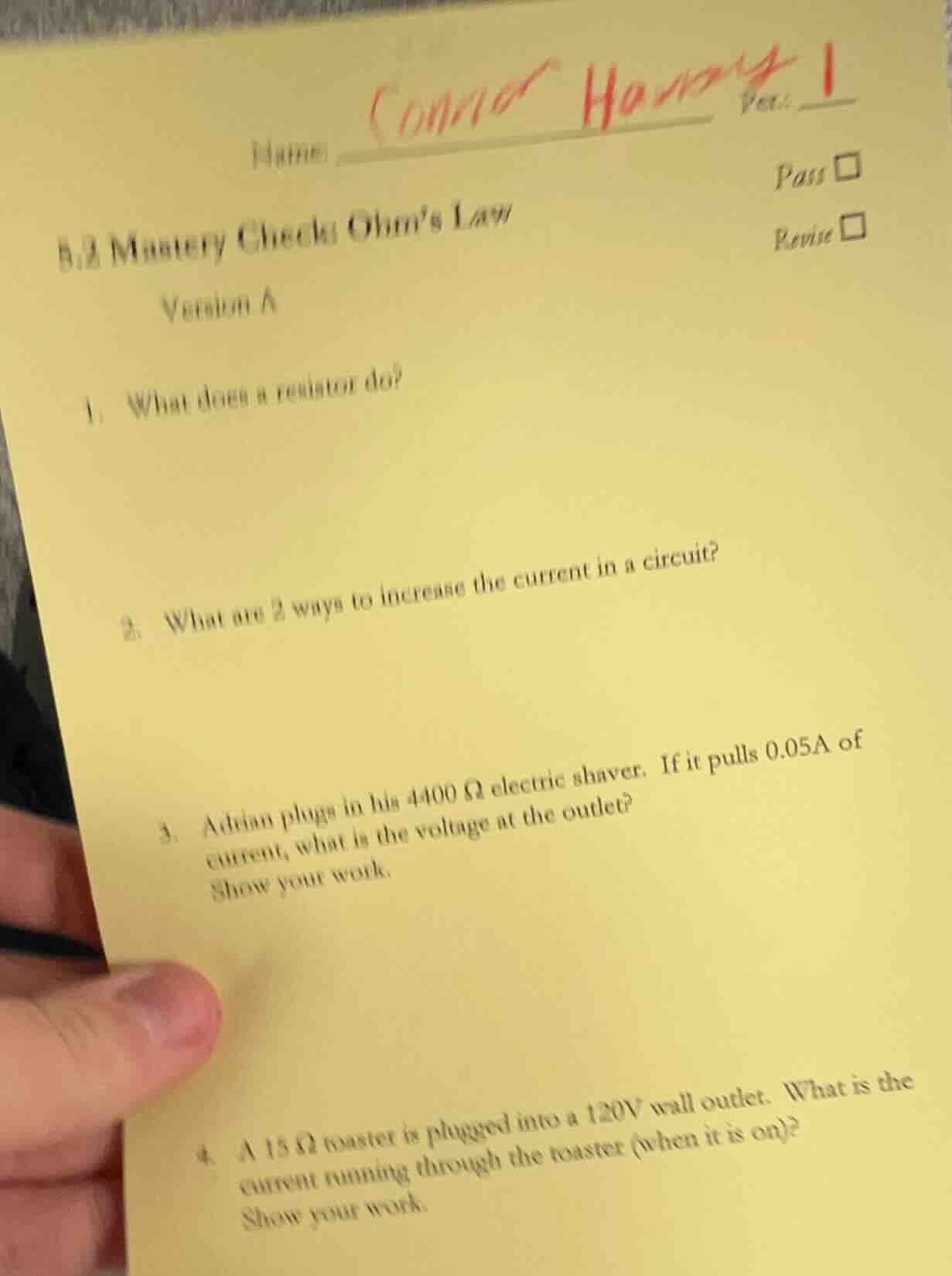
name: connor hardyper: 15.2 mastery check: ohms lawversion apass □revise □1. what does a resistor do?2. what are 2 ways to increase the current in a circuit?3. adrian plugs in his 4400 $omega$ electric shaver. if it pulls 0.05a of current, what is the voltage at the outlet?show your work.4. a 15 $omega$ toaster is plugged into a 120v wall outlet. what is the current running through the toaster (when it is on)?show your work.
Brief Explanations
- A resistor controls electrical current flow in a circuit by providing electrical resistance, which limits current, divides voltage, or dissipates energy as heat.
- Using Ohm's Law ($I=\frac{V}{R}$), current increases by either raising the circuit's voltage source or lowering the total electrical resistance in the circuit.
- Rearrange Ohm's Law to solve for voltage, then substitute given values.
- Rearrange Ohm's Law to solve for current, then substitute given values.
Step1: Recall Ohm's Law for voltage
$V = I \times R$
Step2: Substitute given values
$V = 0.05\,\text{A} \times 4400\,\Omega$
Step3: Calculate the voltage
$V = 220\,\text{V}$
Step1: Recall Ohm's Law for current
$I = \frac{V}{R}$
Step2: Substitute given values
$I = \frac{120\,\text{V}}{15\,\Omega}$
Step3: Calculate the current
$I = 8\,\text{A}$

Snap & solve any problem in the app
Get step-by-step solutions on Sovi AI
Photo-based solutions with guided steps
Explore more problems and detailed explanations
- A resistor limits (or regulates) the flow of electrical current in a circuit, and can also divide voltage or dissipate excess electrical energy as heat.
- 1. Increase the voltage supplied to the circuit.
- Decrease the total electrical resistance in the circuit.
3.