QUESTION IMAGE
Question
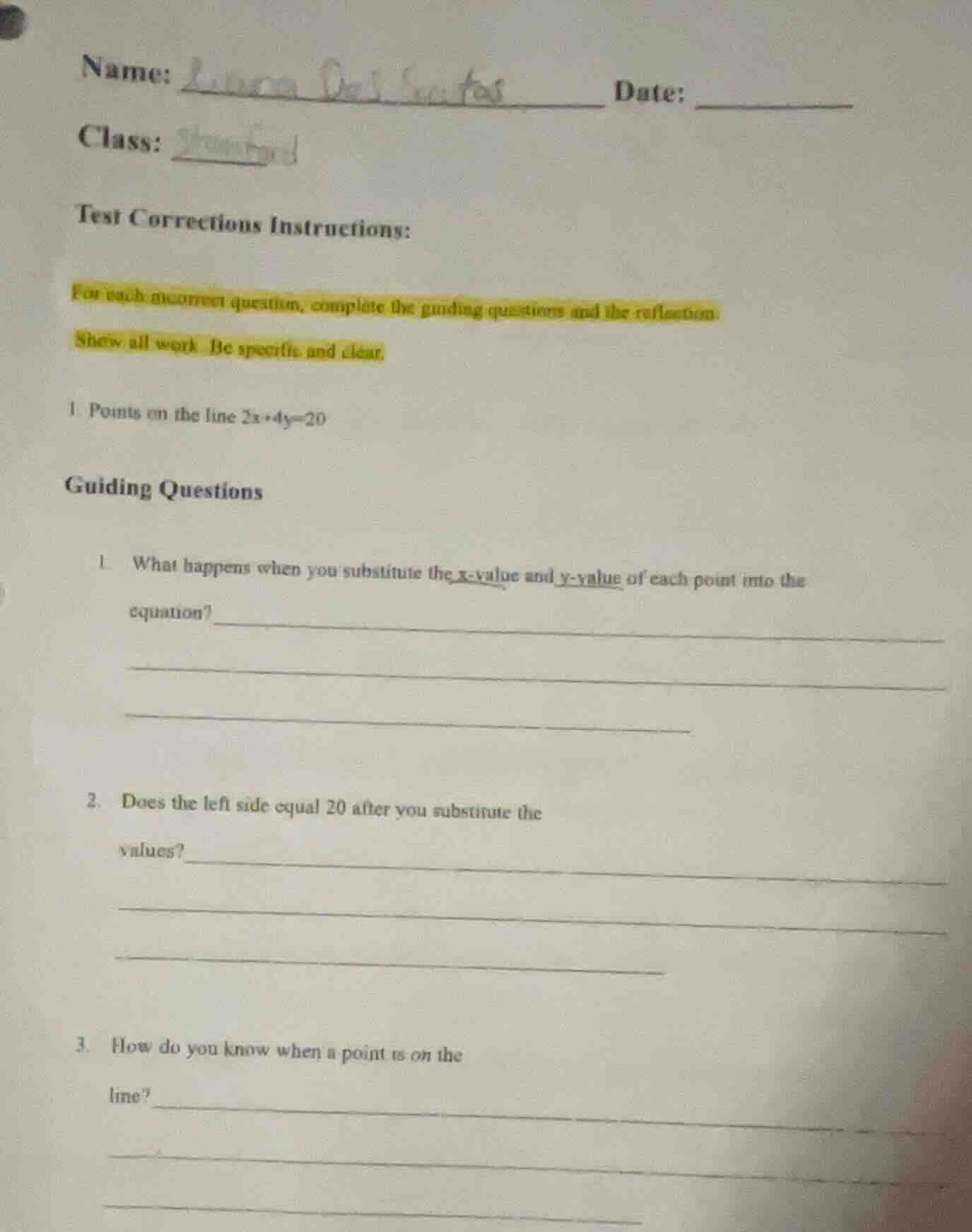
name: date: class: test corrections instructions: for each incorrect question, complete the guiding questions and the reflection. show all work. be specific and clear. 1. points on the line 2x + 4y = 20 guiding questions 1. what happens when you substitute the x - value and y - value of each point into the equation? 2. does the left side equal 20 after you substitute the values? 3. how do you know when a point is on the line?
1. Answering the first guiding question:
When we substitute the \( x \)-value and \( y \)-value of a point into the equation \( 2x + 4y = 20 \), we are checking if the point satisfies the equation. If the point is on the line, substituting its coordinates into the equation will make the left - hand side equal to the right - hand side (which is 20 in this case). For example, if we have a point \((x_0,y_0)\), we calculate \( 2x_0+4y_0 \). If the result is 20, the point is on the line; if not, it is not on the line.
If the point is on the line \( 2x + 4y=20 \), then after substituting the \( x \)-value and \( y \)-value of the point into the left - hand side of the equation (\(2x + 4y\)), the result will be equal to 20. If the point is not on the line, the result of \( 2x + 4y \) (after substitution) will not be equal to 20. For example, take the point \((0,5)\): substitute \( x = 0\) and \( y = 5\) into \( 2x+4y\), we get \(2(0)+4(5)=0 + 20=20\), so the left - hand side equals 20. Take the point \((0,0)\): substitute \( x = 0\) and \( y = 0\) into \( 2x + 4y\), we get \(2(0)+4(0)=0
eq20\), so the left - hand side does not equal 20.
A point \((x,y)\) is on the line represented by the equation \( 2x + 4y = 20 \) (or any linear equation \( Ax+By = C\)) if and only if when we substitute the \( x \)-coordinate and \( y \)-coordinate of the point into the left - hand side of the equation (\(2x + 4y\) for our equation), the result is equal to the right - hand side of the equation (20 in our case). In other words, the point satisfies the equation of the line.

Snap & solve any problem in the app
Get step-by-step solutions on Sovi AI
Photo-based solutions with guided steps
Explore more problems and detailed explanations
When substituting the \( x \)-value and \( y \)-value of a point into the equation \( 2x + 4y = 20 \), we calculate the value of the left - hand side of the equation (\(2x + 4y\)) using the coordinates of the point. If the point is on the line, this calculation will equal 20 (the right - hand side of the equation); if the point is not on the line, the calculation will not equal 20.