QUESTION IMAGE
Question
name
date
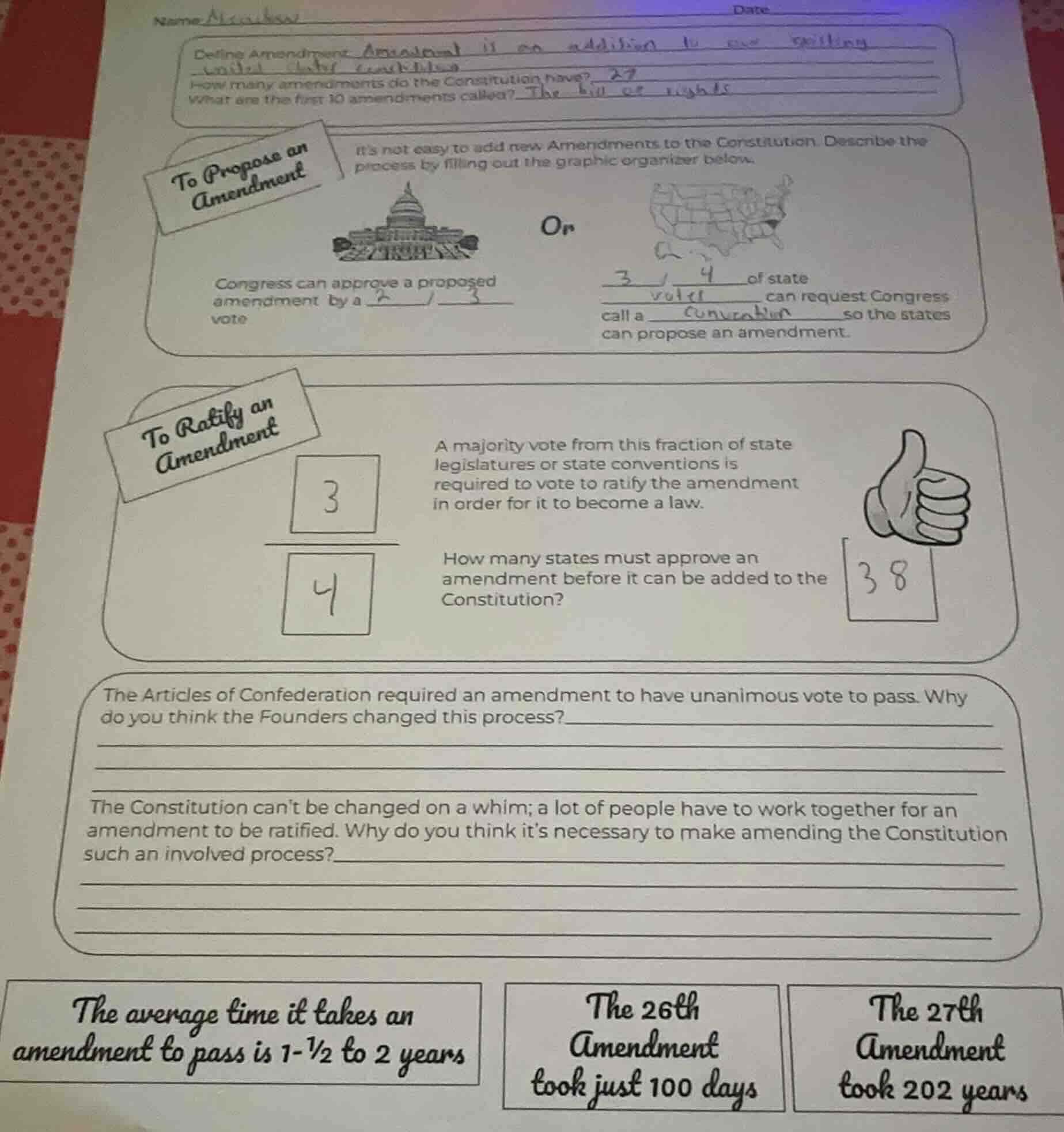
define amendment
how many amendments do the constitution have?
what are the first 10 amendments called?
to propose an amendment
it’s not easy to add new amendments to the constitution. describe the process by filling out the graphic organizer below.
congress can approve a proposed amendment by a __ / __ vote
or
__ / of state can request congress call a __ so the states can propose an amendment.
to ratify an amendment
a majority vote from this fraction of state legislatures or state conventions is required to vote to ratify the amendment in order for it to become a law.
how many states must approve an amendment before it can be added to the constitution?
the articles of confederation required an amendment to have unanimous vote to pass. why do you think the founders changed this process?
the constitution can’t be changed on a whim; a lot of people have to work together for an amendment to be ratified. why do you think it’s necessary to make amending the constitution such an involved process?
the average time it takes an amendment to pass is 1 - ½ to 2 years
the 26th amendment took just 100 days
the 27th amendment took 202 years
- Top Section Verification/Correction:
- An amendment is a formal change or addition to the U.S. Constitution.
- The U.S. Constitution has 27 amendments (correct as written).
- The first 10 amendments are called the Bill of Rights (correct as written).
- Propose an Amendment:
- Congress can approve a proposed amendment by a $\frac{2}{3}$ vote in both the House and Senate.
- $\frac{3}{4}$ of state legislatures cannot request a convention; instead, $\frac{2}{3}$ of state legislatures can request Congress call a national convention for states to propose an amendment.
- Ratify an Amendment:
- A $\frac{3}{4}$ vote of state legislatures (or state conventions for specific amendments) is required to ratify, which equals 38 of the 50 U.S. states (correct as written).
- Founders' Process Change:
- The Articles of Confederation's unanimous vote rule made it nearly impossible to adapt the government to crises or changing needs. The founders wanted a flexible but stable system, so they allowed amendment with supermajorities instead of unanimity.
- Involved Amendment Process Rationale:
- A difficult amendment process protects the core principles of the Constitution from hasty, popular but potentially harmful changes, ensures broad national support for any changes, and preserves the stability of the government.

Snap & solve any problem in the app
Get step-by-step solutions on Sovi AI
Photo-based solutions with guided steps
Explore more problems and detailed explanations
- Define Amendment: A formal change/addition to the U.S. Constitution
- How many amendments do the Constitution have? 27
- What are the first 10 amendments called? The Bill of Rights
- To Propose an Amendment:
- Congress: $\frac{2}{3}$ vote
- States: $\frac{2}{3}$ of state legislatures can request Congress call a national convention
- To Ratify an Amendment:
- Required fraction: $\frac{3}{4}$
- Number of states: 38
- Why change from unanimous Articles rule? The unanimous vote made fixing flaws or adapting the government nearly impossible; the new supermajority rule balances flexibility and stability.
- Why is the process so involved? To prevent hasty, unwise changes to the nation's foundational laws, ensure broad support for any amendments, and maintain long-term governmental stability.