QUESTION IMAGE
Question
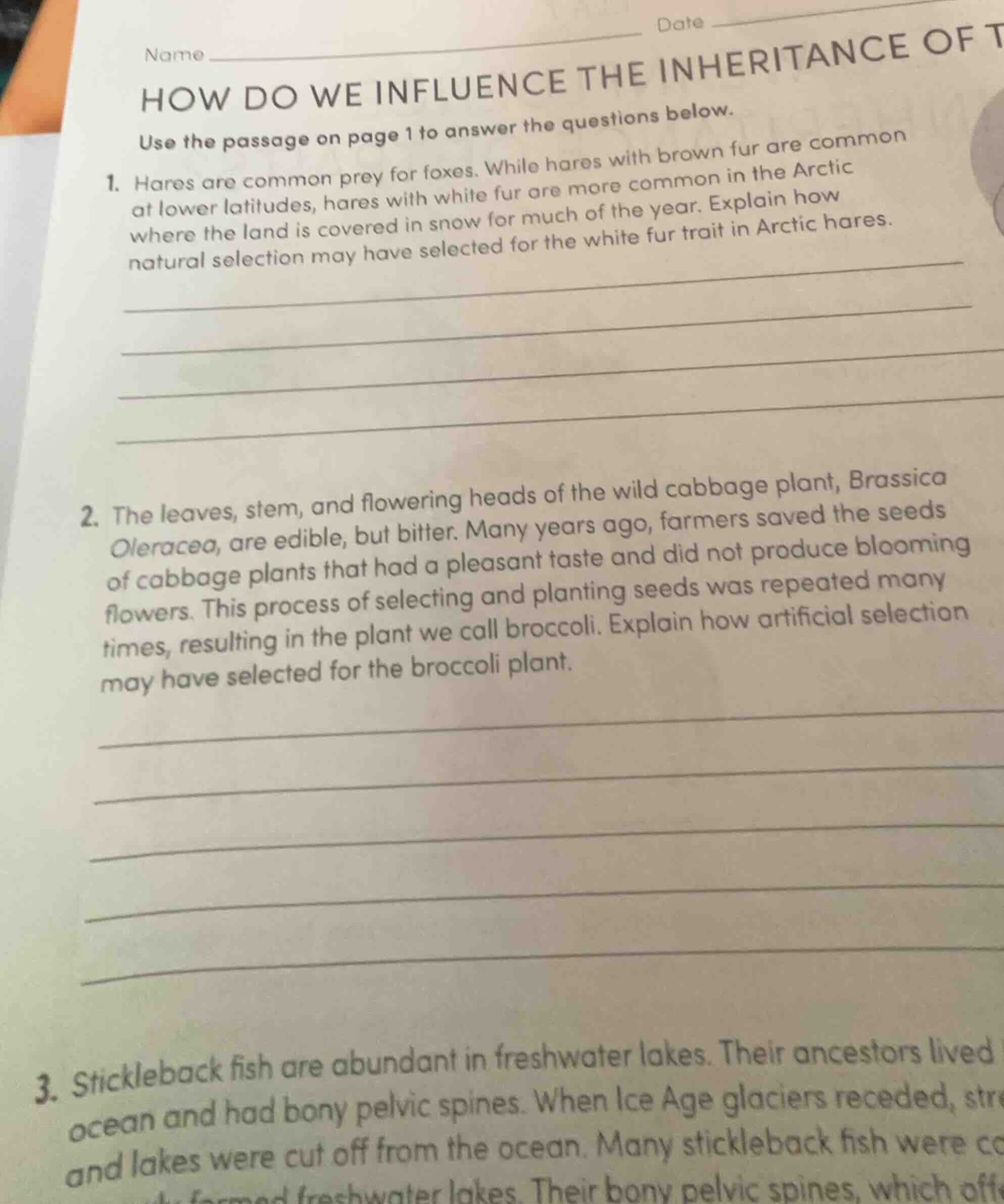
name ____ date ____ how do we influence the inheritance of t use the passage on page 1 to answer the questions below. 1. hares are common prey for foxes. while hares with brown fur are common at lower latitudes, hares with white fur are more common in the arctic where the land is covered in snow for much of the year. explain how natural selection may have selected for the white fur trait in arctic hares. 2. the leaves, stem, and flowering heads of the wild cabbage plant, brassica oleracea, are edible, but bitter. many years ago, farmers saved the seeds of cabbage plants that had a pleasant taste and did not produce blooming flowers. this process of selecting and planting seeds was repeated many times, resulting in the plant we call broccoli. explain how artificial selection may have selected for the broccoli plant. 3. stickleback fish are abundant in freshwater lakes. their ancestors lived ocean and had bony pelvic spines. when ice age glaciers receded, str and lakes were cut off from the ocean. many stickleback fish were co formed freshwater lakes. their bony pelvic spines, which off

Snap & solve any problem in the app
Get step-by-step solutions on Sovi AI
Photo-based solutions with guided steps
Explore more problems and detailed explanations
In the Arctic, hares with white fur are camouflaged against snow, so they are less likely to be hunted by foxes, survive longer, and reproduce more, passing on the white fur trait to offspring. Over time, this leads to white fur being common in Arctic hares.
Farmers repeatedly selected wild cabbage plants with pleasant taste and no blooming flowers, saved their seeds, and planted them. Over generations, the traits for palatable, non-flowering plants became more common, resulting in the broccoli plant.