QUESTION IMAGE
Question
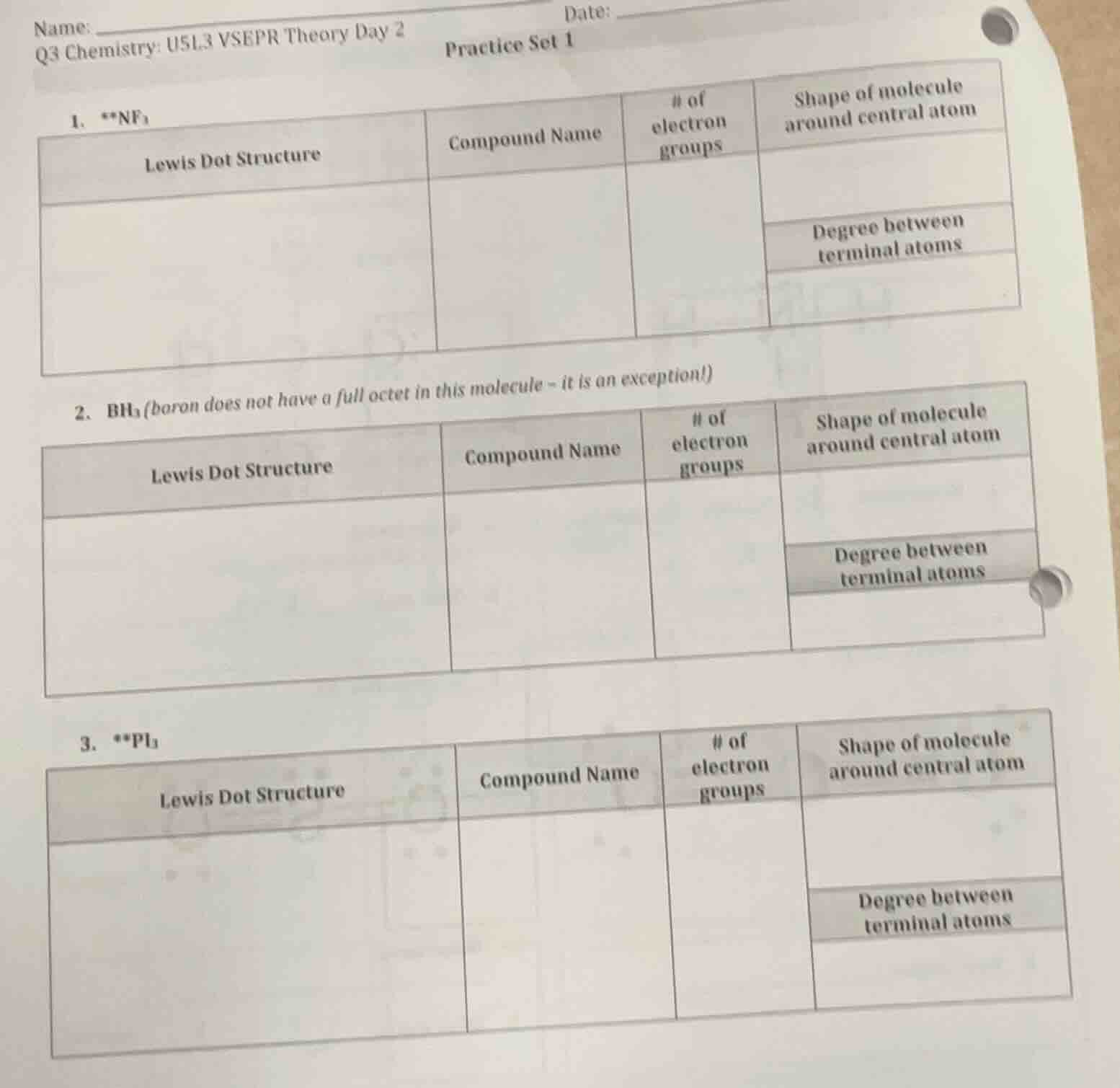
name: date: q3 chemistry: u5l3 vsepr theory day 2 practice set 1 1. nf₃ lewis dot structure compound name # of electron groups shape of molecule around central atom degree between terminal atoms 2. bh₃ (boron does not have a full octet in this molecule - it is an exception!) lewis dot structure compound name # of electron groups shape of molecule around central atom degree between terminal atoms 3. pi₃ lewis dot structure compound name # of electron groups shape of molecule around central atom degree between terminal atoms
Problem 1: $\boldsymbol{NF_3}$
Step 1: Lewis Dot Structure
Nitrogen (N) is central, with 5 valence electrons. Each F has 7 valence electrons. N forms 3 single bonds with F, using 3 electrons, leaving 1 lone pair on N. Each F has 3 lone pairs.
Lewis structure: N in center, 3 single bonds to F, 1 lone pair on N; each F has 3 lone pairs.
Step 2: Compound Name
Named as nitrogen trifluoride (using prefix "tri-" for 3 F atoms).
Step 3: # of Electron Groups
Electron groups = bonding + lone pairs. 3 single bonds (bonding) + 1 lone pair = 4 electron groups.
Step 4: Molecular Shape (VSEPR)
4 electron groups (trigonal pyramidal for 3 bonding, 1 lone pair; electron geometry is tetrahedral, molecular shape is trigonal pyramidal).
Step 5: Bond Angle
Trigonal pyramidal (derived from tetrahedral) has bond angle ~$107^\circ$ (due to lone pair repulsion).
Problem 2: $\boldsymbol{BH_3}$ (Boron Exception)
Step 1: Lewis Dot Structure
Boron (B) is central, with 3 valence electrons. Each H has 1 valence electron. B forms 3 single bonds with H (no lone pairs on B, as it’s an octet exception).
Lewis structure: B in center, 3 single bonds to H; no lone pairs on B.
Step 2: Compound Name
Named as boron trihydride (or borane), using prefix "tri-" for 3 H atoms.
Step 3: # of Electron Groups
3 bonding groups (no lone pairs) = 3 electron groups.
Step 4: Molecular Shape (VSEPR)
3 electron groups (trigonal planar, since all are bonding).
Step 5: Bond Angle
Trigonal planar has bond angle ~$120^\circ$.
Problem 3: $\boldsymbol{PI_3}$
Step 1: Lewis Dot Structure
Phosphorus (P) is central, with 5 valence electrons. Each I has 7 valence electrons. P forms 3 single bonds with I, using 3 electrons, leaving 1 lone pair on P. Each I has 3 lone pairs.
Lewis structure: P in center, 3 single bonds to I, 1 lone pair on P; each I has 3 lone pairs.
Step 2: Compound Name
Named as phosphorus triiodide (prefix "tri-" for 3 I atoms).
Step 3: # of Electron Groups
3 bonding groups + 1 lone pair = 4 electron groups.
Step 4: Molecular Shape (VSEPR)
Electron geometry: tetrahedral; molecular shape: trigonal pyramidal (3 bonding, 1 lone pair).
Step 5: Bond Angle
Trigonal pyramidal (from tetrahedral) has bond angle ~$107^\circ$.
Summary Tables
1. $\boldsymbol{NF_3}$
| Lewis Dot Structure | Compound Name | # of Electron Groups | Shape (Central Atom) | Bond Angle |
|---|
2. $\boldsymbol{BH_3}$
| Lewis Dot Structure | Compound Name | # of Electron Groups | Shape (Central Atom) | Bond Angle |
|---|
3. $\boldsymbol{PI_3}$
| Lewis Dot Structure | Compound Name | # of Electron Groups | Shape (Central Atom) | Bond Angle |
|---|
Key Notes
- $\text{NF}_3$ and $\text{PI}_3$ have 4 electron groups (trigonal pyramidal…

Snap & solve any problem in the app
Get step-by-step solutions on Sovi AI
Photo-based solutions with guided steps
Explore more problems and detailed explanations
Problem 1: $\boldsymbol{NF_3}$
Step 1: Lewis Dot Structure
Nitrogen (N) is central, with 5 valence electrons. Each F has 7 valence electrons. N forms 3 single bonds with F, using 3 electrons, leaving 1 lone pair on N. Each F has 3 lone pairs.
Lewis structure: N in center, 3 single bonds to F, 1 lone pair on N; each F has 3 lone pairs.
Step 2: Compound Name
Named as nitrogen trifluoride (using prefix "tri-" for 3 F atoms).
Step 3: # of Electron Groups
Electron groups = bonding + lone pairs. 3 single bonds (bonding) + 1 lone pair = 4 electron groups.
Step 4: Molecular Shape (VSEPR)
4 electron groups (trigonal pyramidal for 3 bonding, 1 lone pair; electron geometry is tetrahedral, molecular shape is trigonal pyramidal).
Step 5: Bond Angle
Trigonal pyramidal (derived from tetrahedral) has bond angle ~$107^\circ$ (due to lone pair repulsion).
Problem 2: $\boldsymbol{BH_3}$ (Boron Exception)
Step 1: Lewis Dot Structure
Boron (B) is central, with 3 valence electrons. Each H has 1 valence electron. B forms 3 single bonds with H (no lone pairs on B, as it’s an octet exception).
Lewis structure: B in center, 3 single bonds to H; no lone pairs on B.
Step 2: Compound Name
Named as boron trihydride (or borane), using prefix "tri-" for 3 H atoms.
Step 3: # of Electron Groups
3 bonding groups (no lone pairs) = 3 electron groups.
Step 4: Molecular Shape (VSEPR)
3 electron groups (trigonal planar, since all are bonding).
Step 5: Bond Angle
Trigonal planar has bond angle ~$120^\circ$.
Problem 3: $\boldsymbol{PI_3}$
Step 1: Lewis Dot Structure
Phosphorus (P) is central, with 5 valence electrons. Each I has 7 valence electrons. P forms 3 single bonds with I, using 3 electrons, leaving 1 lone pair on P. Each I has 3 lone pairs.
Lewis structure: P in center, 3 single bonds to I, 1 lone pair on P; each I has 3 lone pairs.
Step 2: Compound Name
Named as phosphorus triiodide (prefix "tri-" for 3 I atoms).
Step 3: # of Electron Groups
3 bonding groups + 1 lone pair = 4 electron groups.
Step 4: Molecular Shape (VSEPR)
Electron geometry: tetrahedral; molecular shape: trigonal pyramidal (3 bonding, 1 lone pair).
Step 5: Bond Angle
Trigonal pyramidal (from tetrahedral) has bond angle ~$107^\circ$.
Summary Tables
1. $\boldsymbol{NF_3}$
| Lewis Dot Structure | Compound Name | # of Electron Groups | Shape (Central Atom) | Bond Angle |
|---|
2. $\boldsymbol{BH_3}$
| Lewis Dot Structure | Compound Name | # of Electron Groups | Shape (Central Atom) | Bond Angle |
|---|
3. $\boldsymbol{PI_3}$
| Lewis Dot Structure | Compound Name | # of Electron Groups | Shape (Central Atom) | Bond Angle |
|---|
Key Notes
- $\text{NF}_3$ and $\text{PI}_3$ have 4 electron groups (trigonal pyramidal, bond angle ~$107^\circ$) due to 1 lone pair.
- $\text{BH}_3$ is an octet exception (B has 6 electrons), with 3 electron groups (trigonal planar, bond angle ~$120^\circ$).