QUESTION IMAGE
Question
name _______________________________ due friday, january 25, 2026
celebration of molecules, solids, liquids, gases, and intermolecular forces v2
continuing on the theme of the 4 drawings on the previous page:
if we complete steps 1 - 4 with a dry can, no water in can, explain why that can will not collapse.
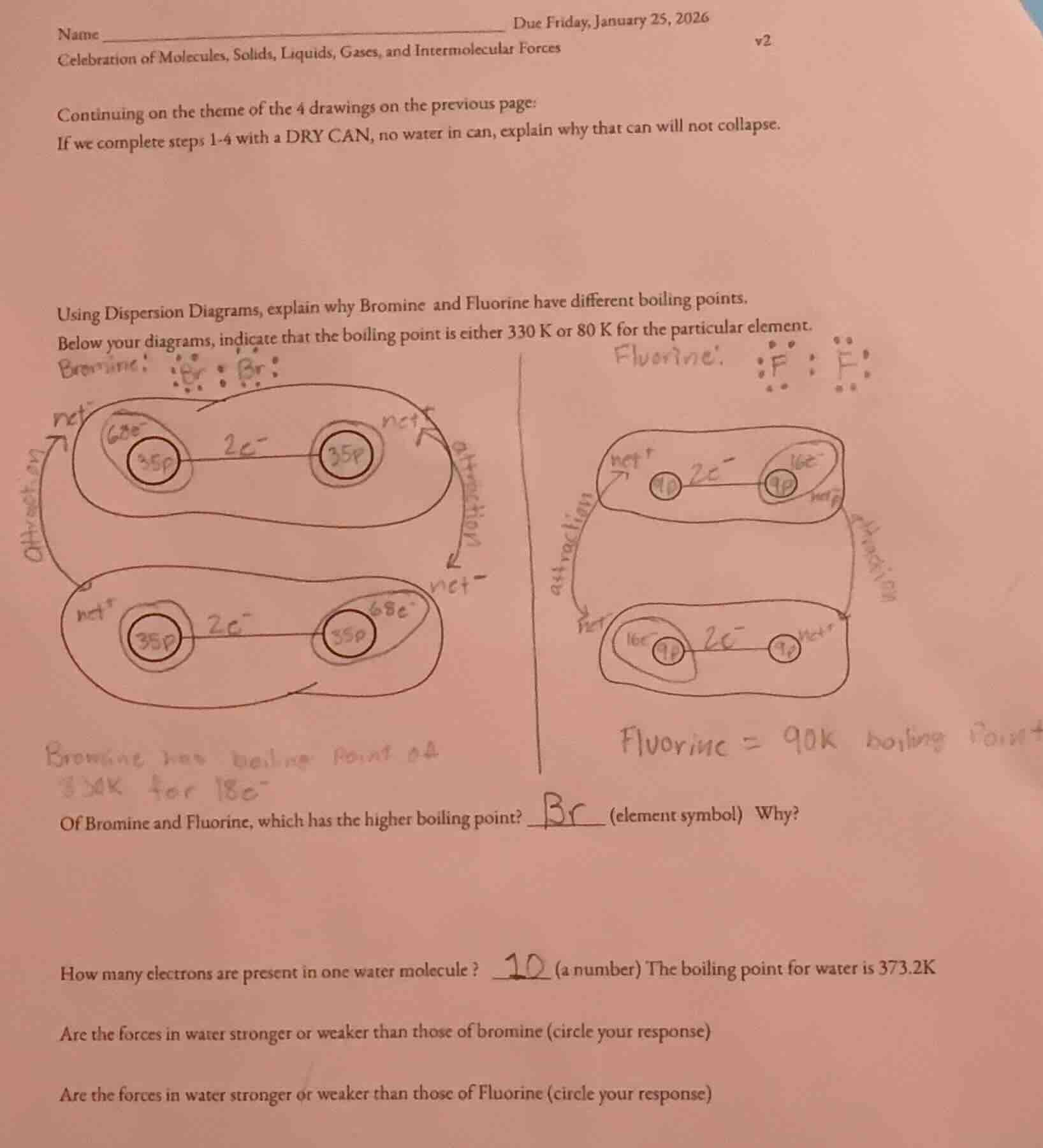
using dispersion diagrams, explain why bromine and fluorine have different boiling points.
below your diagrams, indicate that the boiling point is either 330 k or 80 k for the particular element.
of bromine and fluorine, which has the higher boiling point? ____ (element symbol) why?
how many electrons are present in one water molecule? ____ (a number) the boiling point for water is 373.2k
are the forces in water stronger or weaker than those of bromine (circle your response)
are the forces in water stronger or weaker than those of fluorine (circle your response)
Sub - question 1: Why a dry can won't collapse
When a can is dry (no water), during the steps (likely involving heating and then cooling), there's no water to turn to vapor and then condense. The air inside the can (and outside) has similar pressure. When cooling, since there's no significant pressure difference (as no vapor condenses to reduce internal pressure), the external atmospheric pressure doesn't have a large enough difference to collapse the can. The can's walls are strong enough to withstand the equalized pressure inside and outside.
Bromine (\(Br_2\)) and fluorine (\(F_2\)) are both non - polar molecules, so they have London dispersion forces. The strength of London dispersion forces depends on the number of electrons (molar mass/atomic size). Bromine has more electrons (bromine atoms are larger and have more protons/electrons than fluorine atoms). More electrons mean larger temporary dipoles can form, leading to stronger London dispersion forces. Stronger intermolecular forces require more energy to break, so bromine has a higher boiling point.
A water molecule is \(H_2O\). Hydrogen has 1 electron per atom, and oxygen has 8 electrons. So for \(H_2O\), the total number of electrons is \(2\times1 + 8=10\).

Snap & solve any problem in the app
Get step-by-step solutions on Sovi AI
Photo-based solutions with guided steps
Explore more problems and detailed explanations
A dry can won't collapse because there's no water to vaporize and then condense, so the pressure inside and outside the can remains relatively equal (no large pressure difference is created), and the can's structure can withstand the balanced pressure.