QUESTION IMAGE
Question
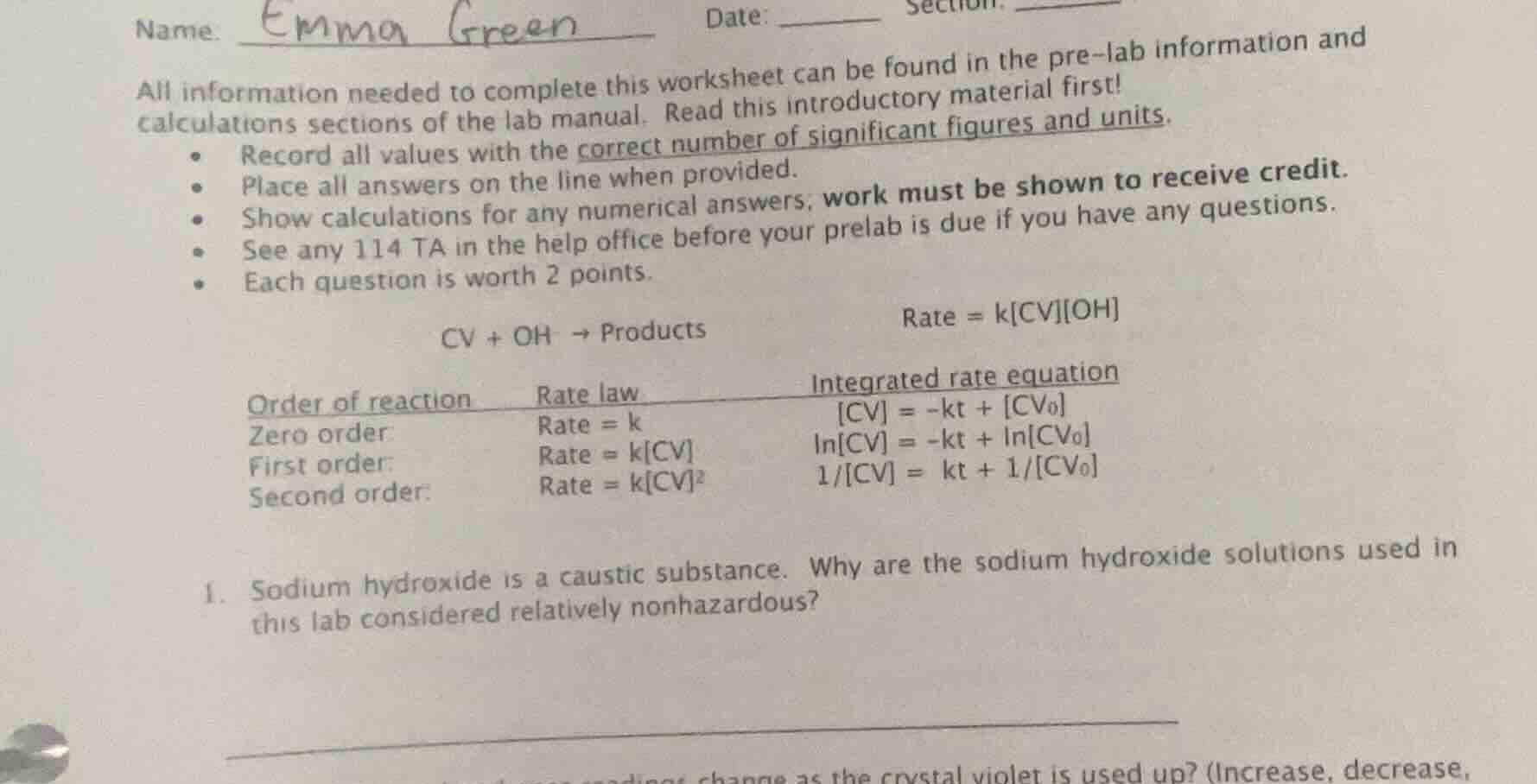
name. emma green date: section:all information needed to complete this worksheet can be found in the pre-lab information and calculations sections of the lab manual. read this introductory material first!• record all values with the correct number of significant figures and units.• place all answers on the line when provided.• show calculations for any numerical answers; work must be shown to receive credit.• see any 114 ta in the help office before your prelab is due if you have any questions.• each question is worth 2 points.cv + oh⁻ → productsrate = kcvoh⁻order of reaction | rate law | integrated rate equationzero order: | rate = k | cv = -kt + cv₀first order: | rate = kcv | lncv = -kt + lncv₀second order: | rate = kcv² | 1/cv = kt + 1/cv₀1. sodium hydroxide is a caustic substance. why are the sodium hydroxide solutions used in this lab considered relatively nonhazardous?change as the crystal violet is used up? (increase, decrease,
The sodium hydroxide solutions used are relatively nonhazardous because they are very dilute. Dilution drastically reduces the concentration of the corrosive hydroxide ions, lowering the solution's causticity and associated risks like severe skin or surface damage.

Snap & solve any problem in the app
Get step-by-step solutions on Sovi AI
Photo-based solutions with guided steps
Explore more problems and detailed explanations
The sodium hydroxide solutions are relatively nonhazardous because they are used in very dilute concentrations, which significantly reduces their caustic and corrosive properties.