QUESTION IMAGE
Question
name
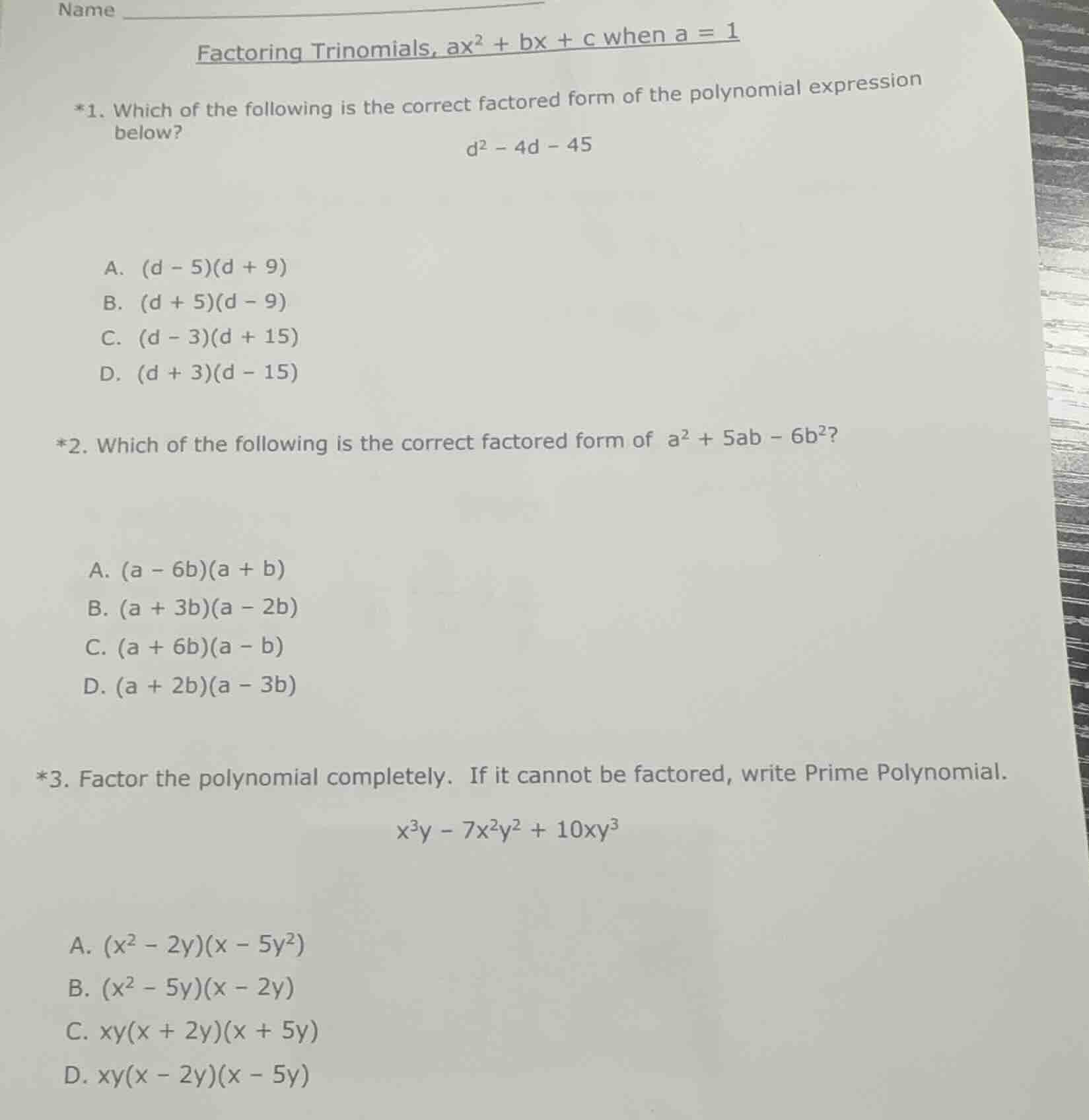
factoring trinomials, $ax^2 + bx + c$ when $a = 1$
*1. which of the following is the correct factored form of the polynomial expression below?
$d^2 - 4d - 45$
a. $(d - 5)(d + 9)$
b. $(d + 5)(d - 9)$
c. $(d - 3)(d + 15)$
d. $(d + 3)(d - 15)$
*2. which of the following is the correct factored form of $a^2 + 5ab - 6b^2$?
a. $(a - 6b)(a + b)$
b. $(a + 3b)(a - 2b)$
c. $(a + 6b)(a - b)$
d. $(a + 2b)(a - 3b)$
*3. factor the polynomial completely. if it cannot be factored, write prime polynomial.
$x^3y - 7x^2y^2 + 10xy^3$
a. $(x^2 - 2y)(x - 5y^2)$
b. $(x^2 - 5y)(x - 2y)$
c. $xy(x + 2y)(x + 5y)$
d. $xy(x - 2y)(x - 5y)$
Question 1
Step1: Recall factoring trinomials \(d^2 + bd + c\) (here \(b=-4\), \(c = - 45\)). We need two numbers that multiply to \(c=-45\) and add to \(b=-4\).
Let the numbers be \(m\) and \(n\), so \(m\times n=-45\) and \(m + n=-4\).
We find that \(m = 5\), \(n=-9\) since \(5\times(-9)=-45\) and \(5+(-9)=-4\). Wait, no, wait: actually, we need two numbers where one is positive and one is negative. Let's re - check: we need two numbers such that their product is \(-45\) and sum is \(-4\). The pairs of factors of \(-45\) are: \((-9,5)\) because \(-9\times5=-45\) and \(-9 + 5=-4\).
So the factored form of \(d^{2}-4d - 45=(d + 5)(d-9)\) (using the formula \((d + m)(d + n)=d^{2}+(m + n)d+mn\), here \(m = 5\), \(n=-9\)).
Step2: Check each option:
- Option A: \((d - 5)(d + 9)=d^{2}+9d-5d - 45=d^{2}+4d-45
eq d^{2}-4d - 45\)
- Option B: \((d + 5)(d - 9)=d^{2}-9d+5d - 45=d^{2}-4d - 45\)
- Option C: \((d - 3)(d + 15)=d^{2}+15d-3d - 45=d^{2}+12d - 45
eq d^{2}-4d - 45\)
- Option D: \((d + 3)(d - 15)=d^{2}-15d+3d - 45=d^{2}-12d - 45
eq d^{2}-4d - 45\)
Step1: For the trinomial \(a^{2}+5ab - 6b^{2}\), we need two numbers that multiply to \(-6b^{2}\) (coefficient of \(a^{0}\) term) and add to \(5b\) (coefficient of \(ab\) term). Let the numbers be \(m\) and \(n\) such that \(m\times n=-6b^{2}\) and \(m + n = 5b\).
We find that \(m = 6b\) and \(n=-b\) since \(6b\times(-b)=-6b^{2}\) and \(6b+(-b)=5b\).
Step2: Then the factored form is \((a + 6b)(a - b)\) (using \((a + m)(a + n)=a^{2}+(m + n)a+mn\), here \(m = 6b\), \(n=-b\)).
Check each option:
- Option A: \((a - 6b)(a + b)=a^{2}+ab-6ab - 6b^{2}=a^{2}-5ab - 6b^{2}
eq a^{2}+5ab - 6b^{2}\)
- Option B: \((a + 3b)(a - 2b)=a^{2}-2ab+3ab - 6b^{2}=a^{2}+ab - 6b^{2}
eq a^{2}+5ab - 6b^{2}\)
- Option C: \((a + 6b)(a - b)=a^{2}-ab+6ab - 6b^{2}=a^{2}+5ab - 6b^{2}\)
- Option D: \((a + 2b)(a - 3b)=a^{2}-3ab+2ab - 6b^{2}=a^{2}-ab - 6b^{2}
eq a^{2}+5ab - 6b^{2}\)
Step1: First, factor out the greatest common factor (GCF) from the polynomial \(x^{3}y-7x^{2}y^{2}+10xy^{3}\). The GCF of \(x^{3}y\), \(-7x^{2}y^{2}\) and \(10xy^{3}\) is \(xy\).
So, \(x^{3}y-7x^{2}y^{2}+10xy^{3}=xy(x^{2}-7xy + 10y^{2})\)
Step2: Now factor the quadratic in the parentheses \(x^{2}-7xy + 10y^{2}\). We need two numbers that multiply to \(10y^{2}\) and add to \(-7y\). The numbers are \(-2y\) and \(-5y\) since \((-2y)\times(-5y)=10y^{2}\) and \(-2y+(-5y)=-7y\).
So \(x^{2}-7xy + 10y^{2}=(x - 2y)(x - 5y)\)
Step3: Then the fully factored form of the original polynomial is \(xy(x - 2y)(x - 5y)\)
Check each option:
- Option A: \((x^{2}-2y)(x - 5y^{2})=x^{3}-5x^{2}y^{2}-2xy + 10y^{3}
eq x^{3}y-7x^{2}y^{2}+10xy^{3}\)
- Option B: \((x^{2}-5y)(x - 2y)=x^{3}-2x^{2}-5xy + 10y
eq x^{3}y-7x^{2}y^{2}+10xy^{3}\)
- Option C: \(xy(x + 2y)(x + 5y)=xy(x^{2}+5xy+2xy + 10y^{2})=xy(x^{2}+7xy + 10y^{2})=x^{3}y+7x^{2}y^{2}+10xy^{3}
eq x^{3}y-7x^{2}y^{2}+10xy^{3}\)
- Option D: \(xy(x - 2y)(x - 5y)=xy(x^{2}-5xy-2xy + 10y^{2})=xy(x^{2}-7xy + 10y^{2})=x^{3}y-7x^{2}y^{2}+10xy^{3}\)

Snap & solve any problem in the app
Get step-by-step solutions on Sovi AI
Photo-based solutions with guided steps
Explore more problems and detailed explanations
B. \((d + 5)(d - 9)\)