QUESTION IMAGE
Question
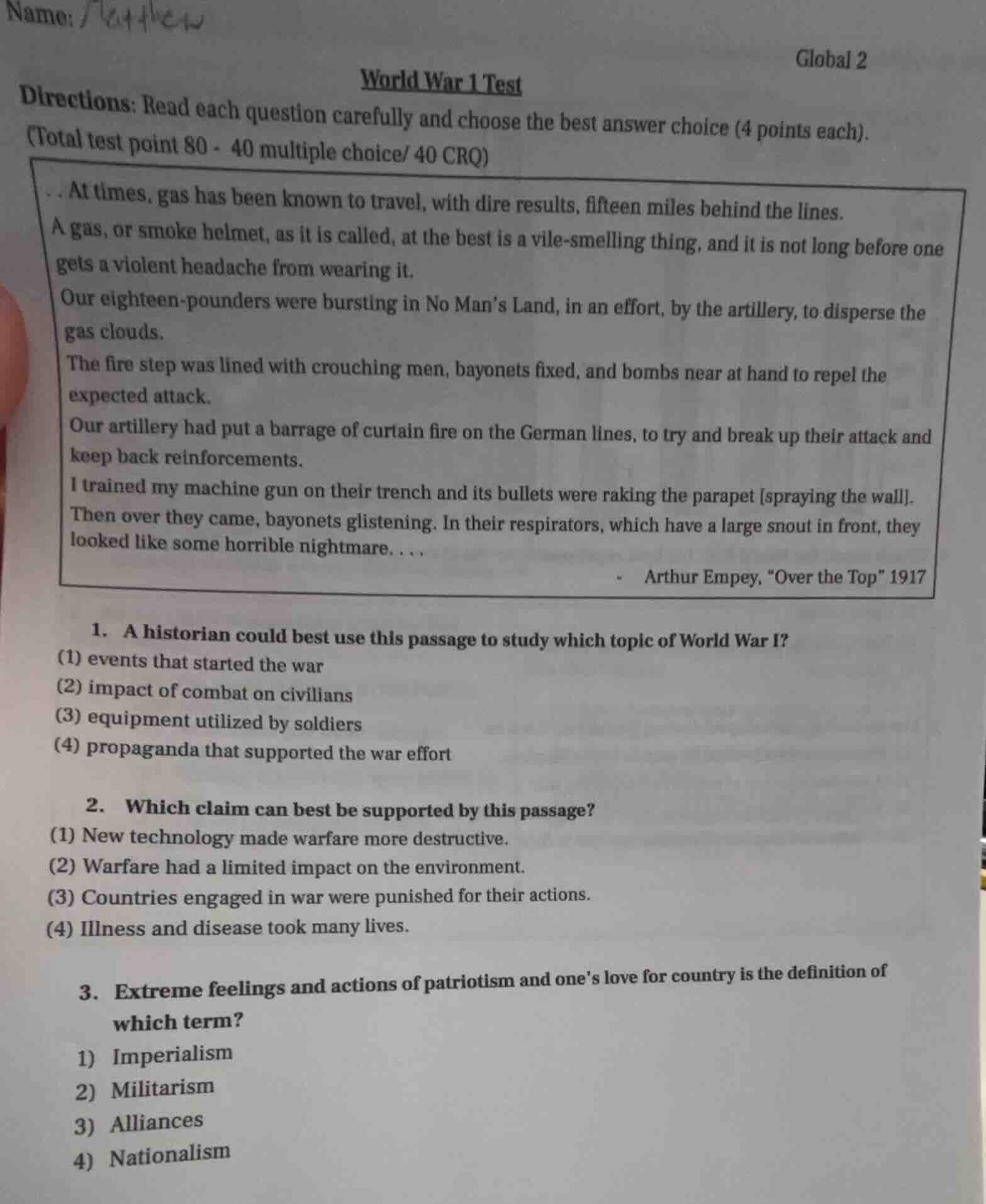
name:global 2world war 1 testdirections: read each question carefully and choose the best answer choice (4 points each).(total test point 80 - 40 multiple choice/ 40 crq)...at times, gas has been known to travel, with dire results, fifteen miles behind the lines.a gas, or smoke helmet, as it is called, at the best is a vile-smelling thing, and it is not long before one gets a violent headache from wearing it.our eighteen-pounders were bursting in no mans land, in an effort, by the artillery, to disperse the gas clouds.the fire step was lined with crouching men, bayonets fixed, and bombs near at hand to repel the expected attack.our artillery had put a barrage of curtain fire on the german lines, to try and break up their attack and keep back reinforcements.i trained my machine gun on their trench and its bullets were raking the parapet spraying the wall.then over they came, bayonets glistening. in their respirators, which have a large snout in front, they looked like some horrible nightmare. . . .- arthur empey, \over the top\ 19171. a historian could best use this passage to study which topic of world war i?(1) events that started the war(2) impact of combat on civilians(3) equipment utilized by soldiers(4) propaganda that supported the war effort2. which claim can best be supported by this passage?(1) new technology made warfare more destructive.(2) warfare had a limited impact on the environment.(3) countries engaged in war were punished for their actions.(4) illness and disease took many lives.3. extreme feelings and actions of patriotism and ones love for country is the definition of which term?1) imperialism2) militarism3) alliances4) nationalism
- For question 1: The passage details gas/smoke helmets, 18-pounders, machine guns, bayonets, and respirators—all soldier equipment. It does not cover war origins, civilian impacts, or propaganda.
- For question 2: The passage describes new WWI technologies (poison gas, heavy artillery, machine guns, respirators) used in destructive trench warfare, showing how they made combat more devastating. It does not address environmental impact limits, war punishments, or illness deaths.
- For question 3: Nationalism is defined as extreme patriotic feelings and devotion to one's country. Imperialism focuses on empire-building, militarism on military buildup, and alliances on cooperative agreements between nations.

Snap & solve any problem in the app
Get step-by-step solutions on Sovi AI
Photo-based solutions with guided steps
Explore more problems and detailed explanations
- (3) equipment utilized by soldiers
- (1) New technology made warfare more destructive.
- 4) Nationalism