QUESTION IMAGE
Question
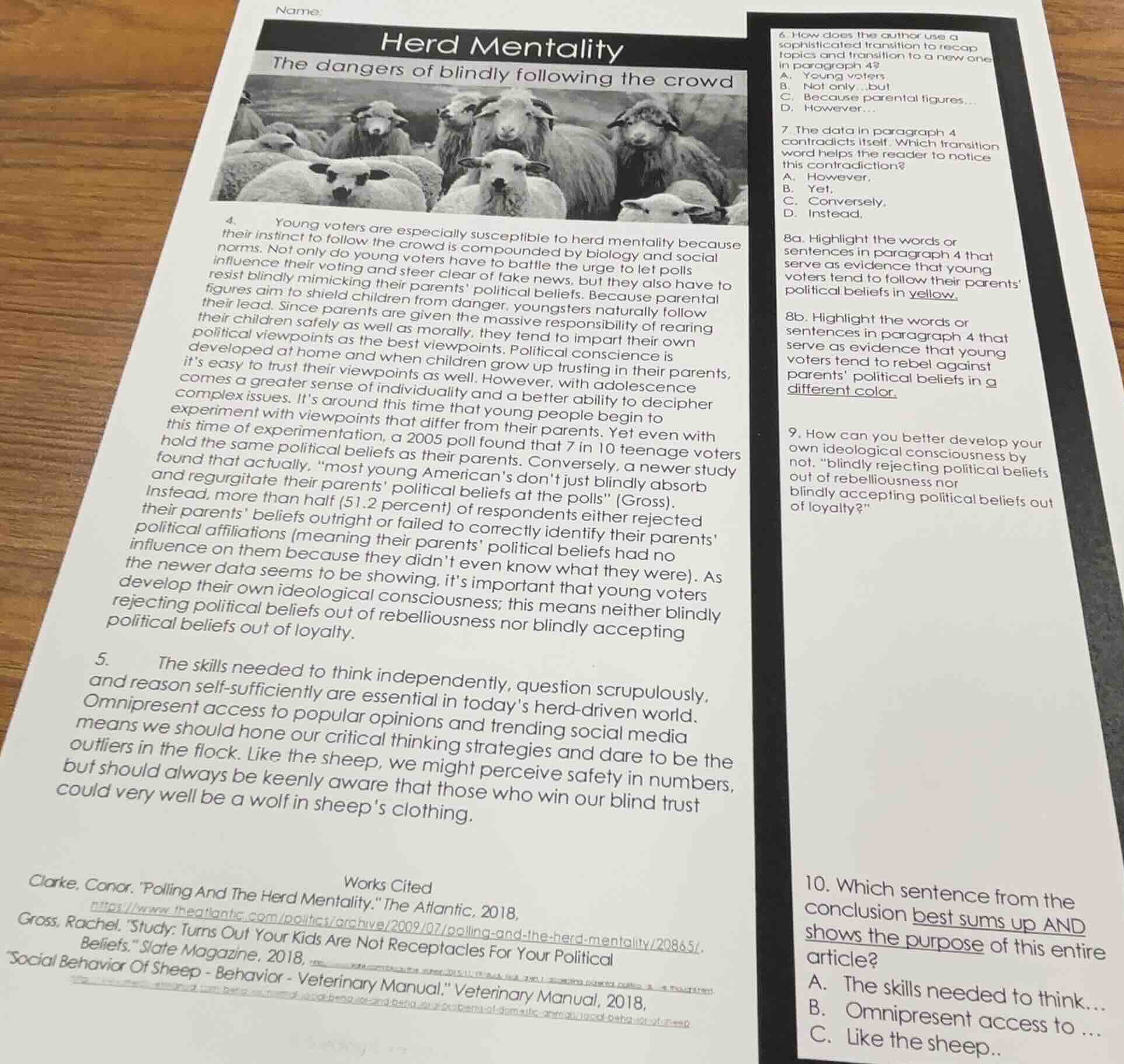
name:herd mentalitythe dangers of blindly following the crowd4. young voters are especially susceptible to herd mentality because their instinct to follow the crowd is compounded by biology and social norms. not only do young voters have to battle the urge to let polls influence their voting and steer clear of fake news, but they also have to resist blindly mimicking their parents political beliefs. because parental figures aim to shield children from danger, youngsters naturally follow their lead. since parents are given the massive responsibility of rearing their children safely as well as morally, they tend to impart their own political viewpoints as the best viewpoints. political conscience is developed at home and when children grow up trusting in their parents, its easy to trust their viewpoints as well. however, with adolescence comes a greater sense of individuality and a better ability to decipher complex issues. its around this time that young people begin to experiment with viewpoints that differ from their parents. yet even with this time of experimentation, a 2005 poll found that 7 in 10 teenage voters hold the same political beliefs as their parents. conversely, a newer study found that actually, \most young americans dont just blindly absorb and regurgitate their parents political beliefs at the polls\ (gross). instead, more than half (51.2 percent) of respondents either rejected their parents beliefs outright or failed to correctly identify their parents political affiliations (meaning their parents political beliefs had no influence on them because they didnt even know what they were). as the newer data seems to be showing, its important that young voters develop their own ideological consciousness; this means neither blindly rejecting political beliefs out of rebelliousness nor blindly accepting political beliefs out of loyalty.5. the skills needed to think independently, question scrupulously, and reason self-sufficiently are essential in todays herd-driven world. omnipresent access to popular opinions and trending social media means we should hone our critical thinking strategies and dare to be the outliers in the flock. like the sheep, we might perceive safety in numbers, but should always be keenly aware that those who win our blind trust could very well be a wolf in sheeps clothing.works citedclarke, conor. \polling and the herd mentality.\ the atlantic, 2018,https://www.theatlantic.com/politics/archive/2009/07/polling-and-the-herd-mentality/20865/.gross, rachel. \study: turns out your kids are not receptacles for your political beliefs.\ slate magazine, 2018,\social behavior of sheep - behavior - veterinary manual.\ veterinary manual, 2018,6. how does the author use a sophisticated transition to recap topics and transition to a new one in paragraph 4?a. young votersb. not only...butc. because parental figures...d. however...7. the data in paragraph 4 contradicts itself. which transition word helps the reader to notice this contradiction?a. however,b. yet,c. conversely,d. instead,8a. highlight the words or sentences in paragraph 4 that serve as evidence that young voters tend to follow their parents political beliefs in yellow.8b. highlight the words or sentences in paragraph 4 that serve as evidence that young voters tend to rebel against parents political beliefs in a different color.9. how can you better develop your own ideological consciousness by not, \blindly rejecting political beliefs out of rebelliousness nor blindly accepting political beliefs out of loyalty?\10. which sentence from the conclusion best sums up and shows the purpose of this entire article?a. the skills needed to think...b. omnipresent access to ...c. like the sheep..
Step1: Answer Q6 (transition for recap/shift)
The phrase "Not only...but" (option B) is used in paragraph 4 to first state one challenge young voters face, then transition to another, which acts as a recap of a topic and shift to a new related point.
Step2: Answer Q7 (contradiction transition)
The word "Yet" (option B) introduces the 2005 poll data that contrasts with the earlier point about adolescent individuality, highlighting the contradiction.
Step3: Answer Q8a (follow parents evidence)
Highlighted text: "Because parental figures aim to shield children from danger, youngsters naturally follow their lead. Since parents are given the massive responsibility of rearing their children safely as well as morally, they tend to impart their own political viewpoints as the best viewpoints. Political conscience is developed at home and when children grow up trusting in their parents, it's easy to trust their viewpoints as well." and "a 2005 poll found that 7 in 10 teenage voters hold the same political beliefs as their parents."
Step4: Answer Q8b (rebel against parents evidence)
Highlighted text: "with adolescence comes a greater sense of individuality and a better ability to decipher complex issues. It's around this time that young people begin to experiment with viewpoints that differ from their parents." and "more than half (51.2 percent) of respondents either rejected their parents' beliefs outright or failed to correctly identify their parents' political affiliations (meaning their parents' political beliefs had no influence on them because they didn't even know what they were)."
Step5: Answer Q9 (develop ideological consciousness)
To develop independent ideological consciousness, young people should practice critical thinking to question information, engage with diverse political perspectives to form informed opinions, research political issues on their own instead of relying solely on family or popular views, and reflect on their own values to align beliefs with personal principles rather than loyalty or rebellion.
Step6: Answer Q10 (conclusion purpose summary)
Option A. The skills needed to think independently, question scrupulously, and reason self-sufficiently are essential in today's herd-driven world.

Snap & solve any problem in the app
Get step-by-step solutions on Sovi AI
Photo-based solutions with guided steps
Explore more problems and detailed explanations
- B. Not only...but
- B. Yet,
8a. Highlighted: "Because parental figures aim to shield children from danger, youngsters naturally follow their lead. Since parents are given the massive responsibility of rearing their children safely as well as morally, they tend to impart their own political viewpoints as the best viewpoints. Political conscience is developed at home and when children grow up trusting in their parents, it's easy to trust their viewpoints as well."; "a 2005 poll found that 7 in 10 teenage voters hold the same political beliefs as their parents."
8b. Highlighted: "with adolescence comes a greater sense of individuality and a better ability to decipher complex issues. It's around this time that young people begin to experiment with viewpoints that differ from their parents."; "more than half (51.2 percent) of respondents either rejected their parents' beliefs outright or failed to correctly identify their parents' political affiliations (meaning their parents' political beliefs had no influence on them because they didn't even know what they were)."
- Young people can develop their own ideological consciousness by practicing critical thinking, engaging with diverse political perspectives, researching issues independently, and aligning beliefs with personal values rather than loyalty or rebellion.
- A. The skills needed to think...