QUESTION IMAGE
Question
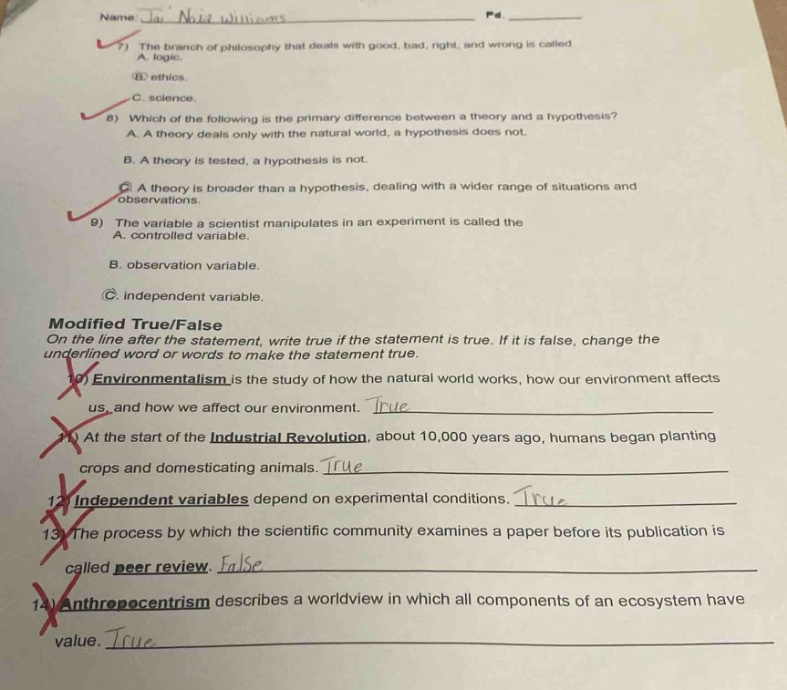
name: junia williams pd 7) the branch of philosophy that deals with good, bad, right, and wrong is called a. logic. b. ethics. c. science. 8) which of the following is the primary difference between a theory and a hypothesis? a. a theory deals only with the natural world, a hypothesis does not. b. a theory is tested, a hypothesis is not. c. a theory is broader than a hypothesis, dealing with a wider range of situations and observations. 9) the variable a scientist manipulates in an experiment is called the a. controlled variable. b. observation variable. c. independent variable. modified true/false on the line after the statement, write true if the statement is true. if it is false, change the underlined word or words to make the statement true. 10) environmentalism is the study of how the natural world works, how our environment affects us, and how we affect our environment. true 11) at the start of the industrial revolution, about 10,000 years ago, humans began planting crops and domesticating animals. true 12) independent variables depend on experimental conditions. true 13) the process by which the scientific community examines a paper before its publication is called peer review. false 14) anthropocentrism describes a worldview in which all components of an ecosystem have value. true
Question 7
Ethics in philosophy focuses on moral concepts like good, bad, right, and wrong. Logic deals with reasoning, science is about empirical study, so ethics is correct.
A hypothesis is a tentative explanation, and a theory is a well - supported, broader explanation that applies to more situations. Option A is wrong as theories can be in non - natural fields too, option B is wrong as hypotheses are tested. So option C is correct.
In an experiment, the independent variable is the one the scientist manipulates. Controlled variable is kept constant, observation variable is not a standard term. So independent variable is correct.

Snap & solve any problem in the app
Get step-by-step solutions on Sovi AI
Photo-based solutions with guided steps
Explore more problems and detailed explanations
B. ethics