QUESTION IMAGE
Question
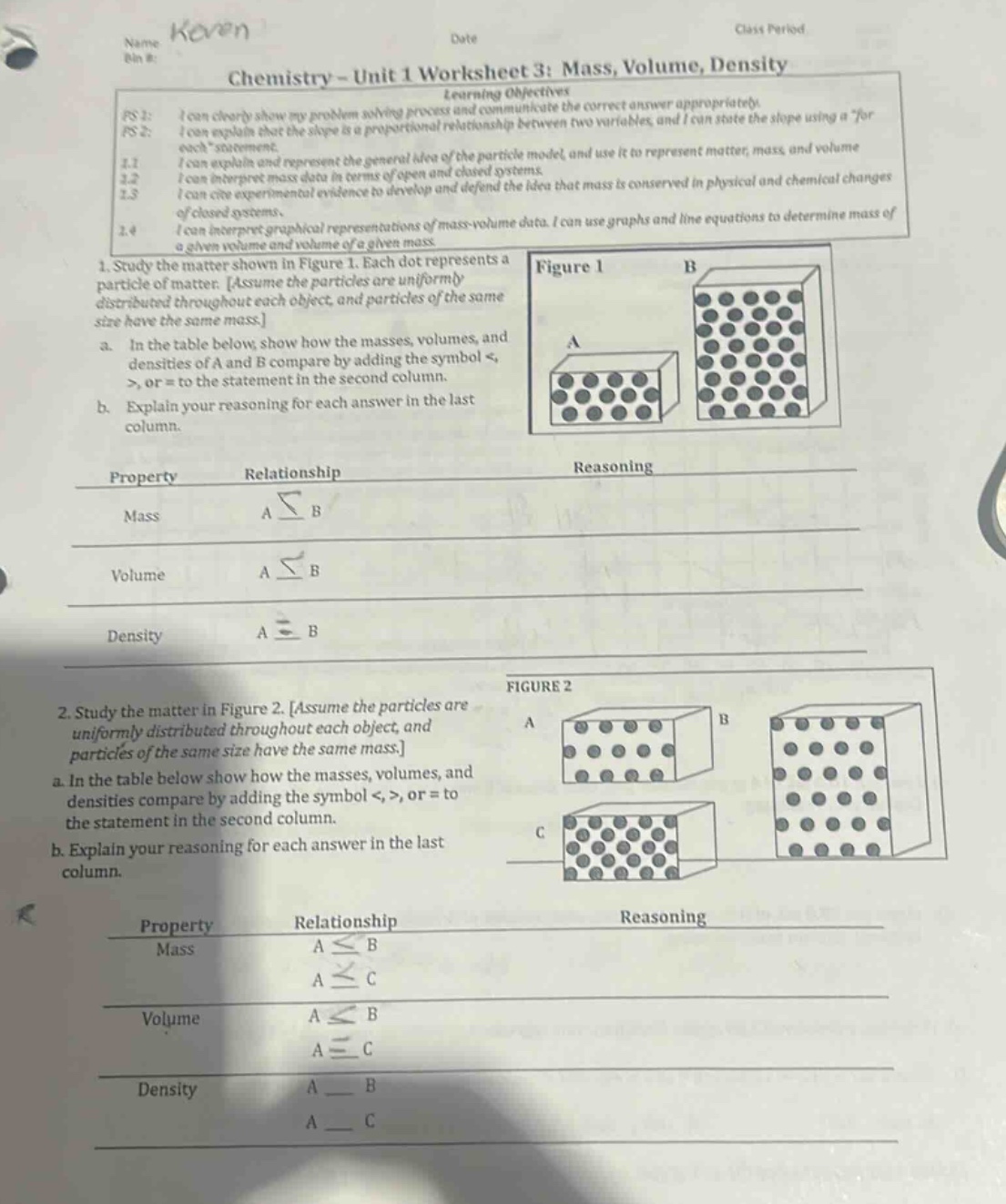
name kevin date class period bin #: chemistry - unit 1 worksheet 3: mass, volume, density learning objectives ps 1: i can clearly show my problem solving process and communicate the correct answer appropriately. ps 2: i can explain that the slope is a proportional relationship between two variables, and i can state the slope using a \for each\ statement. 1.1 i can interpret and represent the general idea of the particle model, and use it to represent matter, mass and volume 1.2 i can interpret mass data in terms of open and closed systems. 1.3 i can cite experimental evidence to develop and defend the idea that mass is conserved in physical and chemical changes of closed systems. 1.4 i can interpret graphical representations of mass - volume data. i can use graphs and line equations to determine mass of a given volume and volume of a given mass. 1. study the matter shown in figure 1. each dot represents a particle of matter. assume the particles are uniformly distributed throughout each object, and particles of the same size have the same mass. a. in the table below, show how the masses, volumes, and densities of a and b compare by adding the symbol <, >, or = to the statement in the second column. b. explain your reasoning for each answer in the last column. property relationship reasoning mass a _ b volume a _ b density a _ b 2. study the matter in figure 2. assume the particles are uniformly distributed throughout each object, and particles of the same size have the same mass. a. in the table below show how the masses, volumes, and densities compare by adding the symbol <, >, or = to the statement in the second column. b. explain your reasoning for each answer in the last column. property relationship reasoning mass a _ b a _ c volume a _ b a _ c density a _ b a ___ c
Problem 1 (Figure 1)
a. Relationship Table
- Mass: Count the number of particles. Object A has fewer particles than B (since B’s box has more dots). So \( A < B \).
- Volume: Object B’s box is larger (taller and wider) than A’s. So \( A < B \).
- Density: Density \(
ho = \frac{\text{mass}}{\text{volume}} \). Particles are uniform (same mass per particle, same spacing? Wait, no—wait, the problem says “particles of the same size have the same mass” and “uniformly distributed.” Wait, actually, if the particles are the same (same mass, same volume per particle), then density is \( \frac{\text{number of particles} \times \text{mass per particle}}{\text{volume of box}} \). But since the particles are uniformly distributed, the density depends on how “packed” they are. Wait, no—wait, in Figure 1, are the particles the same size? The problem says “particles of the same size have the same mass.” So if the particles in A and B are the same size (same mass, same volume per particle), then density is \( \frac{\text{mass}}{\text{volume}} = \frac{\text{number of particles} \times m}{\text{volume of box}} \). But if the particles are uniformly distributed, and the “packing” (particles per unit volume) is the same? Wait, no—wait, in Figure 1, A’s box is smaller, B’s is larger, and B has more particles. Wait, but maybe the particles are the same, so density is \(
ho = \frac{m}{V} \), and since each particle has mass \( m_p \) and volume \( V_p \), then total mass \( M = n m_p \), total volume \( V = n V_p + \text{empty space} \)? No, the problem says “the particle model” to represent matter—so maybe the volume of the object is the volume of the box, and the mass is the number of particles (since same size = same mass). So density is \( \frac{\text{number of particles}}{\text{volume of box}} \times \text{mass per particle} \). If the particles are the same (same mass per particle, same volume per particle), then density is proportional to \( \frac{\text{number of particles}}{\text{volume of box}} \). But in Figure 1, are the particles packed the same? Wait, the dots in A and B—A’s box has, say, 12 dots, B has 24? And B’s box is twice as big? Wait, maybe the particles are the same, so density is equal. Wait, the problem says “particles of the same size have the same mass” and “uniformly distributed.” So if the particles are the same (same mass, same volume), then density (mass/volume) should be equal. So \( A = B \) for density.
b. Reasoning
- Mass: \( A < B \) because B has more particles (dots) than A, and each particle has the same mass.
- Volume: \( A < B \) because B’s box (the object) is larger in size (volume) than A’s.
- Density: \( A = B \) because density is \( \frac{\text{mass}}{\text{volume}} \). Since both mass and volume scale proportionally (B has more mass and more volume, but the ratio \( \frac{\text{mass}}{\text{volume}} \) is the same—because particles are uniform, so the “packing” of particles (mass per unit volume) is identical).
Problem 2 (Figure 2)
a. Relationship Table
- Mass: Compare particles. Object A has, say, 10 dots, B has 15, C has 20? Wait, no—look at Figure 2: A’s box has fewer dots than B? Wait, no—A: top box, B: top right, C: bottom left. Wait, A’s box: let’s count dots. A: maybe 12 dots, B: 18, C: 24? Wait, no—wait, the problem says “particles of the same size have the same mass.” So mass depends on number of particles.
- \( A \) vs \( B \): A has fewer particles than B → \( A < B \).
- \( A \) vs \( C \): A has fewer particles than C → \( A < C \)? Wait, no—wa…

Snap & solve any problem in the app
Get step-by-step solutions on Sovi AI
Photo-based solutions with guided steps
Explore more problems and detailed explanations
Problem 1 (Figure 1)
a. Relationship Table
- Mass: Count the number of particles. Object A has fewer particles than B (since B’s box has more dots). So \( A < B \).
- Volume: Object B’s box is larger (taller and wider) than A’s. So \( A < B \).
- Density: Density \(
ho = \frac{\text{mass}}{\text{volume}} \). Particles are uniform (same mass per particle, same spacing? Wait, no—wait, the problem says “particles of the same size have the same mass” and “uniformly distributed.” Wait, actually, if the particles are the same (same mass, same volume per particle), then density is \( \frac{\text{number of particles} \times \text{mass per particle}}{\text{volume of box}} \). But since the particles are uniformly distributed, the density depends on how “packed” they are. Wait, no—wait, in Figure 1, are the particles the same size? The problem says “particles of the same size have the same mass.” So if the particles in A and B are the same size (same mass, same volume per particle), then density is \( \frac{\text{mass}}{\text{volume}} = \frac{\text{number of particles} \times m}{\text{volume of box}} \). But if the particles are uniformly distributed, and the “packing” (particles per unit volume) is the same? Wait, no—wait, in Figure 1, A’s box is smaller, B’s is larger, and B has more particles. Wait, but maybe the particles are the same, so density is \(
ho = \frac{m}{V} \), and since each particle has mass \( m_p \) and volume \( V_p \), then total mass \( M = n m_p \), total volume \( V = n V_p + \text{empty space} \)? No, the problem says “the particle model” to represent matter—so maybe the volume of the object is the volume of the box, and the mass is the number of particles (since same size = same mass). So density is \( \frac{\text{number of particles}}{\text{volume of box}} \times \text{mass per particle} \). If the particles are the same (same mass per particle, same volume per particle), then density is proportional to \( \frac{\text{number of particles}}{\text{volume of box}} \). But in Figure 1, are the particles packed the same? Wait, the dots in A and B—A’s box has, say, 12 dots, B has 24? And B’s box is twice as big? Wait, maybe the particles are the same, so density is equal. Wait, the problem says “particles of the same size have the same mass” and “uniformly distributed.” So if the particles are the same (same mass, same volume), then density (mass/volume) should be equal. So \( A = B \) for density.
b. Reasoning
- Mass: \( A < B \) because B has more particles (dots) than A, and each particle has the same mass.
- Volume: \( A < B \) because B’s box (the object) is larger in size (volume) than A’s.
- Density: \( A = B \) because density is \( \frac{\text{mass}}{\text{volume}} \). Since both mass and volume scale proportionally (B has more mass and more volume, but the ratio \( \frac{\text{mass}}{\text{volume}} \) is the same—because particles are uniform, so the “packing” of particles (mass per unit volume) is identical).
Problem 2 (Figure 2)
a. Relationship Table
- Mass: Compare particles. Object A has, say, 10 dots, B has 15, C has 20? Wait, no—look at Figure 2: A’s box has fewer dots than B? Wait, no—A: top box, B: top right, C: bottom left. Wait, A’s box: let’s count dots. A: maybe 12 dots, B: 18, C: 24? Wait, no—wait, the problem says “particles of the same size have the same mass.” So mass depends on number of particles.
- \( A \) vs \( B \): A has fewer particles than B → \( A < B \).
- \( A \) vs \( C \): A has fewer particles than C → \( A < C \)? Wait, no—wait, C’s box: maybe same volume as A? Wait, C’s box looks same size as A? Wait, Figure 2: A and C have boxes of same size? Wait, A is top, C is bottom—maybe same volume. Then:
- \( A \) vs \( C \): C has more particles (dots) than A → \( A < C \)? Wait, no—wait, the table in the problem has \( A \_\_ C \) for mass. Wait, maybe I misread. Let’s re-express:
- Mass:
- \( A \) vs \( B \): B has more particles (dots) → \( A < B \).
- \( A \) vs \( C \): C has more particles (dots) than A (if C’s box is same size as A, but more dots) → \( A < C \)? Wait, no—wait, the table in the problem has “\( A \_\_ C \)” for mass. Wait, maybe C’s box is same volume as A, but more particles. So mass: \( A < C \).
- Volume:
- \( A \) vs \( B \): B’s box is larger (wider/taller) than A’s → \( A < B \).
- \( A \) vs \( C \): A and C’s boxes look same size (volume) → \( A = C \).
- Density:
- \( A \) vs \( B \): Density \(
ho = \frac{\text{mass}}{\text{volume}} \). A has less mass, less volume. But B’s volume is larger, and mass is larger—do they scale? Wait, particles: A has, say, 10 particles, volume \( V \); B has 15 particles, volume \( 1.5V \). Then \(
ho_A = \frac{10m}{V} \), \(
ho_B = \frac{15m}{1.5V} = \frac{10m}{V} \) → \( A = B \)? Wait, no—wait, maybe B’s particles are same size as A’s? Wait, the problem says “particles of the same size have the same mass.” So if A and B have particles of same size (same mass, same volume per particle), then density is \( \frac{\text{mass}}{\text{volume}} = \frac{n m_p}{V_{\text{box}}} \). If B’s box is 1.5x A’s volume, and B has 1.5x A’s particles, then density is equal. But wait, in Figure 2, maybe A and B have different particle sizes? No, the problem says “particles of the same size have the same mass”—so if particles are same size, same mass. If A and B have different particle sizes, but the problem doesn’t say that. Wait, no—Figure 2: A’s particles are, say, smaller? No, the problem says “particles of the same size have the same mass”—so maybe A and B have different particle sizes? Wait, no—maybe the key is:
- For \( A \) vs \( C \): A and C have same volume (boxes same size), but C has more particles (more mass) → \(
ho_C = \frac{\text{more mass}}{\text{same volume}} >
ho_A \), so \( A < C \) for density.
- For \( A \) vs \( B \): A has less mass, less volume. If B’s volume is larger than A’s, but mass is also larger—if the ratio \( \frac{\text{mass}}{\text{volume}} \) is same (same particle size, same packing), then \( A = B \). But if B’s particles are same as A’s, then yes. Wait, maybe the problem is that in Figure 2, A and B have particles of same size (same mass, same volume per particle), so density is equal. A and C: C has more particles (more mass) in same volume, so density of C is higher.
b. Reasoning
- Mass (A vs B): \( A < B \) because B has more particles (dots) than A (same particle mass).
- Mass (A vs C): \( A < C \) because C has more particles than A (same particle mass).
- Volume (A vs B): \( A < B \) because B’s box (object) is larger in volume than A’s.
- Volume (A vs C): \( A = C \) because A and C’s boxes are the same size (volume).
- Density (A vs B): \( A = B \) because \( \frac{\text{mass}}{\text{volume}} \) is proportional to \( \frac{\text{number of particles}}{\text{volume of box}} \), and B’s mass and volume scale proportionally (same particle size, same packing).
- Density (A vs C): \( A < C \) because C has more mass (more particles) in the same volume as A, so \(
ho_C = \frac{\text{more mass}}{\text{same volume}} >
ho_A \).
Final Answers (Filled Tables)
Problem 1 (Figure 1)
| Property | Relationship | Reasoning |
|---|---|---|
| Volume | \( A < B \) | B’s box is larger (greater volume). |
| Density | \( A = B \) | \( \frac{\text{mass}}{\text{volume}} \) ratio is equal (same particle packing, same particle mass/volume). |
Problem 2 (Figure 2)
| Property | Relationship (A vs B) | Relationship (A vs C) | Reasoning (A vs B) | Reasoning (A vs C) |
|---|---|---|---|---|
| Volume | \( A < B \) | \( A = C \) | B’s box is larger. | A and C’s boxes are same size. |
| Density | \( A = B \) | \( A < C \) | Mass/volume ratio is equal (same particle packing). | C has more mass in same volume, so higher density. |
(Note: The exact number of particles/dots may vary based on the figure, but the logic is based on particle count, box size, and density formula \(
ho = \frac{m}{V} \).)