QUESTION IMAGE
Question
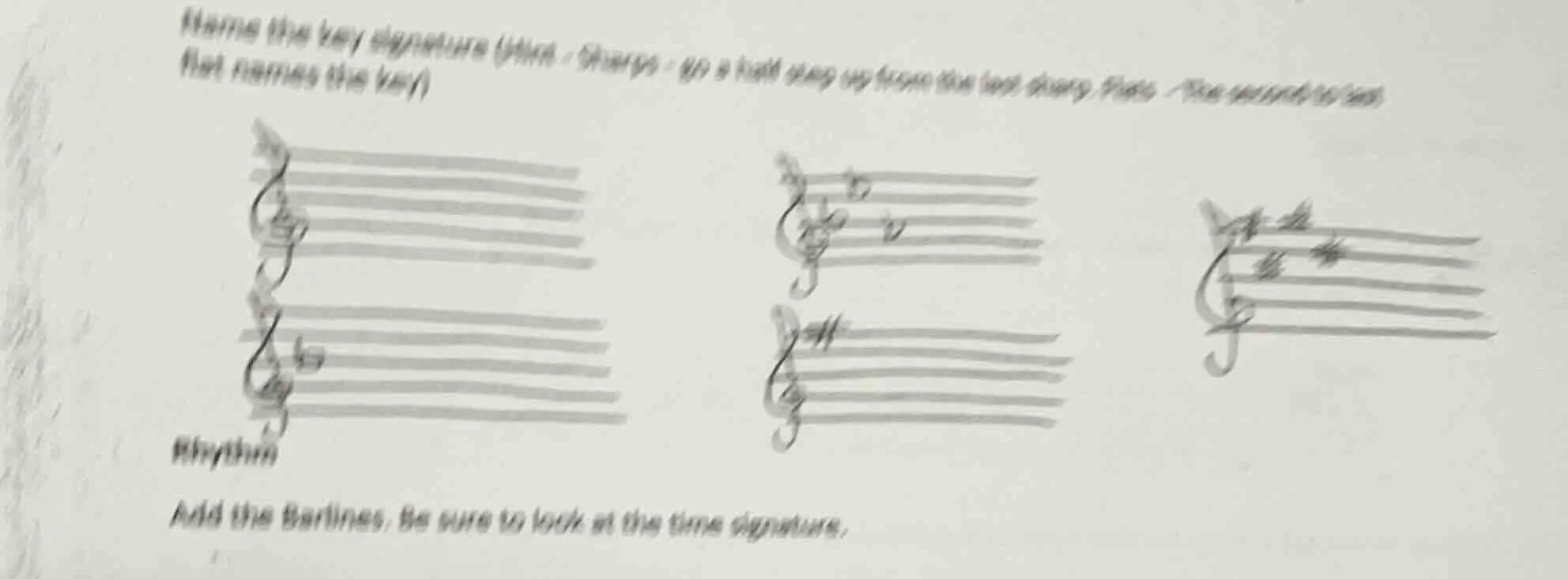
name the key signature (hint : sharps - go a half step up from the last sharp. flats - the second to last flat names the key)
rhythm
add the barlines. be sure to look at the time signatures.
To solve this, we analyze each key signature:
1. First Treble Clef (No Accidents)
- No sharps or flats.
- Key: C Major (or A minor, relative minor).
2. Second Treble Clef (Two Flats: B♭, E♭)
- For flats, the second - to - last flat names the key.
- Second flat is E♭? Wait, no—wait, order of flats: B♭, E♭, A♭, D♭, G♭, C♭, F♭. If two flats, they are B♭ and E♭. Second - to - last flat is B♭? No, wait, when there are flats, the key is the major key with the name of the second - to - last flat. Wait, no: for flats, the key is determined by the second - to - last flat. Wait, if there are \( n \) flats, the key is the major key where the \( (n - 1) \)th flat (second - to - last when \( n\geq2 \)) is the tonic. Wait, no, correct rule: For flats, the key signature’s major key is named by the second - to - last flat. For example, 1 flat (B♭) is F major. 2 flats (B♭, E♭): second - to - last flat is B♭? No, wait, 2 flats: B♭ and E♭. The second - to - last is B♭? No, the order is B♭ (first), E♭ (second). So second - to - last is B♭? No, that can't be. Wait, no, the correct rule is: For flats, the major key is the key of the flat that is one step above the last flat. Wait, no, let's recall:
- Sharps: The major key is a half - step above the last sharp.
- Flats: The major key is the second - to - last flat (when there are 2 or more flats). If there is 1 flat (B♭), the key is F major (since F is a fifth below B♭? No, F major has 1 flat (B♭). Wait, maybe better to use the circle of fifths.
Wait, let's start over:
Key Signature Rules:
- Sharps: The major key is a half - step above the last sharp. For example, 1 sharp (F♯): half - step above F♯ is G, so G major. 2 sharps (F♯, C♯): half - step above C♯ is D, so D major.
- Flats: The major key is the second - to - last flat (when there are 2 or more flats). If there is 1 flat (B♭), the key is F major (since F major has B♭ as its flat, and it's the only flat - based key with 1 flat where the rule is a bit different: F major is the key with 1 flat, and the rule for multiple flats is second - to - last).
Analyzing Each Clef:
- First Treble Clef (No Sharps/Flats):
- Key: C Major (or A minor, relative minor).
- Second Treble Clef (Two Flats: B♭, E♭):
- Number of flats \( n = 2 \). Second - to - last flat (when \( n = 2 \), the first flat is B♭, second is E♭; second - to - last is B♭? No, that's not right. Wait, no, the order of flats is B♭, E♭, A♭, D♭, G♭, C♭, F♭. So for 2 flats, they are B♭ (1st) and E♭ (2nd). The second - to - last flat is B♭? No, that would be the first flat. Wait, I think I mixed up. The correct rule for flats: The major key is the key of the flat that is one flat before the last flat. Wait, no, let's use the circle of fifths. The circle of fifths for flats: F major (1 flat: B♭), B♭ major (2 flats: B♭, E♭), E♭ major (3 flats: B♭, E♭, A♭), etc. Ah! So 2 flats: B♭ and E♭ correspond to B♭ major. Wait, that's the mistake. The number of flats: F major (1), B♭ major (2), E♭ major (3), A♭ major (4), D♭ major (5), G♭ major (6), C♭ major (7). So for 2 flats, the key is B♭ major. So my earlier rule was wrong. The correct rule for flats: The major key with \( n \) flats is the key where the tonic is a fifth below the tonic of the key with \( n - 1 \) flats. Or, more simply, the key signature with \( n \) flats is B♭ major when \( n = 2 \), E♭ major when \( n = 3 \), etc.
- So 2 flats (B♭, E♭) → B♭ major.
- Third Treble Clef (Two Sharps: F♯, C♯):
- Last sharp is C♯. A half - step above C♯ is D. So key: D major.
- **Fourth Treble Clef (On…

Snap & solve any problem in the app
Get step-by-step solutions on Sovi AI
Photo-based solutions with guided steps
Explore more problems and detailed explanations
s (Key Signatures):
- C Major
- B♭ Major
- D Major
- F Major
- D Major (if two sharps)
- (Depends on sharps, e.g., if two sharps, D Major)
(Note: The exact barlines depend on the rhythm values of the notes, which are not fully clear from the drawing, but the key signature analysis follows the rules of music theory for key signatures: sharps → half - step above last sharp; flats → major key is determined by the number of flats (with 1 flat = F major, 2 flats = B♭ major, etc., or second - to - last flat rule corrected with circle of fifths).)