QUESTION IMAGE
Question
name
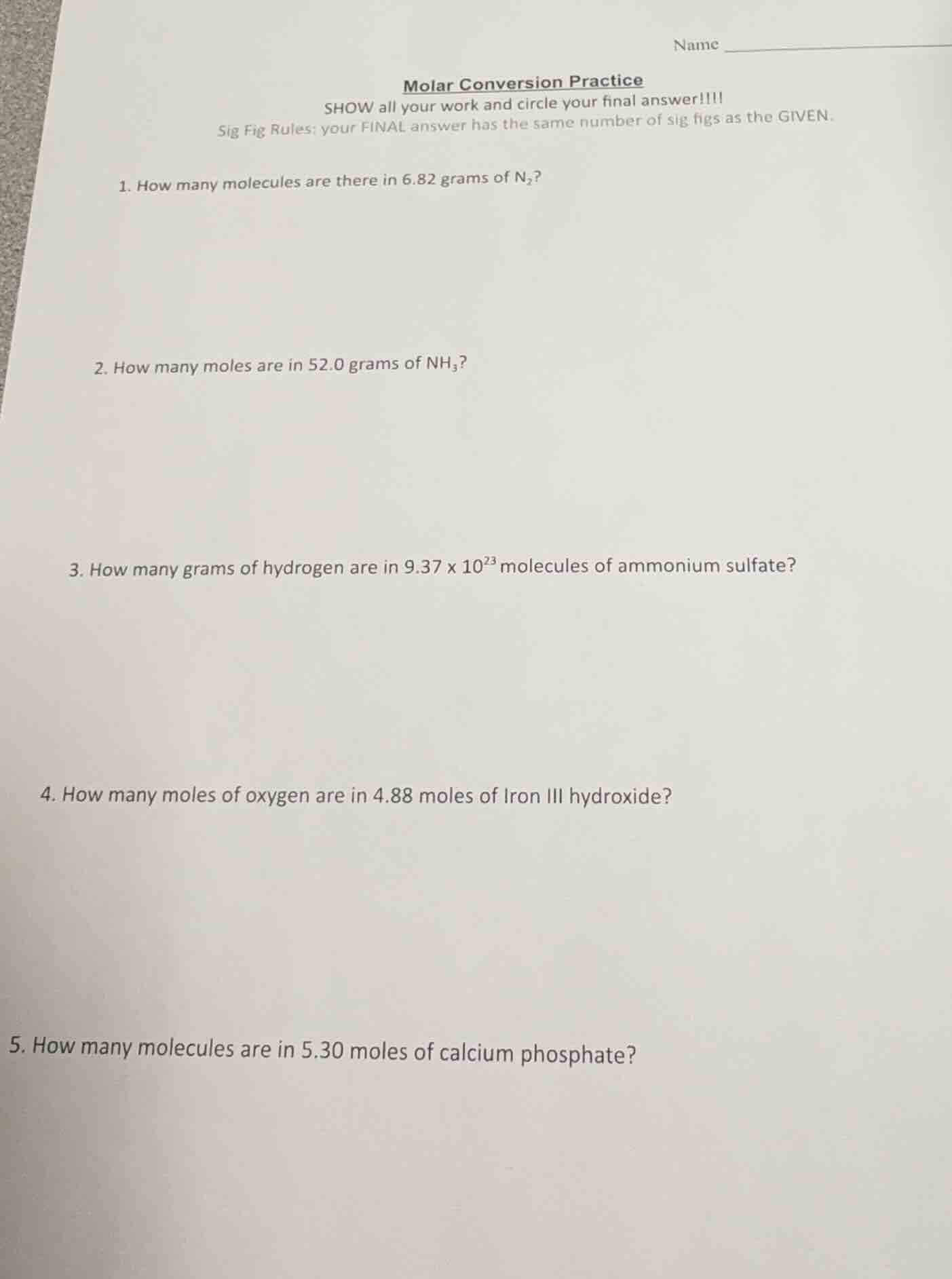
molar conversion practice
show all your work and circle your final answer!!!!
sig fig rules: your final answer has the same number of sig figs as the given.
- how many molecules are there in 6.82 grams of n₂?
- how many moles are in 52.0 grams of nh₃?
- how many grams of hydrogen are in 9.37 x 10²³ molecules of ammonium sulfate?
- how many moles of oxygen are in 4.88 moles of iron iii hydroxide?
- how many molecules are in 5.30 moles of calcium phosphate?
Question 1: How many molecules are there in 6.82 grams of \( \text{N}_2 \)?
Step 1: Calculate the molar mass of \( \text{N}_2 \)
The molar mass of \( \text{N} \) is \( 14.01 \, \text{g/mol} \), so for \( \text{N}_2 \):
\( \text{Molar Mass of } \text{N}_2 = 2 \times 14.01 \, \text{g/mol} = 28.02 \, \text{g/mol} \)
Step 2: Convert grams to moles
Use the formula \( \text{Moles} = \frac{\text{Mass}}{\text{Molar Mass}} \):
\( \text{Moles of } \text{N}_2 = \frac{6.82 \, \text{g}}{28.02 \, \text{g/mol}} \approx 0.2434 \, \text{mol} \)
Step 3: Convert moles to molecules (using Avogadro’s number \( 6.022 \times 10^{23} \, \text{molecules/mol} \))
\( \text{Molecules} = \text{Moles} \times 6.022 \times 10^{23} \, \text{molecules/mol} \)
\( \text{Molecules} = 0.2434 \, \text{mol} \times 6.022 \times 10^{23} \, \text{molecules/mol} \approx 1.466 \times 10^{23} \, \text{molecules} \)
Step 4: Apply significant figures (3 sig figs, same as 6.82)
\( \text{Final Answer} \approx 1.47 \times 10^{23} \, \text{molecules} \)
Step 1: Calculate the molar mass of \( \text{NH}_3 \)
Molar mass of \( \text{N} = 14.01 \, \text{g/mol} \), \( \text{H} = 1.008 \, \text{g/mol} \):
\( \text{Molar Mass of } \text{NH}_3 = 14.01 + 3 \times 1.008 = 17.034 \, \text{g/mol} \)
Step 2: Convert grams to moles
\( \text{Moles of } \text{NH}_3 = \frac{52.0 \, \text{g}}{17.034 \, \text{g/mol}} \approx 3.053 \, \text{mol} \)
Step 3: Apply significant figures (3 sig figs, same as 52.0)
\( \text{Final Answer} \approx 3.05 \, \text{mol} \)
Step 1: Determine the formula for ammonium sulfate (\( (\text{NH}_4)_2\text{SO}_4 \))
Each \( (\text{NH}_4)_2\text{SO}_4 \) has \( 8 \, \text{H} \) atoms (2 \( \text{NH}_4^+ \) ions, each with 4 H).
Step 2: Convert molecules to moles (using Avogadro’s number)
\( \text{Moles of } (\text{NH}_4)_2\text{SO}_4 = \frac{9.37 \times 10^{23} \, \text{molecules}}{6.022 \times 10^{23} \, \text{molecules/mol}} \approx 1.556 \, \text{mol} \)
Step 3: Moles of H atoms
Each \( (\text{NH}_4)_2\text{SO}_4 \) has 8 H atoms, so:
\( \text{Moles of H} = 1.556 \, \text{mol} \times 8 = 12.448 \, \text{mol} \)
Step 4: Convert moles of H to grams (molar mass of H = \( 1.008 \, \text{g/mol} \))
\( \text{Mass of H} = 12.448 \, \text{mol} \times 1.008 \, \text{g/mol} \approx 12.55 \, \text{g} \)
Step 5: Apply significant figures (3 sig figs, same as \( 9.37 \times 10^{23} \))
\( \text{Final Answer} \approx 12.6 \, \text{g} \)

Snap & solve any problem in the app
Get step-by-step solutions on Sovi AI
Photo-based solutions with guided steps
Explore more problems and detailed explanations
\( \boxed{1.47 \times 10^{23} \text{ molecules}} \)