QUESTION IMAGE
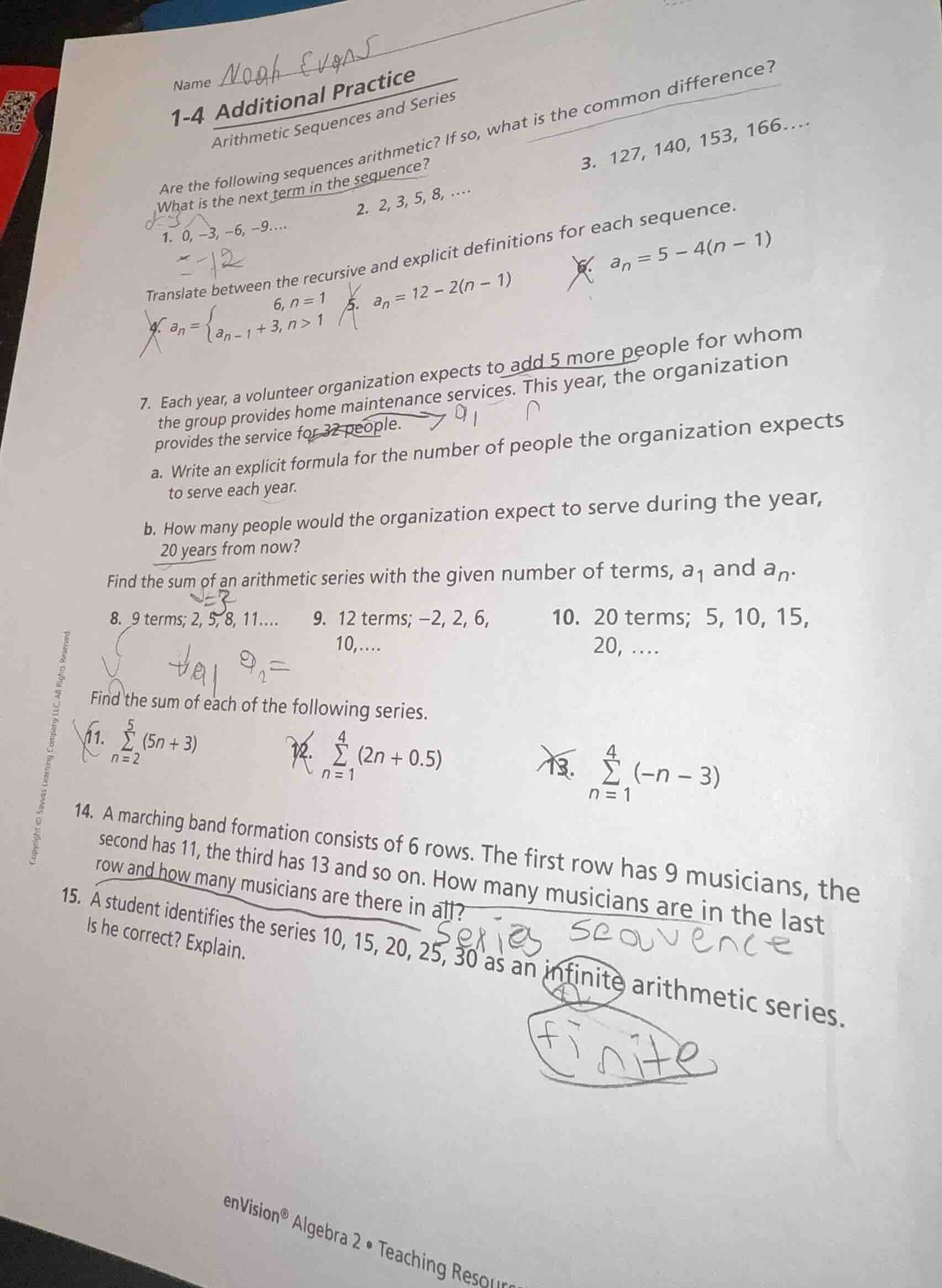
Question
name noah evans
1-4 additional practice
arithmetic sequences and series
are the following sequences arithmetic? if so, what is the common difference?
what is the next term in the sequence?
- 0, -3, -6, -9....
- 2, 3, 5, 8,....
- 127, 140, 153, 166....
translate between the recursive and explicit definitions for each sequence.
- $a_n = \
$
- $a_n = 12 - 2(n - 1)$
- $a_n = 5 - 4(n - 1)$
- each year, a volunteer organization expects to add 5 more people for whom the group provides home maintenance services. this year, the organization provides the service for 32 people.
a. write an explicit formula for the number of people the organization expects to serve each year.
b. how many people would the organization expect to serve during the year, 20 years from now?
find the sum of an arithmetic series with the given number of terms, $a_1$ and $a_n$.
- 9 terms; 2, 5, 8, 11....
- 12 terms; -2, 2, 6, 10,....
- 20 terms; 5, 10, 15, 20,....
find the sum of each of the following series.
- $\sum_{n = 2}^5 (5n + 3)$
- $\sum_{n = 1}^4 (2n + 0.5)$
- $\sum_{n = 1}^4 (-n - 3)$
- a marching band formation consists of 6 rows. the first row has 9 musicians, the second has 11, the third has 13 and so on. how many musicians are in the last row and how many musicians are there in all?
- a student identifies the series 10, 15, 20, 25, 30 as an infinite arithmetic series. is he correct? explain.
copyright © savvas learning company llc all rights reserved.
envision® algebra 2 • teaching resour
Let's solve problem 1: "0, -3, -6, -9… Are the following sequences arithmetic? If so, what is the common difference? What is the next term in the sequence?"
Step 1: Check if it's an arithmetic sequence
To check if a sequence is arithmetic, we find the difference between consecutive terms.
First difference: $-3 - 0 = -3$
Second difference: $-6 - (-3) = -3$
Third difference: $-9 - (-6) = -3$
Since the difference between consecutive terms is constant ($-3$), it is an arithmetic sequence.
Step 2: Find the common difference
The common difference $d$ is the constant difference between consecutive terms, which we found to be $-3$.
Step 3: Find the next term
To find the next term, we add the common difference to the last given term. The last given term is $-9$. So the next term is $-9 + (-3) = -12$.

Snap & solve any problem in the app
Get step-by-step solutions on Sovi AI
Photo-based solutions with guided steps
Explore more problems and detailed explanations
The sequence is arithmetic with a common difference of $-3$. The next term is $-12$.