QUESTION IMAGE
Question
name ________________ period ___
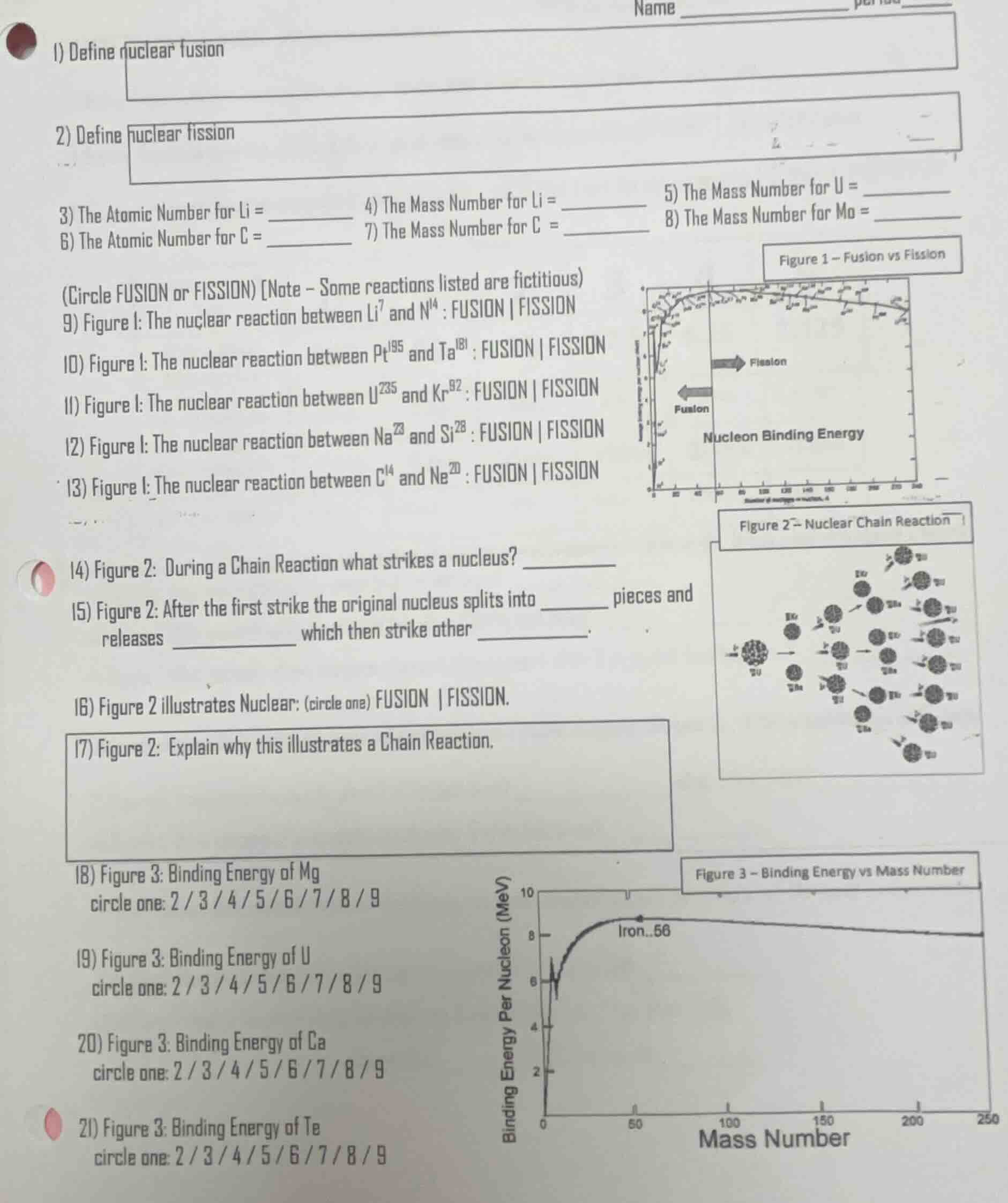
- define nuclear fusion
- define nuclear fission
- the atomic number for li = _____ 4) the mass number for li = ___ 5) the mass number for u = _____
- the atomic number for c = _____ 7) the mass number for c = ___ 8) the mass number for mo = _____
(circle fusion or fission) note – some reactions listed are fictitious
- figure 1: the nuclear reaction between li⁷ and n¹⁴ : fusion | fission
- figure 1: the nuclear reaction between pt¹⁹⁵ and ta¹⁸¹ : fusion | fission
- figure 1: the nuclear reaction between u²³⁵ and kr⁹² : fusion | fission
- figure 1: the nuclear reaction between na²³ and si²⁸ : fusion | fission
- figure 1: the nuclear reaction between c¹⁴ and ne²⁰ : fusion | fission
- figure 2: during a chain reaction what strikes a nucleus? _______
- figure 2: after the first strike the original nucleus splits into ___ pieces and releases _____ which then strike other _______.
- figure 2 illustrates nuclear: (circle one) fusion | fission.
- figure 2: explain why this illustrates a chain reaction.
- figure 3: binding energy of mg
circle one: 2 / 3 / 4 / 5 / 6 / 7 / 8 / 9
- figure 3: binding energy of u
circle one: 2 / 3 / 4 / 5 / 6 / 7 / 8 / 9
- figure 3: binding energy of ca
circle one: 2 / 3 / 4 / 5 / 6 / 7 / 8 / 9
- figure 3: binding energy of te
circle one: 2 / 3 / 4 / 5 / 6 / 7 / 8 / 9
figure 1 – fusion vs fission
graph showing nucleon binding energy with fusion and fission arrows
figure 2 – nuclear chain reaction
diagram of nuclear chain reaction with splitting nuclei and particles
figure 3 – binding energy vs mass number
graph of binding energy per nucleon (mev) vs mass number, with iron-56 marked
Brief Explanations
- Nuclear Fusion Definition: Core definition of light nuclei merging.
- Nuclear Fission Definition: Core definition of heavy nucleus splitting.
- Li Atomic Number: From periodic table, Li (lithium) has atomic number 3.
- Li Mass Number: Most common isotope $^7$Li has mass number 7.
- U Mass Number: Most common isotope $^{238}$U has mass number 238.
- C Atomic Number: From periodic table, C (carbon) has atomic number 6.
- C Mass Number: Most common isotope $^{12}$C has mass number 12.
- Mo Mass Number: Most common isotope $^{98}$Mo has mass number 98.
- Li-N Reaction: Light nuclei combining = fusion.
- Pt-Ta Reaction: Heavy nuclei splitting = fission.
- U-Kr Reaction: Heavy nucleus splitting = fission.
- Na-Si Reaction: Light nuclei combining = fusion.
- C-Ne Reaction: Light nuclei combining = fusion.
- Chain Reaction Trigger: Neutrons initiate fission in chain reactions.
- Fission Products: Fission splits nuclei into 2 fragments, releasing neutrons to strike other nuclei.
- Figure 2 Reaction: Chain reaction of splitting nuclei = fission.
- Chain Reaction Reason: Neutrons from each fission trigger new fissions, sustaining the cycle.
- Mg Binding Energy: Mg (mass number ~24) falls near 8 MeV/nucleon on the graph.
- U Binding Energy: U (mass number ~238) falls near 7 MeV/nucleon on the graph.
- Ca Binding Energy: Ca (mass number ~40) falls near 8 MeV/nucleon on the graph.
- Te Binding Energy: Te (mass number ~128) falls near 8 MeV/nucleon on the graph.

Snap & solve any problem in the app
Get step-by-step solutions on Sovi AI
Photo-based solutions with guided steps
Explore more problems and detailed explanations
- Nuclear fusion is the process where two light atomic nuclei combine to form a heavier nucleus, releasing large energy.
- Nuclear fission is the process where a heavy atomic nucleus splits into two smaller nuclei, releasing large energy.
- 3
- 7
- 238 (most abundant isotope)
- 6
- 12 (most abundant isotope)
- 98 (most abundant isotope)
- FUSION
- FISSION
- FISSION
- FUSION
- FUSION
- A neutron
- two; neutrons; nuclei
- FISSION
- The reaction produces neutrons that trigger additional identical nuclear reactions, creating a self-sustaining cycle.
- 8
- 7
- 8
- 8