QUESTION IMAGE
Question
name
power notes
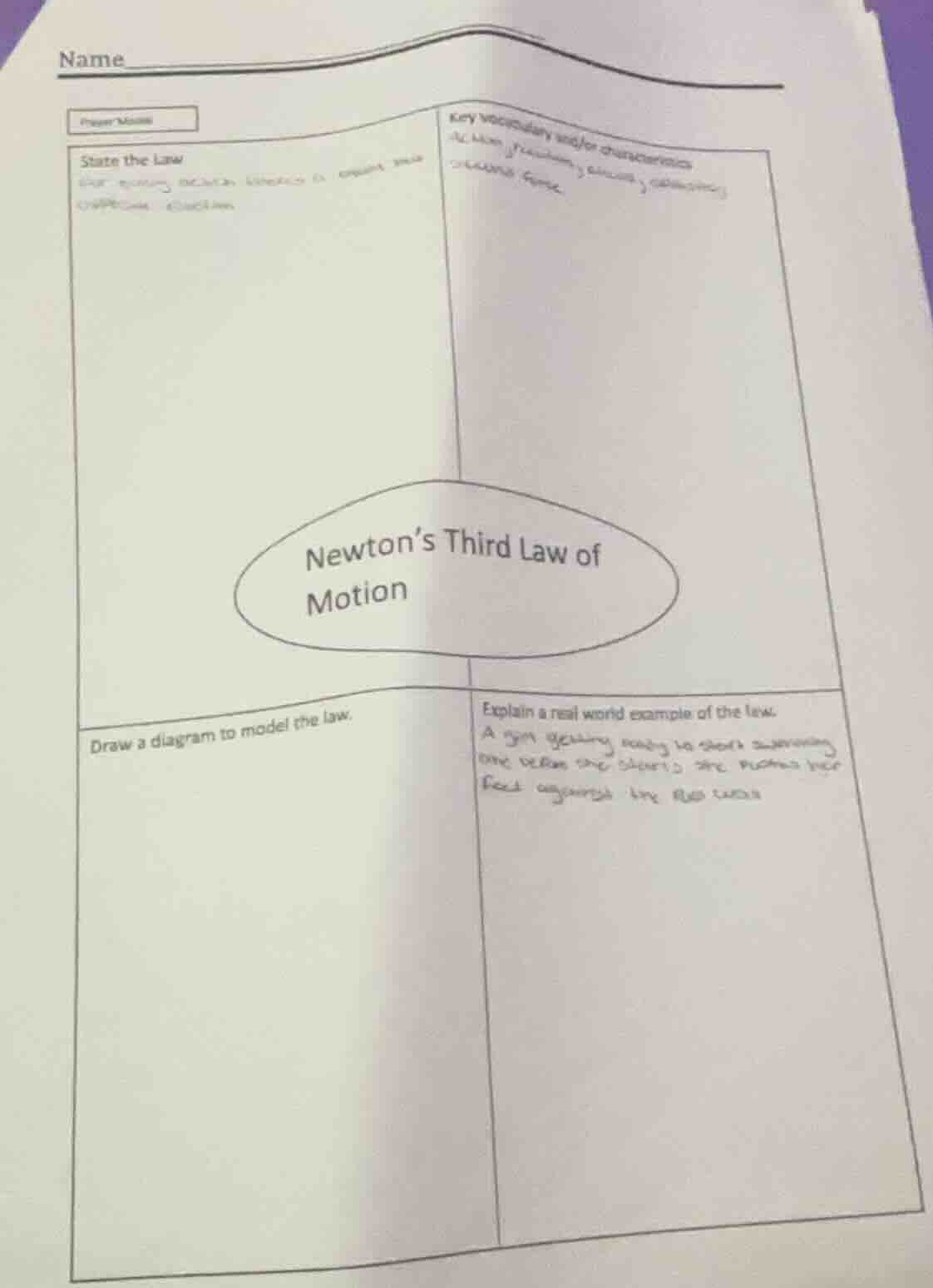
state the law
key vocabulary/major characteristics
newton’s third law of motion
draw a diagram to model the law.
explain a real world example of the law.
Brief Explanations
- State the law: Newton's Third Law of Motion is defined as a fundamental physics principle describing paired forces between interacting objects.
- Key vocabulary: The core terms describe the paired, equal-opposite forces in interactions.
- Diagram model: The diagram visualizes the equal-magnitude, opposite-direction forces between two interacting objects.
- Real-world example clarification: The example explains how the gun-bullet interaction directly demonstrates the law's paired forces.

Snap & solve any problem in the app
Get step-by-step solutions on Sovi AI
Photo-based solutions with guided steps
Explore more problems and detailed explanations
- State the law: For every action, there is an equal and opposite reaction. When object A exerts a force on object B, object B exerts an equal force in magnitude and opposite in direction on object A.
- Key vocabulary and/or characteristics:
- Action force: The force exerted by one object on another
- Reaction force: The force exerted back by the second object on the first, equal in magnitude, opposite in direction
- Interacting pairs: Forces always occur between two objects, never in isolation
- Diagram description (to model the law):
Draw two objects (e.g., a gun and a bullet) with labeled force vectors:
- A forward-pointing vector labeled $F_{bullet \to gun}$ (action force, force of gun on bullet)
- A backward-pointing vector of the same length labeled $F_{gun \to bullet}$ (reaction force, force of bullet on gun)
- Real world example clarification: When a gun fires a bullet, the gun exerts an action force that propels the bullet forward. At the exact same time, the bullet exerts an equal and opposite reaction force on the gun, causing the gun to recoil (kick backward). The forward force on the bullet and backward force on the gun are an action-reaction pair that follows Newton's Third Law.