QUESTION IMAGE
Question
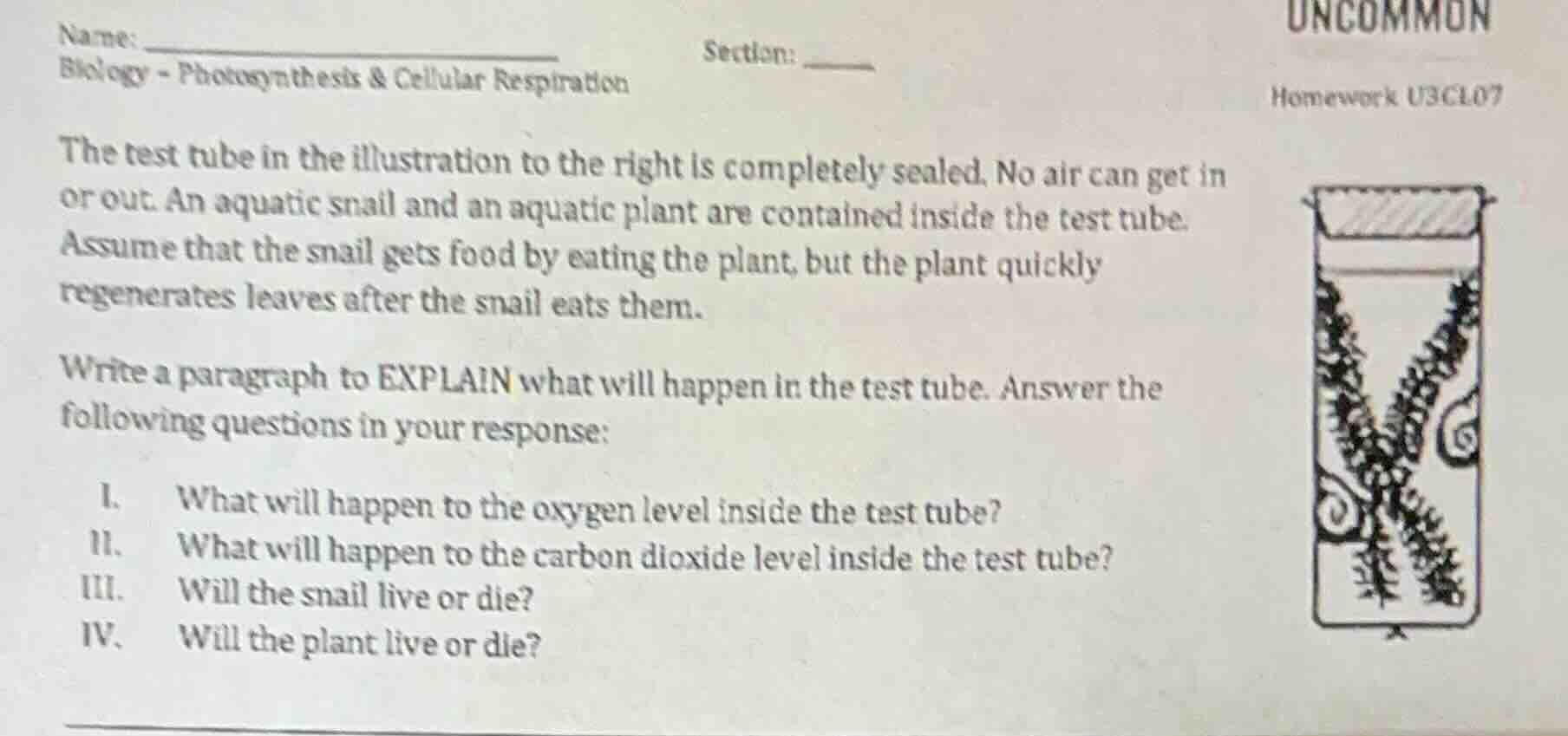
name: _________________________section: ____biology - photosynthesis & cellular respirationuncommonhomework u3cl07the test tube in the illustration to the right is completely sealed. no air can get in or out. an aquatic snail and an aquatic plant are contained inside the test tube. assume that the snail gets food by eating the plant, but the plant quickly regenerates leaves after the snail eats them.write a paragraph to explain what will happen in the test tube. answer the following questions in your response:i. what will happen to the oxygen level inside the test tube?ii. what will happen to the carbon dioxide level inside the test tube?iii. will the snail live or die?iv. will the plant live or die?
In this sealed test tube ecosystem, a cyclic exchange of gases and nutrients will occur between the snail and plant. The aquatic plant performs photosynthesis using carbon dioxide, water, and light to produce glucose (food) and oxygen, while the snail performs cellular respiration, using oxygen and glucose (from eating the plant) to produce carbon dioxide, water, and energy. Since the plant regenerates leaves after being eaten, it can continue photosynthesizing as long as there is light and carbon dioxide.
- The oxygen level will reach a stable, balanced state: the plant produces oxygen via photosynthesis, and the snail consumes oxygen via respiration, with no net long-term depletion or excess if light is consistent.
- The carbon dioxide level will also stabilize: the snail releases carbon dioxide through respiration, which the plant uses for photosynthesis, creating a closed, cyclic supply.
- The snail will live, as it has a continuous food source from the regenerating plant, and a steady supply of oxygen from the plant's photosynthesis to support its respiration.
- The plant will live, as it receives carbon dioxide from the snail's respiration to fuel photosynthesis, and while the snail eats its leaves, the plant can regenerate them to sustain growth and function.

Snap & solve any problem in the app
Get step-by-step solutions on Sovi AI
Photo-based solutions with guided steps
Explore more problems and detailed explanations
In this sealed test tube, a balanced, sustainable cycle will form between the snail and the aquatic plant. I. The oxygen level will stabilize at a consistent, livable level: the plant produces oxygen during photosynthesis, which the snail uses for cellular respiration, creating a continuous, cyclical exchange with no net long-term loss or overaccumulation (assuming consistent light access). II. The carbon dioxide level will also reach a stable balance: the snail releases carbon dioxide as a waste product of respiration, which the plant immediately uses as a key input for photosynthesis, preventing a buildup or depletion of the gas. III. The snail will live: it has an ongoing food source from the plant's regenerating leaves, and a steady supply of oxygen from the plant's photosynthesis to support its energy needs via respiration. IV. The plant will live: it obtains the carbon dioxide it needs for photosynthesis from the snail's respiration, and its ability to regenerate leaves means the snail's feeding does not prevent it from continuing to grow and carry out essential metabolic processes.