QUESTION IMAGE
Question
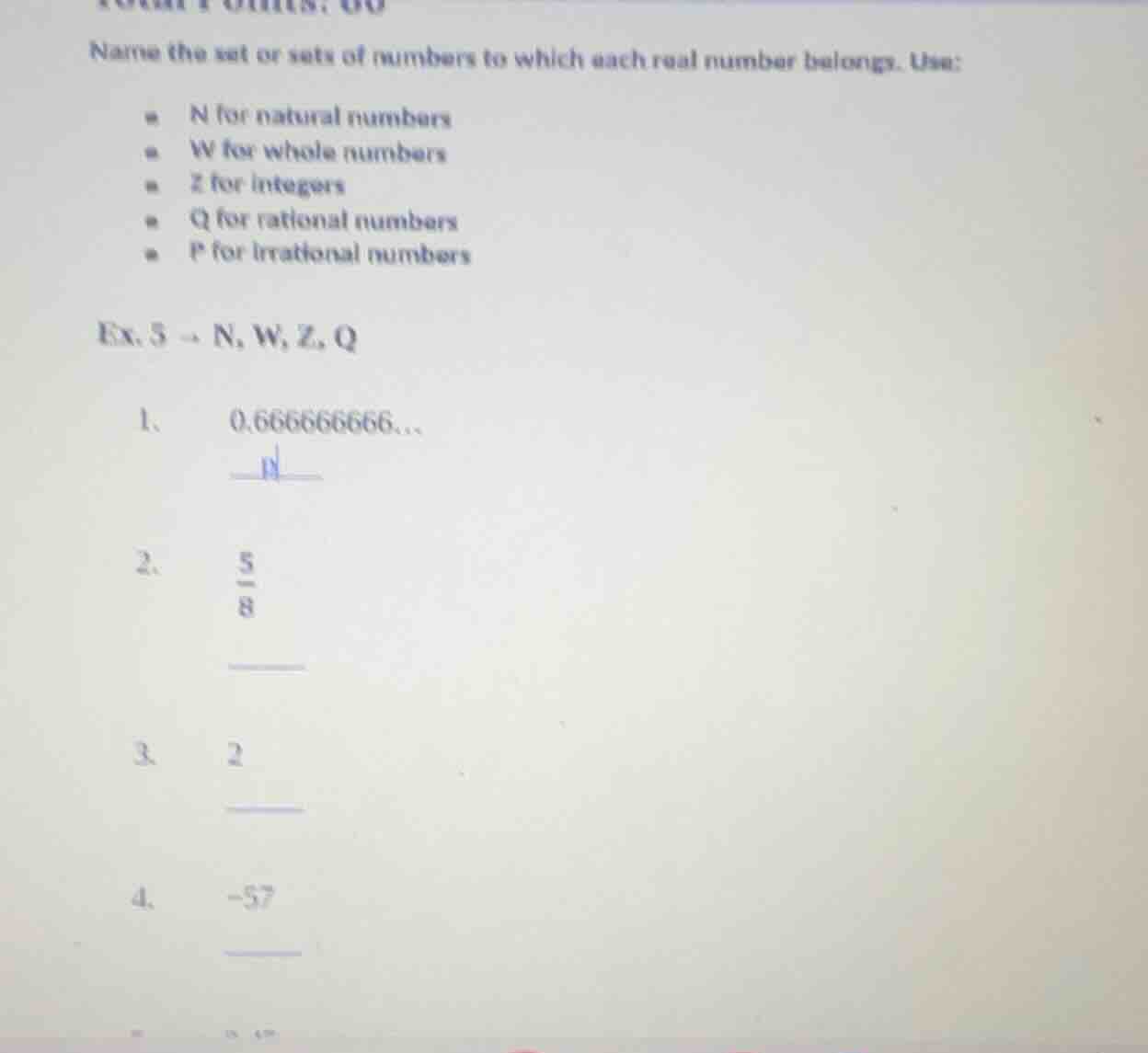
name the set or sets of numbers to which each real number belongs. use:
- n for natural numbers
- w for whole numbers
- z for integers
- q for rational numbers
- p for irrational numbers
ex. 3 → n, w, z, q
- 0.66666666...
- \\(\frac{5}{8}\\)
- 2
- -57
Problem 1: \(0.66666666\ldots\)
Step 1: Recall number set definitions
Natural numbers (\(N\)): positive integers (1, 2, 3, ...). Whole numbers (\(W\)): non - negative integers (0, 1, 2, ...). Integers (\(Z\)): positive/negative whole numbers and 0. Rational numbers (\(Q\)): numbers that can be expressed as \(\frac{a}{b}\) (\(b
eq0\), \(a,b\in Z\)). Irrational numbers (\(P\)): non - repeating, non - terminating decimals, cannot be expressed as \(\frac{a}{b}\).
The number \(0.66666666\ldots=\frac{2}{3}\) (since \(0.\overline{6}=\frac{2}{3}\)), so it can be written as a fraction of two integers. It is not a natural number (not a positive integer starting from 1 in the natural number sense here, as it's a non - integer decimal), not a whole number (not a non - negative integer), not an integer (not a whole number or its negative). But it is a rational number.
Step 2: Determine the set
Since \(0.66666666\ldots=\frac{2}{3}\), it belongs to the set of rational numbers (\(Q\)). It does not belong to \(N\) (not a positive integer), \(W\) (not a non - negative integer), \(Z\) (not an integer), or \(P\) (it is a repeating decimal, hence rational).
Step 1: Recall number set definitions
As before, rational numbers (\(Q\)) are numbers that can be written as \(\frac{a}{b}\) with \(b
eq0\) and \(a,b\in Z\). \(\frac{5}{8}\) is in the form \(\frac{a}{b}\) where \(a = 5\), \(b = 8\), both are integers and \(b
eq0\).
It is not a natural number (not a positive integer), not a whole number (not a non - negative integer), not an integer (not a whole number or its negative), and not an irrational number (since it can be expressed as a fraction of two integers).
Step 2: Determine the set
Since \(\frac{5}{8}\) can be expressed as a fraction of two integers, it belongs to the set of rational numbers (\(Q\)).
Step 1: Recall number set definitions
Natural numbers (\(N\)): positive integers (1, 2, 3, ...). Whole numbers (\(W\)): non - negative integers (0, 1, 2, ...). Integers (\(Z\)): positive/negative whole numbers and 0. Rational numbers (\(Q\)): numbers that can be expressed as \(\frac{a}{b}\) (\(b
eq0\), \(a,b\in Z\)).
The number \(2\) is a positive integer, so it is a natural number (\(N\)), a whole number (\(W\)) (since it is a non - negative integer), an integer (\(Z\)) (since it is a whole number), and it can be written as \(\frac{2}{1}\), so it is also a rational number (\(Q\)). It is not an irrational number (\(P\)) because it is a rational number.
Step 2: Determine the set
\(2\) belongs to \(N\) (positive integer), \(W\) (non - negative integer), \(Z\) (integer), and \(Q\) (can be written as \(\frac{2}{1}\)).

Snap & solve any problem in the app
Get step-by-step solutions on Sovi AI
Photo-based solutions with guided steps
Explore more problems and detailed explanations
\(Q\)