QUESTION IMAGE
Question
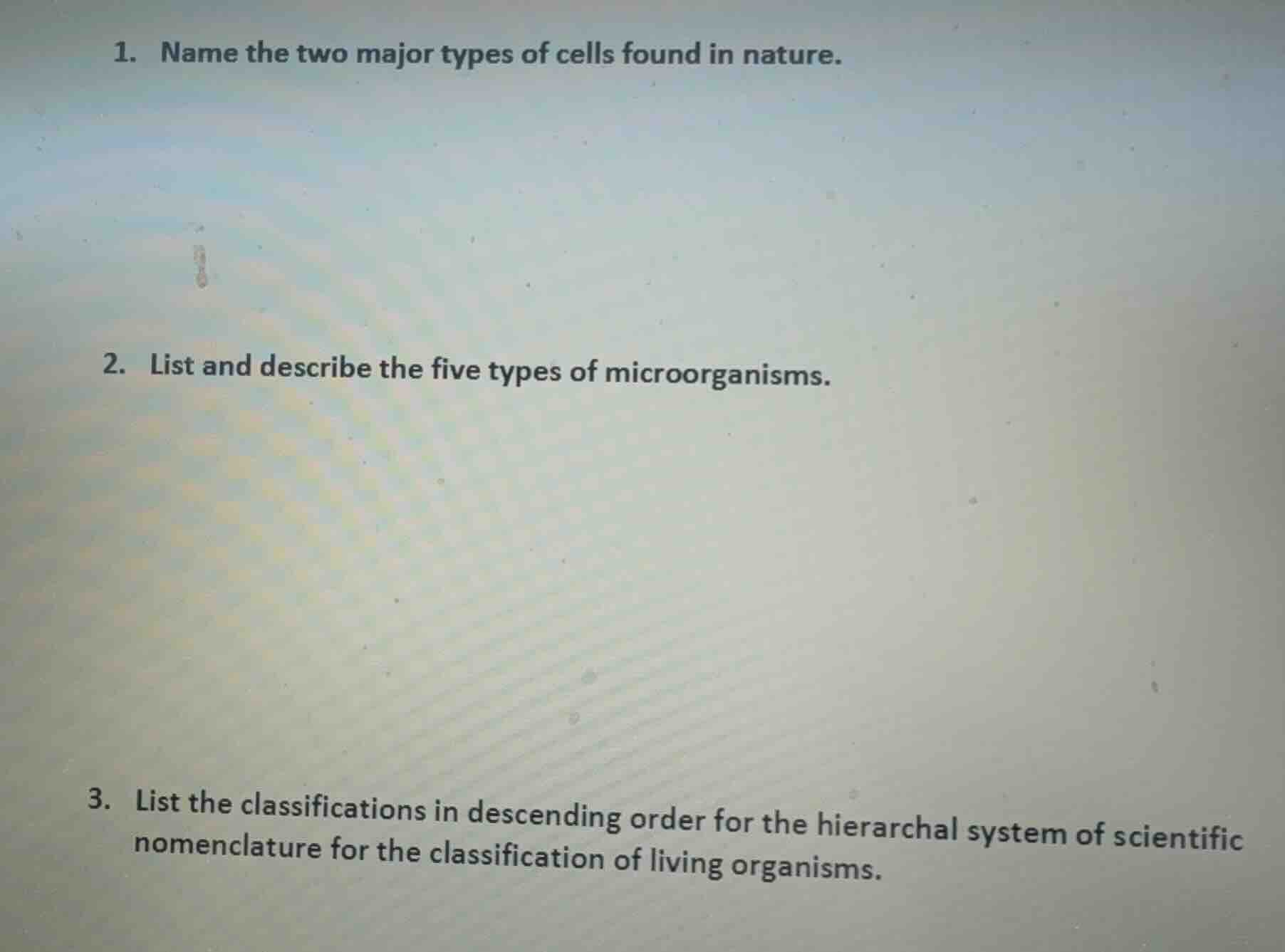
- name the two major types of cells found in nature.
- list and describe the five types of microorganisms.
- list the classifications in descending order for the hierarchal system of scientific nomenclature for the classification of living organisms.
Brief Explanations
- For the first question, cells are categorized based on the presence/absence of a membrane-bound nucleus.
- For the second question, the five main types of microorganisms are defined by their cellular structure, reproduction, and habitat traits.
- For the third question, the taxonomic hierarchy follows a standardized descending order of broad to specific groups.

Snap & solve any problem in the app
Get step-by-step solutions on Sovi AI
Photo-based solutions with guided steps
Explore more problems and detailed explanations
- The two major types of cells are:
- Prokaryotic cells: Lack a membrane-bound nucleus and organelles.
- Eukaryotic cells: Have a membrane-bound nucleus and organelles.
- The five types of microorganisms are:
- Bacteria: Unicellular prokaryotes, with cell walls made of peptidoglycan; reproduce asexually via binary fission.
- Viruses: Acellular particles, consisting of genetic material (DNA/RNA) enclosed in a protein coat; require a host cell to replicate.
- Fungi: Eukaryotic organisms, including yeasts (unicellular) and molds (multicellular); absorb nutrients from organic matter.
- Protozoa: Unicellular eukaryotes, often motile; obtain nutrients by ingesting other organisms or organic matter.
- Algae: Eukaryotic (mostly aquatic) organisms, perform photosynthesis to produce their own food; can be unicellular or multicellular.
- The hierarchical system of scientific nomenclature in descending order is:
Kingdom, Phylum, Class, Order, Family, Genus, Species