QUESTION IMAGE
Question
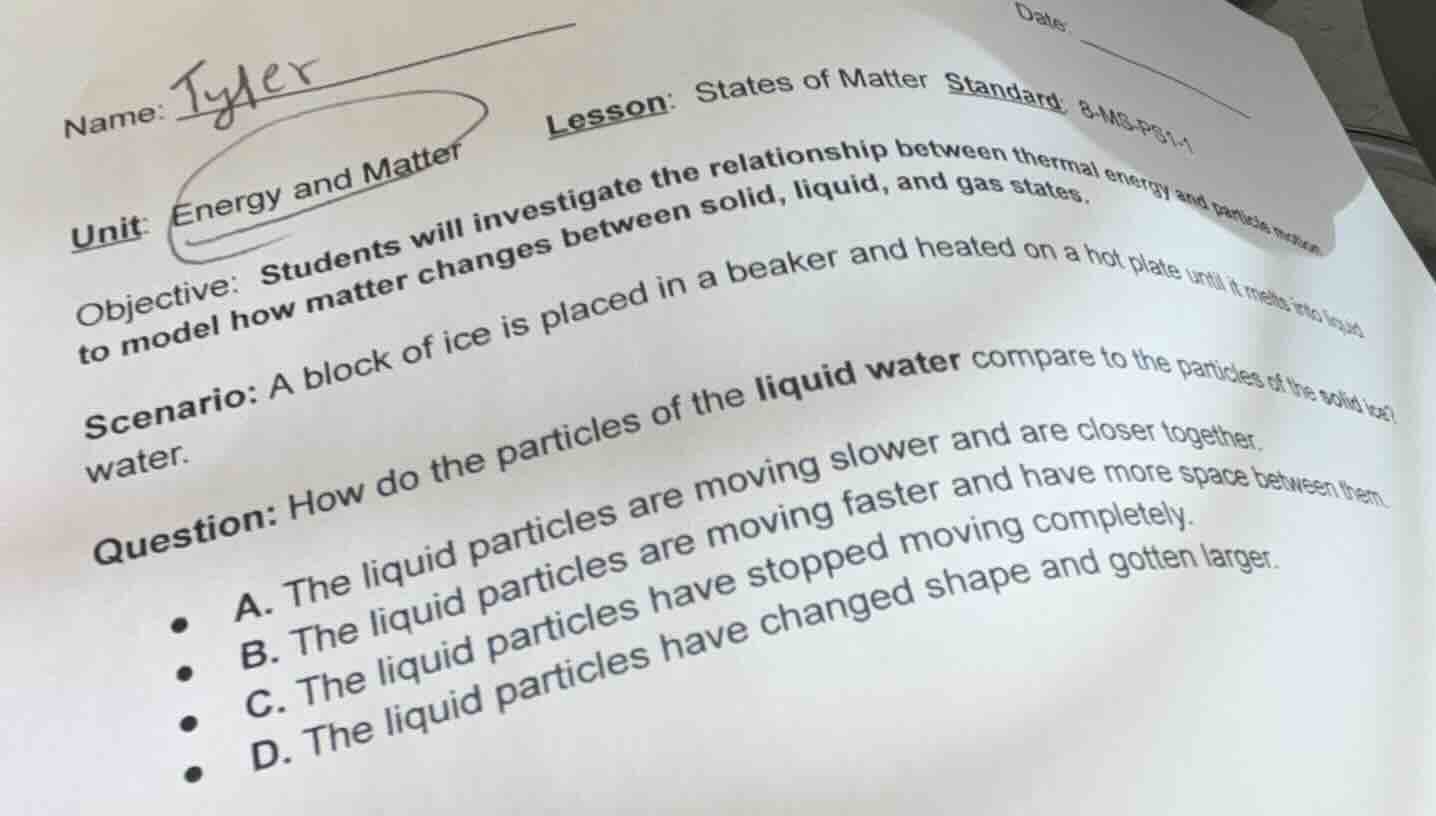
name: tyler
unit: energy and matter
lesson: states of matter standard: 8-ms-ps1-1
objective: students will investigate the relationship between thermal energy and particle motion to model how matter changes between solid, liquid, and gas states.
scenario: a block of ice is placed in a beaker and heated on a hot plate until it melts into liquid water.
question: how do the particles of the liquid water compare to the particles of the solid ice?
- a. the liquid particles are moving slower and are closer together.
- b. the liquid particles are moving faster and have more space between them.
- c. the liquid particles have stopped moving completely.
- d. the liquid particles have changed shape and gotten larger.
date:
When thermal energy is added to solid ice to melt it into liquid water, the thermal energy increases the kinetic energy of the particles. In solids, particles are tightly packed and vibrate in place; in liquids, particles have more kinetic energy, move faster, and have more space between them to flow. Option A is incorrect because liquid particles move faster, not slower. Option C is wrong because particles never stop moving completely (even in solids they vibrate). Option D is incorrect because the particles themselves do not change shape or size during a phase change, only their arrangement and movement change.

Snap & solve any problem in the app
Get step-by-step solutions on Sovi AI
Photo-based solutions with guided steps
Explore more problems and detailed explanations
B. The liquid particles are moving faster and have more space between them.