QUESTION IMAGE
Question
name:
types of bone cells - roles in bone tissue
instructions: the bone basics unit is full of many complicated processes involving the four types of bone cells you learned about. here are a few of those processes:
- endochondral ossification: how your bones form in the womb and early years
- bone remodeling: how your bones maintain themselves through daily wear and tear
- fracture repair: how your bones heal themselves after a fracture
the four types of bone cells are involved in each and every complicated process. in this activity today, you will be introduced to these complicated processes. your job is to determine which role each bone cell plays through the processes.
- what are the four types of bone cells?
- what is the matrix of bone called?
endochondral ossification
lets take a trip back in time... to when you were just a tiny embryo! when you were around 6 to 8 weeks post conception, you had no bones. none! your body was about to start a process known as endochondral ossification. ossification is the formation of bone. in endochondral ossification, your body created cartilage models for your bones... and then replaced those models with bone!
- before your skeleton was made of bone, what was it made of?
- at what age in the womb does endochondral ossification begin?
- think back to the anatomy of a long bone. what is the shaft of a long bone called?
- what are the ends of a long bone called?
- what does the latin word \peri\ mean?
- what does the latin word \chond\ mean?
- what does the latin word \os\ or \osteo\ mean?
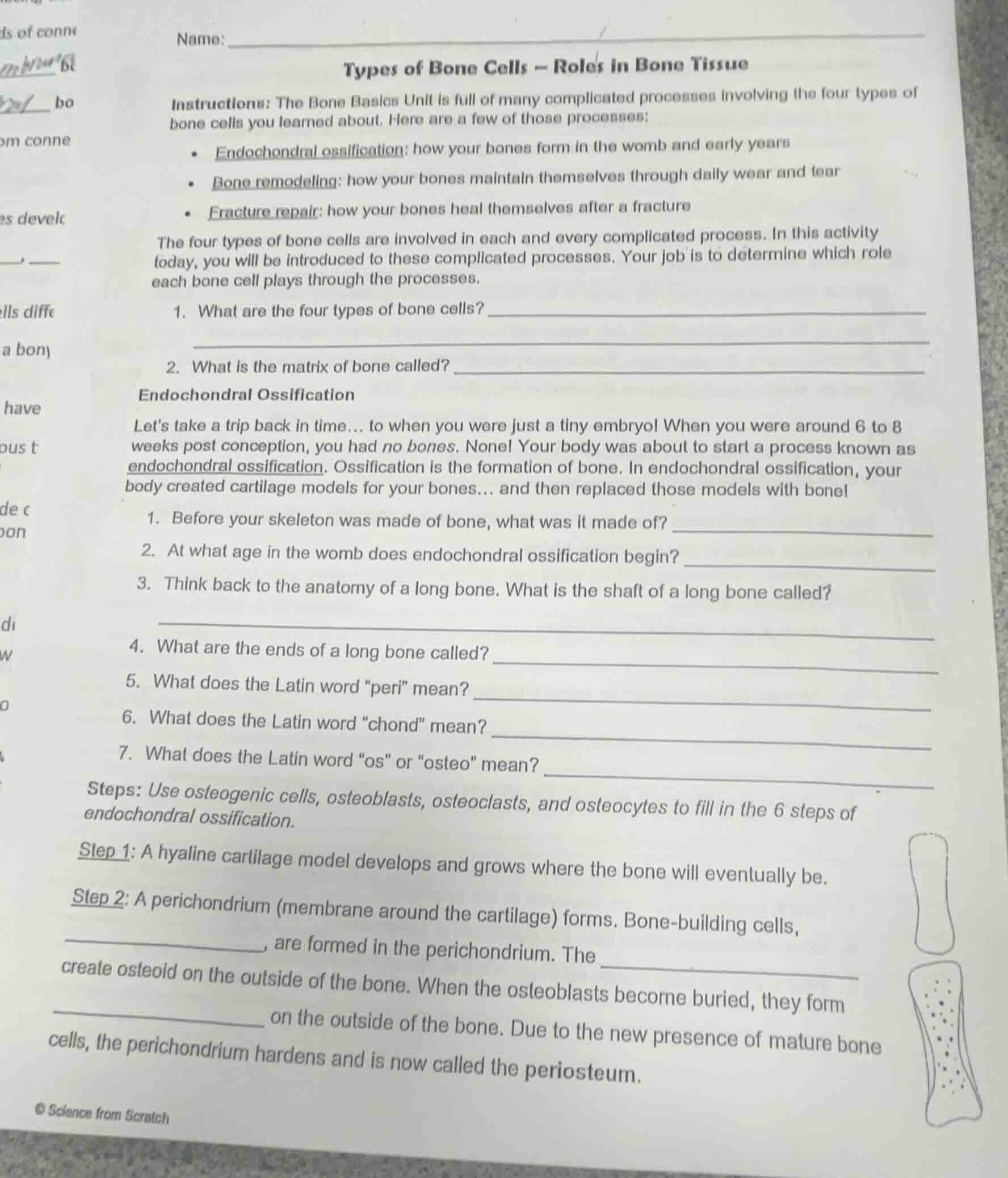
steps: use osteogenic cells, osteoblasts, osteoclasts, and osteocytes to fill in the 6 steps of endochondral ossification.
step 1: a hyaline cartilage model develops and grows where the bone will eventually be.
step 2: a perichondrium (membrane around the cartilage) forms. bone - building cells,
, are formed in the perichondrium. the
create osteoid on the outside of the bone. when the osteoblasts become buried, they form
on the outside of the bone. due to the new presence of mature bone cells, the perichondrium hardens and is now called the periosteum.
© science from scratch
All answers are derived from standard human skeletal system and bone development anatomy.
- The four primary bone cell types are defined by their roles in bone growth, maintenance, and repair.
- Bone matrix has a specific, widely recognized name.
- The pre-bone embryonic skeleton and timing of endochondral ossification are established developmental facts.
- Long bone anatomy terms (shaft, ends) are standard anatomical vocabulary.
- The Latin root definitions are standard etymological meanings used in medical/anatomical terminology.
- The cell roles in endochondral ossification align with each cell's core function: osteogenic cells are progenitor cells, osteoblasts build bone, and osteocytes are mature, embedded bone cells.

Snap & solve any problem in the app
Get step-by-step solutions on Sovi AI
Photo-based solutions with guided steps
Explore more problems and detailed explanations
Initial Questions
- Osteogenic cells, osteoblasts, osteocytes, osteoclasts
- Osteoid (or extracellular bone matrix)
Endochondral Ossification Section
- Hyaline cartilage
- 6 to 8 weeks post-conception
- Diaphysis
- Epiphyses
- Around, surrounding
- Cartilage
- Bone
Step 2 of Endochondral Ossification
- Bone-building cells, osteogenic cells, are formed in the perichondrium. The osteoblasts create osteoid on the outside of the bone. When the osteoblasts become buried, they form osteocytes on the outside of the bone.