QUESTION IMAGE
Question
name:
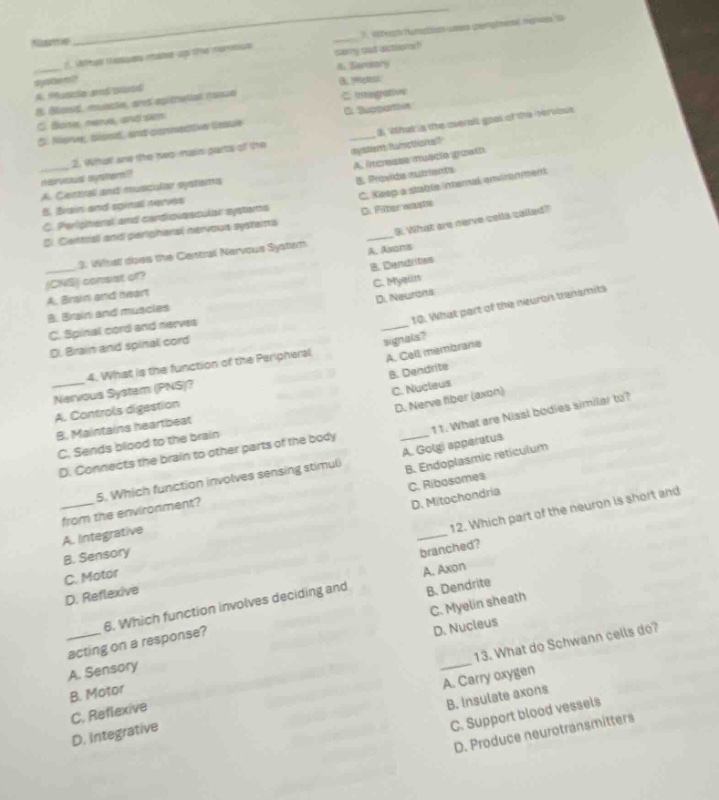
______ 1. what tissues make up the nervous system?
a. muscle and connective
b. blood, muscle, and epithelial tissue
c. bone, nerve, and skin
d. nerve, muscle, and connective tissue
______ 2. what are the two main parts of the nervous system?
a. central and muscular systems
b. brain and spinal nerves
c. peripheral and cardiovascular systems
d. central and peripheral nervous systems
______ 3. what does the central nervous system (cns) consist of?
a. brain and heart
b. brain and muscles
c. spinal cord and nerves
d. brain and spinal cord
______ 4. what is the function of the peripheral nervous system (pns)?
a. controls digestion
b. maintains heartbeat
c. sends blood to the brain
d. connects the brain to other parts of the body
______ 5. which function involves sensing stimuli from the environment?
a. integrative
b. sensory
c. motor
d. reflexive
______ 6. which function involves deciding and acting on a response?
a. sensory
b. motor
c. reflexive
d. integrative
______ 7. which function uses efferent nerves to carry out actions?
a. sensory
b. motor
c. integrative
d. digestive
______ 8. what is the overall goal of the nervous system functions?
a. increase muscle growth
b. provide nutrients
c. keep a stable internal environment
d. filter wastes
______ 9. what are nerve cells called?
a. axons
b. dendrites
c. myelin
d. neurons
______ 10. what part of the neuron transmits signals?
a. cell membrane
b. dendrite
c. nucleus
d. nerve fiber (axon)
______ 11. what are nissl bodies similar to?
a. golgi apparatus
b. endoplasmic reticulum
c. ribosomes
d. mitochondria
______ 12. which part of the neuron is short and branched?
a. axon
b. dendrite
c. myelin sheath
d. nucleus
______ 13. what do schwann cells do?
a. carry oxygen
b. insulate axons
c. support blood vessels
d. produce neurotransmitters
- The nervous system is composed of neural tissue, blood vessels, and connective tissue that supports neurons.
- The nervous system is structurally split into the central (CNS) and peripheral (PNS) divisions.
- The CNS is defined as consisting of the brain and spinal cord, the body's central processing structures.
- The PNS acts as a communication network, linking the CNS to all other body tissues and organs.
- Sensory functions of the nervous system involve detecting external and internal environmental stimuli.
- Integrative functions process sensory input to make decisions and formulate responses.
- Integrative functions are responsible for interpreting stimuli and coordinating appropriate actions.
- A core homeostatic role of the nervous system is maintaining a stable internal body environment.
- Nerve cells are the fundamental functional units of the nervous system, called neurons.
- Axons (nerve fibers) are specialized to transmit electrical signals away from the neuron cell body.
- Nissl bodies are clusters of rough endoplasmic reticulum and ribosomes, responsible for protein synthesis in neurons.
- Dendrites are the short, branched extensions of a neuron that receive incoming signals.
- Schwann cells are glial cells in the PNS that produce myelin to insulate and protect axons.

Snap & solve any problem in the app
Get step-by-step solutions on Sovi AI
Photo-based solutions with guided steps
Explore more problems and detailed explanations
- D. Nerve, blood, and connective tissue
- D. Central and peripheral nervous systems
- D. Brain and spinal cord
- D. Connects the brain to other parts of the body
- B. Sensory
- D. Integrative
- C. Integrative
- C. Keep a stable internal environment
- D. Neurons
- D. Nerve fiber (axon)
- C. Ribosomes
- B. Dendrite
- B. Insulate axons