QUESTION IMAGE
Question
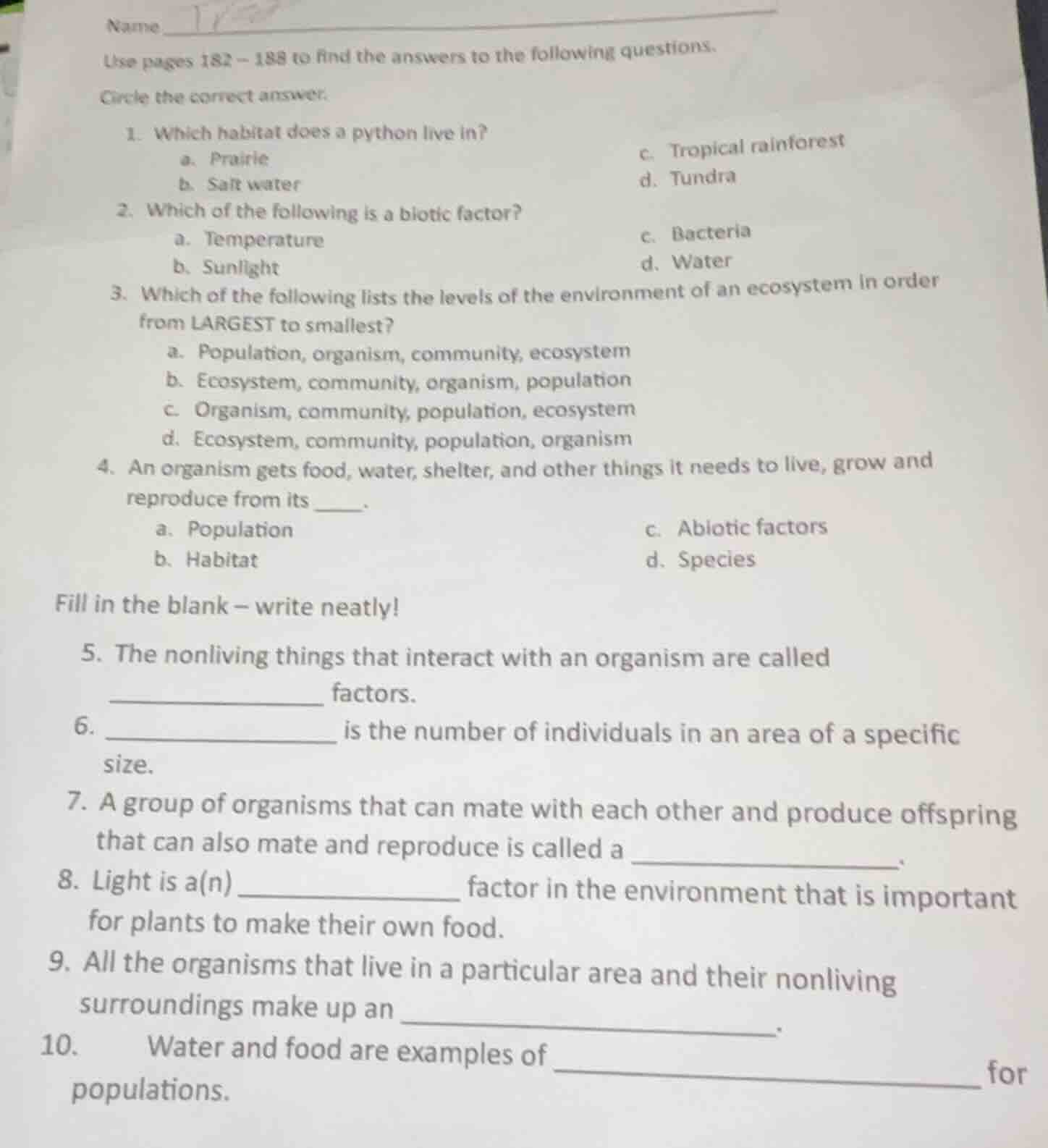
nameuse pages 182 - 188 to find the answers to the following questions.circle the correct answer.1. which habitat does a python live in?a. prairieb. salt waterc. tropical rainforestd. tundra2. which of the following is a biotic factor?a. temperatureb. sunlightc. bacteriad. water3. which of the following lists the levels of the environment of an ecosystem in order from largest to smallest?a. population, organism, community, ecosystemb. ecosystem, community, organism, populationc. organism, community, population, ecosystemd. ecosystem, community, population, organism4. an organism gets food, water, shelter, and other things it needs to live, grow and reproduce from its ____.a. populationb. habitatc. abiotic factorsd. speciesfill in the blank – write neatly!5. the nonliving things that interact with an organism are called ________ factors.6. ________ is the number of individuals in an area of a specific size.7. a group of organisms that can mate with each other and produce offspring that can also mate and reproduce is called a ________.8. light is a(n) ________ factor in the environment that is important for plants to make their own food.9. all the organisms that live in a particular area and their nonliving surroundings make up an ________.10. water and food are examples of __________ for populations.
- Pythons are native to warm, dense forest environments, so tropical rainforests are their habitat.
- Biotic factors are living components of an ecosystem; bacteria are living, while the others are non-living.
- Ecosystems are the broadest level, followed by communities (all organisms in an area), populations (same species group), then individual organisms.
- A habitat provides all resources an organism needs to survive and reproduce.
- Non-living components that interact with organisms are defined as abiotic factors.
- Population density refers to the count of individuals in a defined area.
- A species is a group of organisms that can interbreed to produce fertile offspring.
- Light is a non-living (abiotic) factor critical for photosynthesis in plants.
- An ecosystem includes all living organisms and their non-living environment in a specific area.
- Water and food are resources that support population survival and growth.

Snap & solve any problem in the app
Get step-by-step solutions on Sovi AI
Photo-based solutions with guided steps
Explore more problems and detailed explanations
- c. Tropical rainforest
- c. Bacteria
- d. Ecosystem, community, population, organism
- b. Habitat
- abiotic
- Population density
- species
- abiotic
- ecosystem
- resources