QUESTION IMAGE
Question
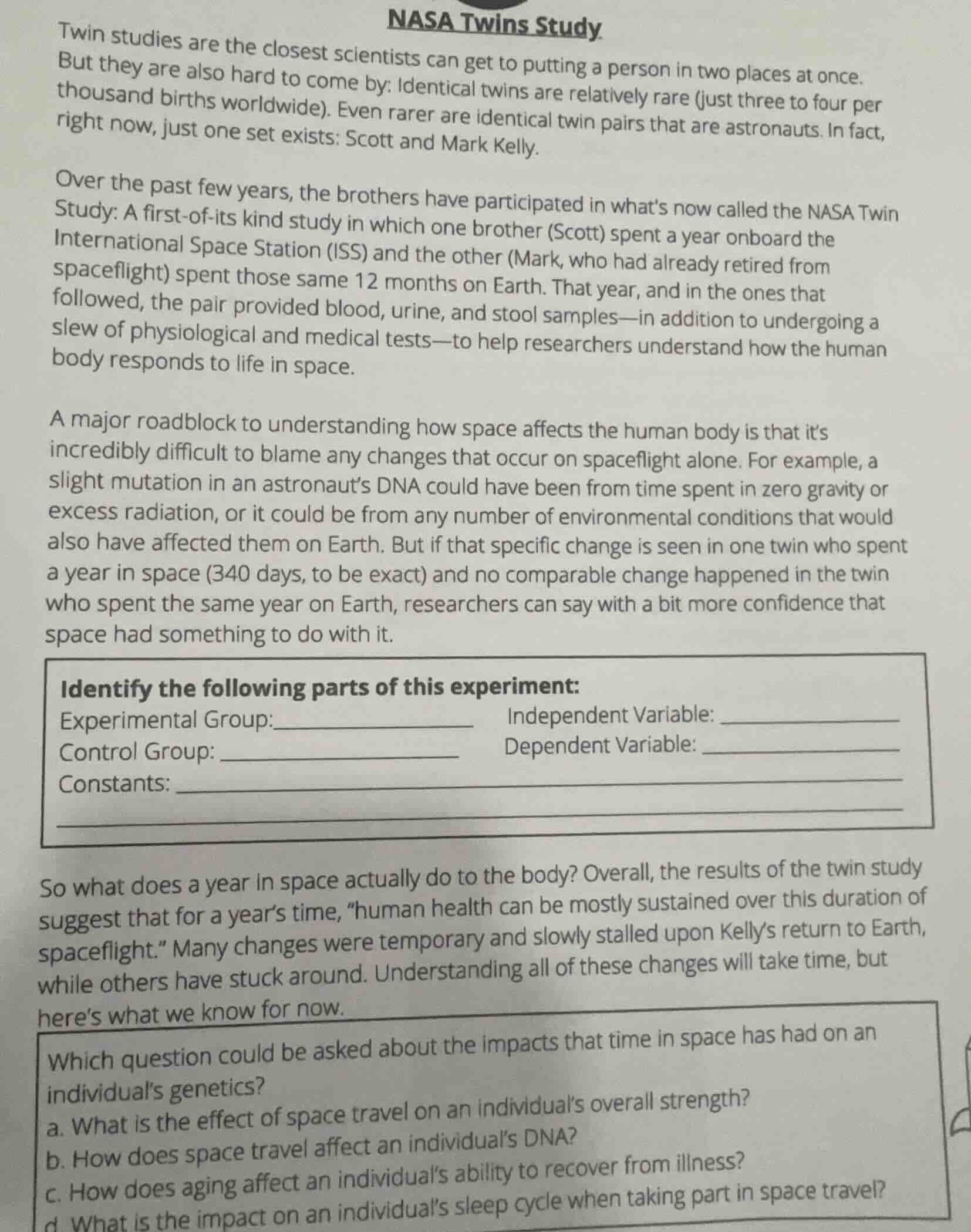
nasa twins study
twin studies are the closest scientists can get to putting a person in two places at once.
but they are also hard to come by: identical twins are relatively rare (just three to four per thousand births worldwide). even rarer are identical twin pairs that are astronauts. in fact, right now, just one set exists: scott and mark kelly.
over the past few years, the brothers have participated in whats now called the nasa twin study: a first - of - its kind study in which one brother (scott) spent a year onboard the international space station (iss) and the other (mark, who had already retired from spaceflight) spent those same 12 months on earth. that year, and in the ones that followed, the pair provided blood, urine, and stool samples—in addition to undergoing a slew of physiological and medical tests—to help researchers understand how the human body responds to life in space.
a major roadblock to understanding how space affects the human body is that its incredibly difficult to blame any changes that occur on spaceflight alone. for example, a slight mutation in an astronaut’s dna could have been from time spent in zero gravity or excess radiation, or it could be from any number of environmental conditions that would also have affected them on earth. but if that specific change is seen in one twin who spent a year in space (340 days, to be exact) and no comparable change happened in the twin who spent the same year on earth, researchers can say with a bit more confidence that space had something to do with it.
identify the following parts of this experiment:
experimental group: __________ independent variable: __________
control group: __________ dependent variable: __________
constants: ____________
so what does a year in space actually do to the body? overall, the results of the twin study suggest that for a year’s time, “human health can be mostly sustained over this duration of spaceflight.” many changes were temporary and slowly stalled upon kelly’s return to earth, while others have stuck around. understanding all of these changes will take time, but heres what we know for now.
which question could be asked about the impacts that time in space has had on an individual’s genetics?
a. what is the effect of space travel on an individual’s overall strength?
b. how does space travel affect an individual’s dna?
c. how does aging affect an individual’s ability to recover from illness?
d. what is the impact on an individual’s sleep cycle when taking part in space travel?
Step1: Identify experimental group
The experimental group is the subject exposed to the test condition (spaceflight).
Experimental Group: Scott Kelly (the twin who spent 340 days on the ISS)
Step2: Identify control group
The control group is the subject not exposed to the test condition, used for comparison.
Control Group: Mark Kelly (the twin who stayed on Earth for the same period)
Step3: Identify independent variable
The independent variable is the factor being tested/changed.
Independent Variable: Environment (spaceflight vs. Earth surface living conditions)
Step4: Identify dependent variable
The dependent variable is the factor measured to see change from the independent variable.
Dependent Variable: Physiological/medical changes in the human body (including genetic changes, blood/urine/stool sample metrics, and other test results)
Step5: Identify constants
Constants are factors kept the same for both groups.
Constants: Identical twin genetics, 12-month study duration, same types of medical/physiological tests and sample collections
Step6: Select genetics-focused question
Choose the option that directly addresses genetic impacts of space travel.
Correct option: b. How does space travel affect an individual's DNA?

Snap & solve any problem in the app
Get step-by-step solutions on Sovi AI
Photo-based solutions with guided steps
Explore more problems and detailed explanations
Experimental Group: Scott Kelly (twin who spent 340 days on the ISS)
Control Group: Mark Kelly (twin who stayed on Earth)
Independent Variable: Environment (space vs. Earth living conditions)
Dependent Variable: Physiological and medical changes in the human body (including genetic, blood/urine/stool, and test metrics)
Constants: Identical twin genetics, 12-month study length, identical testing/sample protocols
Multiple Choice Answer: b. How does space travel affect an individual's DNA?