QUESTION IMAGE
Question
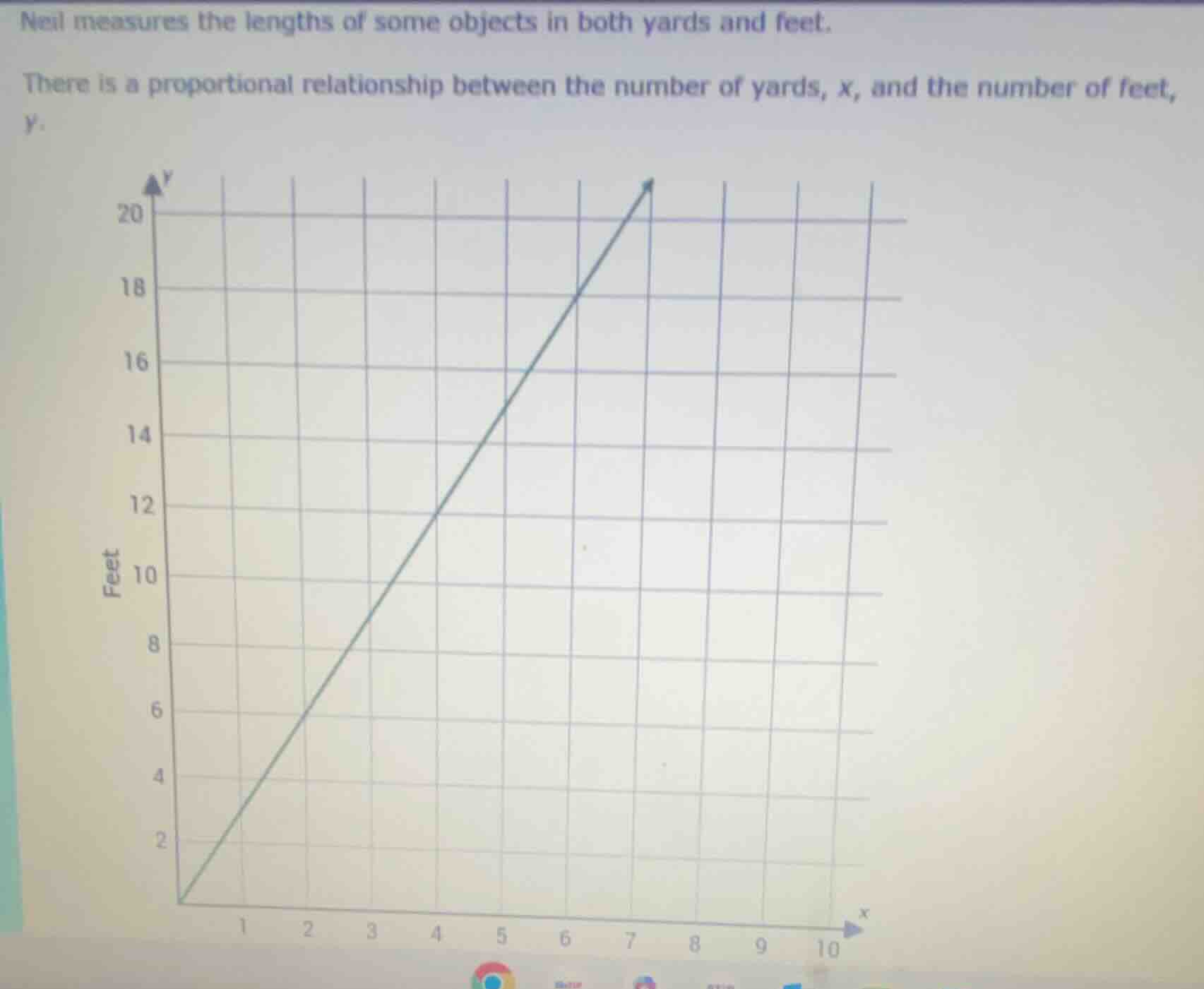
neil measures the lengths of some objects in both yards and feet. there is a proportional relationship between the number of yards, x, and the number of feet, y.
Since the problem is about a proportional relationship between yards and feet (a unit conversion and proportionality problem), we can assume we need to find the constant of proportionality (the number of feet per yard) or an equation. Let's find the slope (constant of proportionality) using the graph.
Step1: Identify two points on the line
From the graph, when \( x = 2 \) (yards), \( y = 6 \) (feet); when \( x = 4 \), \( y = 12 \).
Step2: Calculate the slope (constant of proportionality)
The formula for slope \( k \) is \( k=\frac{y_2 - y_1}{x_2 - x_1} \). Using \( (2,6) \) and \( (4,12) \):
\( k=\frac{12 - 6}{4 - 2}=\frac{6}{2} = 3 \)
So the equation is \( y = 3x \), meaning 1 yard = 3 feet (which is correct, as 1 yard = 3 feet).
If we needed to find, for example, how many feet in 7 yards, using \( y = 3x \), when \( x = 7 \), \( y = 3\times7 = 21 \) (which matches the graph's point at \( x = 7 \), \( y = 21 \)).

Snap & solve any problem in the app
Get step-by-step solutions on Sovi AI
Photo-based solutions with guided steps
Explore more problems and detailed explanations
The constant of proportionality is 3 (feet per yard), and the equation is \( y = 3x \). (If a specific question was, e.g., "How many feet are in 5 yards?", the answer would be \( 3\times5 = 15 \) feet.)