QUESTION IMAGE
Question
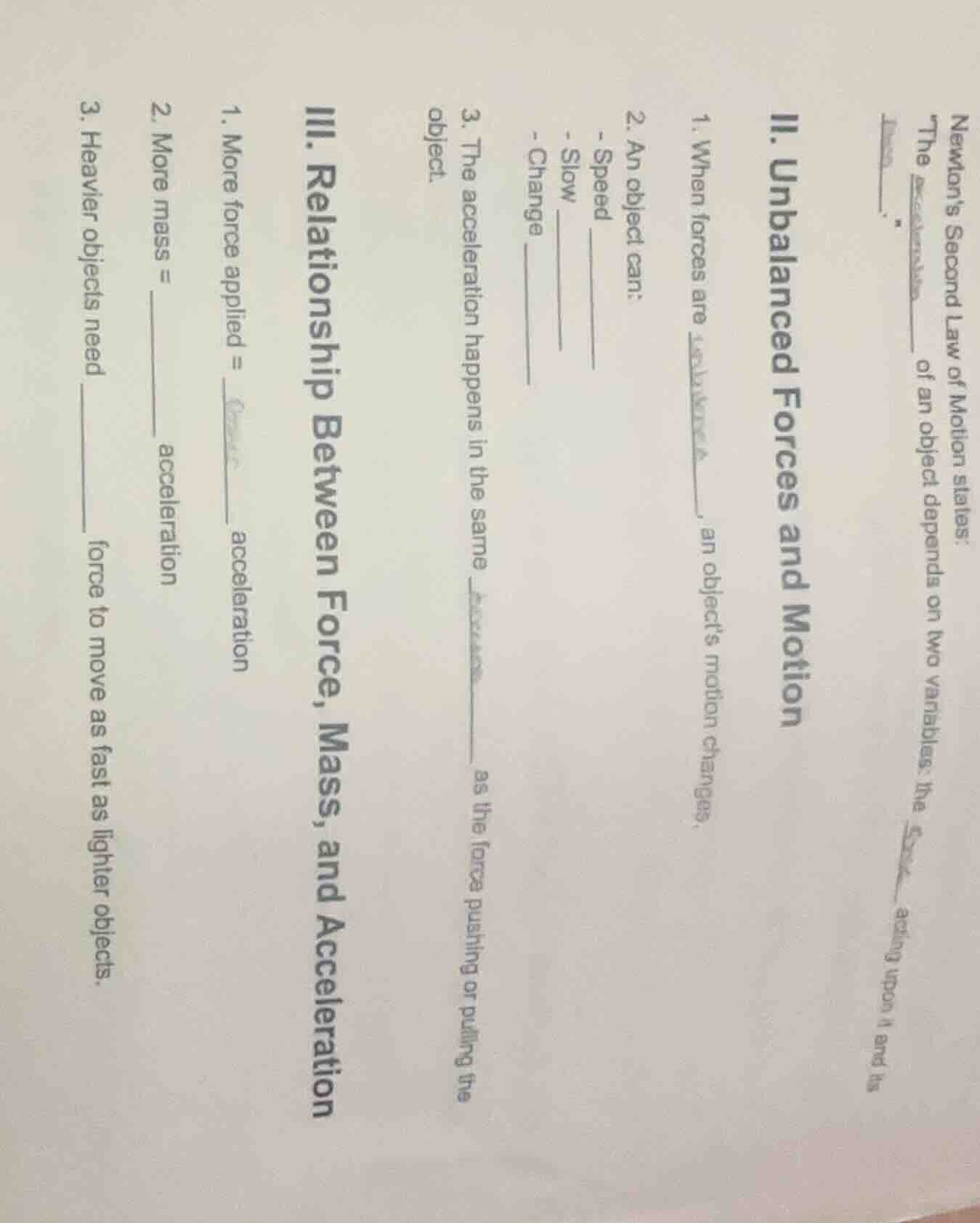
newton’s second law of motion states: the ______ of an object depends on two variables: the ____ acting upon it and its ___.
ii. unbalanced forces and motion
- when forces are ________, an object’s motion changes.
- an object can:
- speed ________
- slow ________
- change ________
- the acceleration happens in the same ________ as the force pushing or pulling the object.
iii. relationship between force, mass, and acceleration
- more force applied = ________ acceleration
- more mass = ________ acceleration
- heavier objects need ________ force to move as fast as lighter objects.
Step1: Fill Newton's 2nd Law blanks
Newton's Second Law states: "The acceleration of an object depends on two variables: the net force acting upon it and its mass."
Step2: Fill Unbalanced Forces blanks
- When forces are unbalanced, an object's motion changes.
- An object can:
- Speed up
- Slow down
- Change direction
- The acceleration happens in the same direction as the force pushing or pulling the object.
Step3: Fill Force-Mass-Acceleration blanks
- More force applied = greater acceleration
- More mass = less acceleration
- Heavier objects need more force to move as fast as lighter objects.

Snap & solve any problem in the app
Get step-by-step solutions on Sovi AI
Photo-based solutions with guided steps
Explore more problems and detailed explanations
Newton's Second Law of Motion:
The acceleration of an object depends on two variables: the net force acting upon it and its mass.
II. Unbalanced Forces and Motion
- When forces are unbalanced, an object's motion changes.
- An object can:
- Speed up
- Slow down
- Change direction
- The acceleration happens in the same direction as the force pushing or pulling the object.
III. Relationship Between Force, Mass, and Acceleration
- More force applied = greater acceleration
- More mass = less acceleration
- Heavier objects need more force to move as fast as lighter objects.