QUESTION IMAGE
Question
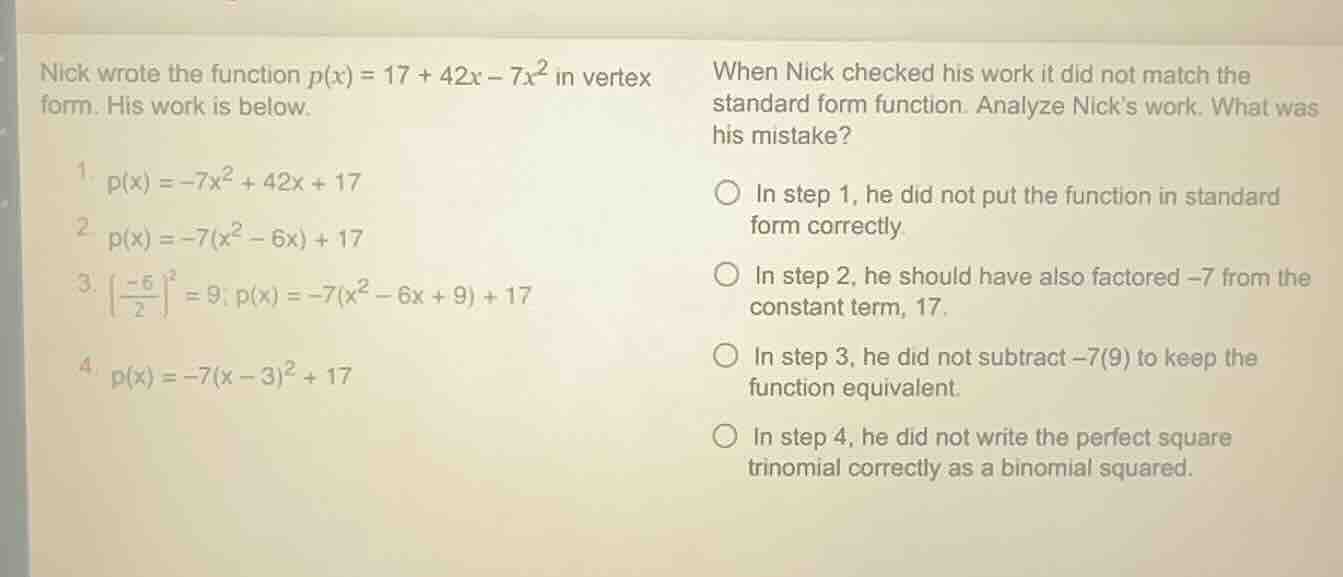
nick wrote the function $p(x) = 17 + 42x - 7x^2$ in vertex form. his work is below.
- $p(x) = -7x^2 + 42x + 17$
- $p(x) = -7(x^2 - 6x) + 17$
- $\left(\frac{-6}{2}\
ight)^2 = 9$; $p(x) = -7(x^2 - 6x + 9) + 17$
- $p(x) = -7(x - 3)^2 + 17$
when nick checked his work it did not match the standard form function. analyze nicks work. what was his mistake?
\bigcirc in step 1, he did not put the function in standard form correctly.
\bigcirc in step 2, he should have also factored $-7$ from the constant term, $17$.
\bigcirc in step 3, he did not subtract $-7(9)$ to keep the function equivalent.
\bigcirc in step 4, he did not write the perfect square trinomial correctly as a binomial squared.
To convert a quadratic function to vertex form, we complete the square. When we add a constant inside the parentheses (after factoring out the coefficient of \(x^2\)), we must also adjust the outside constant to maintain the function's equivalence. In step 3, Nick added \(9\) inside the parentheses (which is multiplied by \(-7\) from the factoring). So, he should have subtracted \(-7\times9\) (or added \(7\times9\)) to the outside constant \(17\) to keep the function equal. He didn't do this, which is the mistake.
- Step 1: The function is in standard form (\(ax^2 + bx + c\)) correctly as \( -7x^2 + 42x + 17\).
- Step 2: Factoring \(-7\) from the first two terms is correct; the constant term \(17\) is not factored with \(-7\) in this step (factoring is for the variable terms).
- Step 4: The perfect square trinomial \(x^2 - 6x + 9\) is correctly written as \((x - 3)^2\).

Snap & solve any problem in the app
Get step-by-step solutions on Sovi AI
Photo-based solutions with guided steps
Explore more problems and detailed explanations
In step 3, he did not subtract \(-7(9)\) to keep the function equivalent.