QUESTION IMAGE
Question
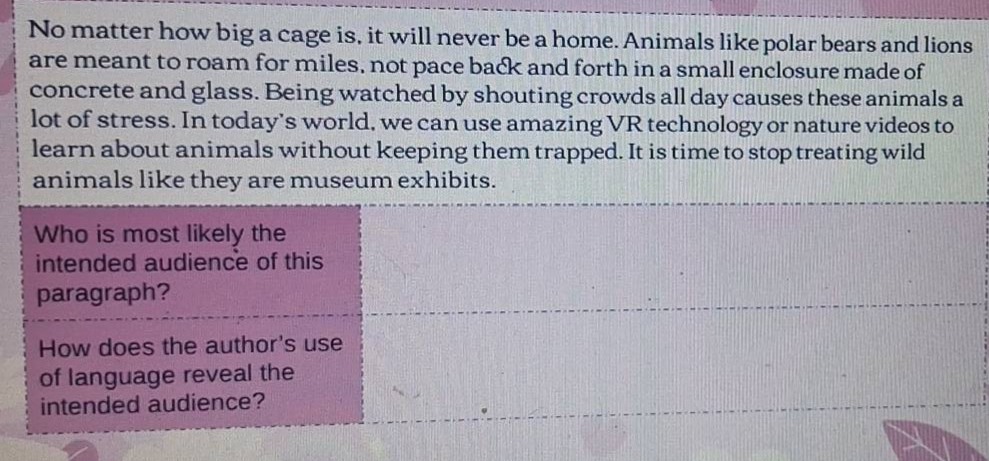
no matter how big a cage is, it will never be a home. animals like polar bears and lions are meant to roam for miles, not pace back and forth in a small enclosure made of concrete and glass. being watched by shouting crowds all day causes these animals a lot of stress. in todays world, we can use amazing vr technology or nature videos to learn about animals without keeping them trapped. it is time to stop treating wild animals like they are museum exhibits.
who is most likely the intended audience of this paragraph?
how does the author’s use of language reveal the intended audience?
Sub - question 1: Who is most likely the intended audience of this paragraph?
The paragraph talks about the unethical treatment of wild animals in enclosures and suggests using VR or nature videos instead. It has a persuasive tone to make people rethink their views on keeping wild animals in captivity. The general public, including zoo - goers or people interested in animal welfare, are likely the intended audience as the language is accessible and aims to raise awareness among a broad group. Also, it could be students or individuals who visit places with caged wild animals, as the message is about changing the way we interact with and view these animals.
The author uses simple, accessible language (e.g., “No matter how big a cage is, it will never be a home”, “pace back and forth in a small enclosure”) that is easy for a general audience to understand. The use of relatable examples (polar bears, lions) and a persuasive tone (e.g., “It is time to stop...”) shows that the author wants to reach a broad audience, not a specialized or academic - only group. The language is emotive (e.g., “causes these animals a lot of stress”) to appeal to the empathy of the general public, indicating the audience is people who can be emotionally moved to change their behavior or views about wild animals in captivity.

Snap & solve any problem in the app
Get step-by-step solutions on Sovi AI
Photo-based solutions with guided steps
Explore more problems and detailed explanations
The intended audience is likely the general public (including zoo - goers, people interested in animal welfare, or students) who may visit places with caged wild animals and can be influenced to change their views on keeping wild animals in captivity.