QUESTION IMAGE
Question
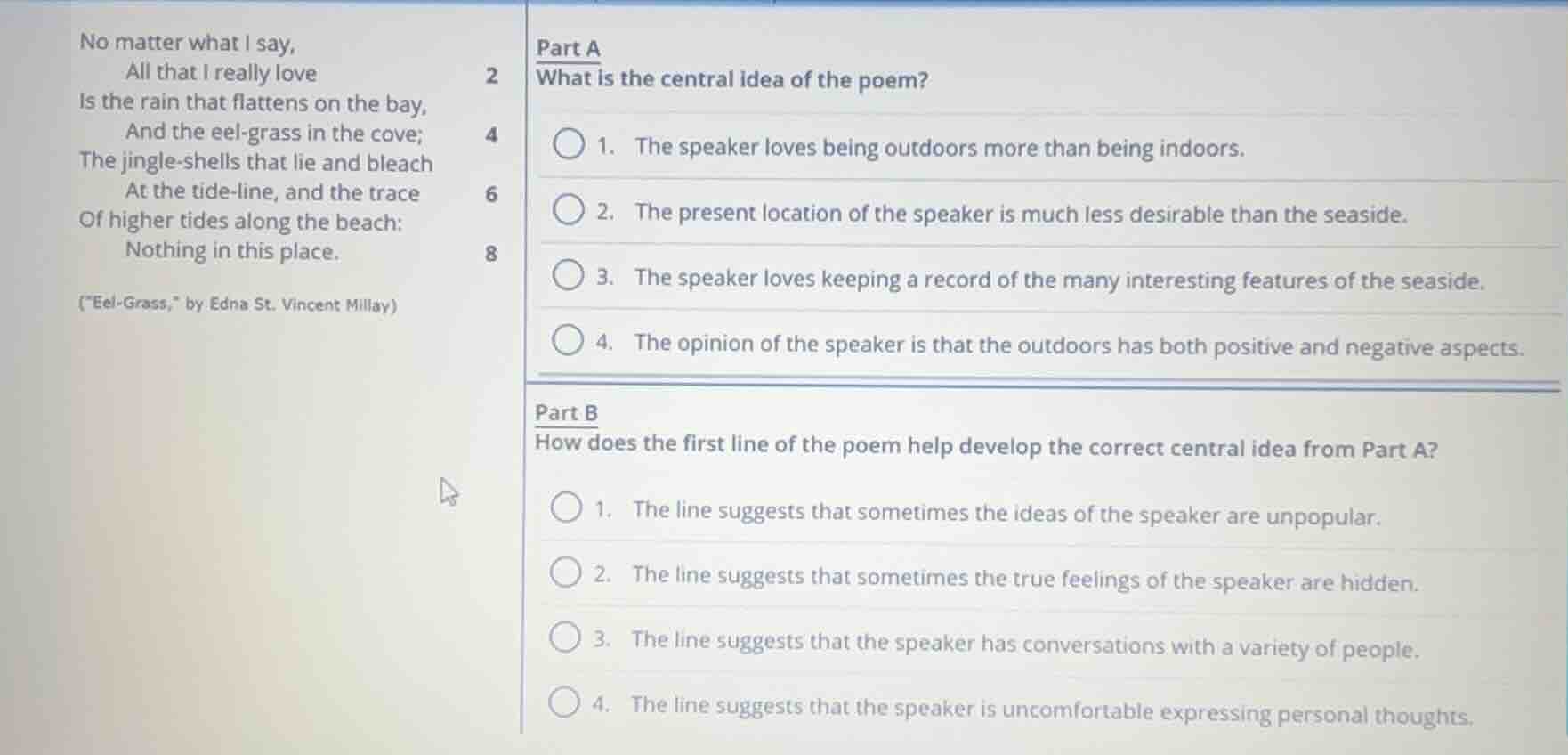
no matter what i say,
all that i really love
is the rain that flattens on the bay,
and the eel-grass in the cove;
the jingle-shells that lie and bleach
at the tide-line, and the trace
of higher tides along the beach:
nothing in this place.
(\eel-grass,\ by edna st. vincent millay)
part a
what is the central idea of the poem?
- the speaker loves being outdoors more than being indoors.
- the present location of the speaker is much less desirable than the seaside.
- the speaker loves keeping a record of the many interesting features of the seaside.
- the opinion of the speaker is that the outdoors has both positive and negative aspects.
part b
how does the first line of the poem help develop the correct central idea from part a?
- the line suggests that sometimes the ideas of the speaker are unpopular.
- the line suggests that sometimes the true feelings of the speaker are hidden.
- the line suggests that the speaker has conversations with a variety of people.
- the line suggests that the speaker is uncomfortable expressing personal thoughts.
For Part A: The poem contrasts the speaker's deep affection for specific seaside elements (rain on the bay, eel-grass, jingle-shells) with their dismissal of their current place ("Nothing in this place"). This shows the seaside is far more desirable than where they are now.
For Part B: The first line "No matter what I say" implies the speaker may state other things, but their true love is for the seaside, meaning their real feelings are not what they might outwardly express.

Snap & solve any problem in the app
Get step-by-step solutions on Sovi AI
Photo-based solutions with guided steps
Explore more problems and detailed explanations
Part A: 2. The present location of the speaker is much less desirable than the seaside.
Part B: 2. The line suggests that sometimes the true feelings of the speaker are hidden.