QUESTION IMAGE
Question
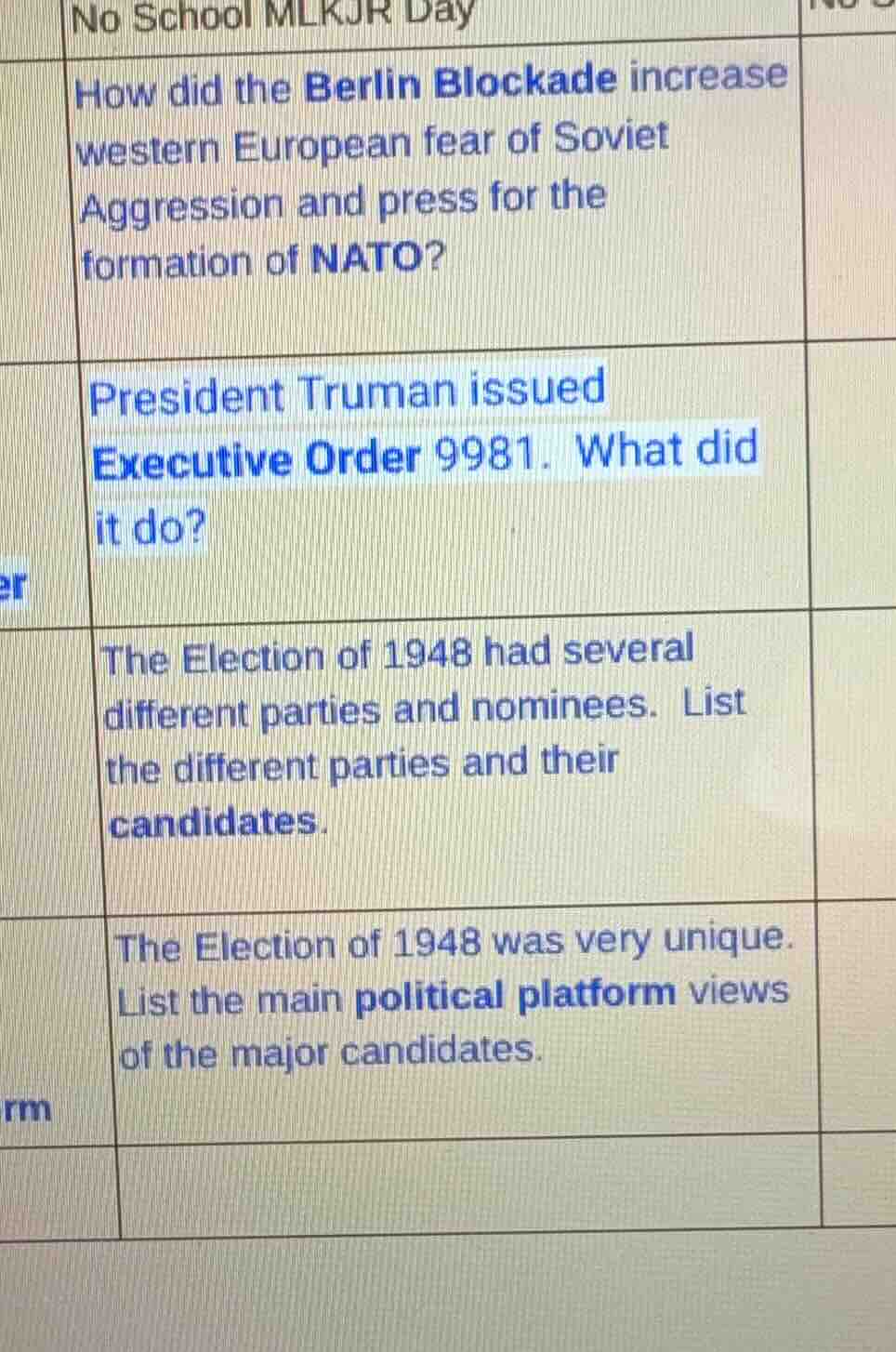
no school mlkjr day
how did the berlin blockade increase western european fear of soviet aggression and press for the formation of nato?
president truman issued executive order 9981. what did it do?
the election of 1948 had several different parties and nominees. list the different parties and their candidates.
the election of 1948 was very unique. list the main political platform views of the major candidates.
Brief Explanations
- For the Berlin Blockade question: The 1948-1949 Soviet blockade cut off West Berlin's supplies, showing Soviet willingness to use coercion against Western-aligned areas. This convinced Western Europe the Soviets might expand aggressively, pushing them to seek collective defense via NATO (founded 1949).
- For Executive Order 9981: This 1948 order desegregated the U.S. armed forces, ending racial segregation in military units and facilities.
- For 1948 Election parties/candidates:
- Democratic Party: Harry S. Truman
- Republican Party: Thomas E. Dewey
- States' Rights Democratic (Dixiecrat) Party: Strom Thurmond
- Progressive Party: Henry A. Wallace
- For 1948 Election platforms:
- Truman (Democrat): Supported civil rights, expanding New Deal programs, and a tough stance against Soviet expansion.
- Dewey (Republican): Focused on fiscal conservatism, reducing government spending, and a moderate anti-Soviet policy.
- Thurmond (Dixiecrat): Opposed civil rights, defended racial segregation and states' rights on racial issues.
- Wallace (Progressive): Advocated for cooperation with the Soviet Union, ending the Cold War, and expanding social welfare programs.

Snap & solve any problem in the app
Get step-by-step solutions on Sovi AI
Photo-based solutions with guided steps
Explore more problems and detailed explanations
- The Berlin Blockade showed the Soviet Union was willing to use coercive, aggressive tactics to cut off supplies to West Berlin (a Western-aligned enclave in East Germany). This convinced Western European nations that Soviet expansionist aggression was a direct threat, leading them to push for a collective mutual defense alliance, which became the North Atlantic Treaty Organization (NATO) in 1949.
- Executive Order 9981 desegregated the United States Armed Forces, ending racial segregation in military units, training facilities, and all military-related spaces.
- 1948 U.S. Election parties and candidates:
- Democratic Party: Harry S. Truman
- Republican Party: Thomas E. Dewey
- States' Rights Democratic (Dixiecrat) Party: Strom Thurmond
- Progressive Party: Henry A. Wallace
- 1948 U.S. Election main platform views:
- Harry S. Truman (Democrat): Advocated for civil rights protections, expansion of New Deal social welfare programs, and a hardline foreign policy against Soviet expansion.
- Thomas E. Dewey (Republican): Focused on fiscal restraint, reducing federal government spending, and a moderate approach to opposing Soviet influence.
- Strom Thurmond (Dixiecrat): Defended racial segregation and states' rights to enforce racial discrimination, opposing federal civil rights efforts.
- Henry A. Wallace (Progressive): Pushed for diplomatic cooperation with the Soviet Union to end the Cold War, and expanded social and economic welfare programs for working Americans.