QUESTION IMAGE
Question
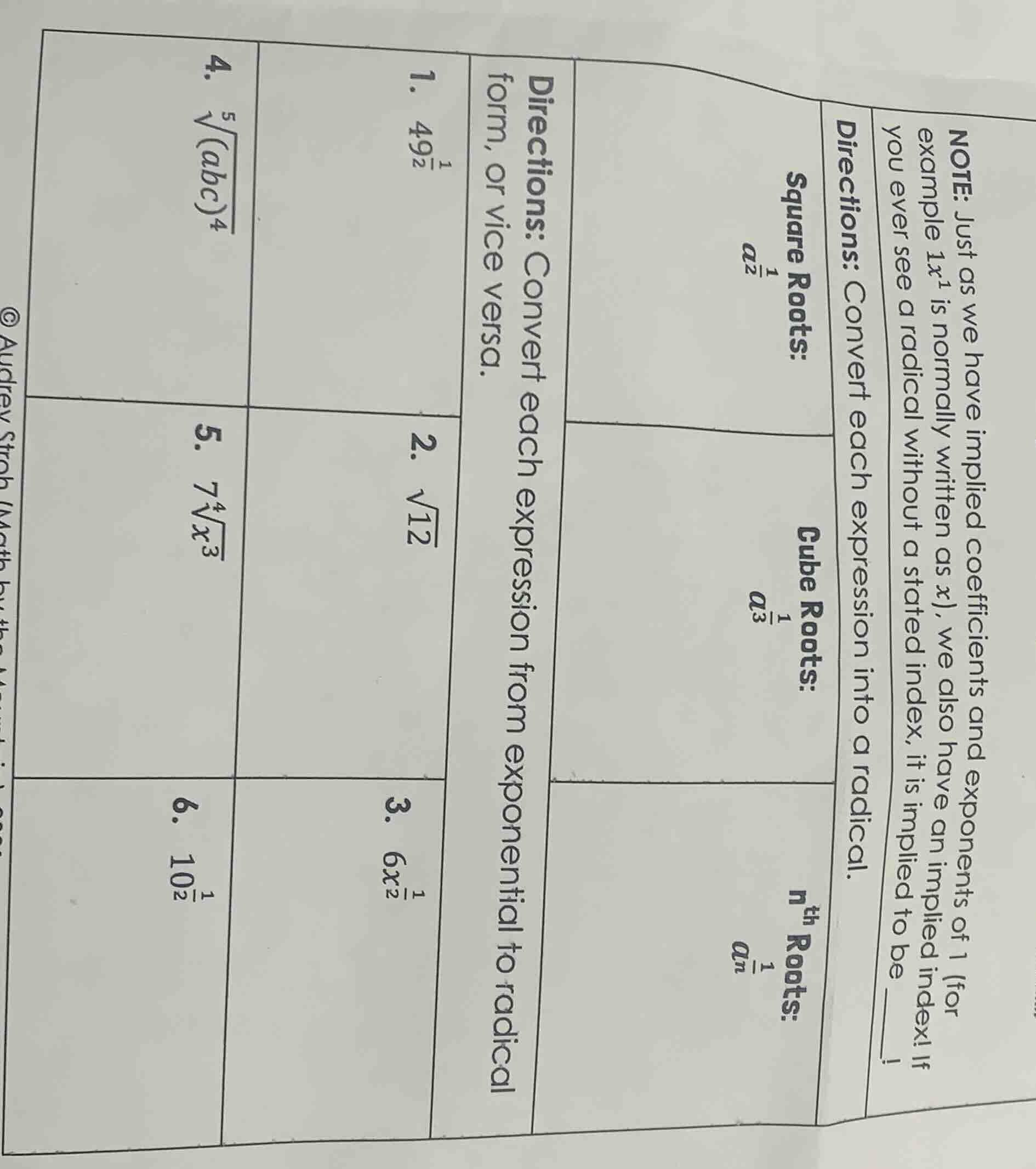
note: just as we have implied coefficients and exponents of 1 (for example $1x^1$ is normally written as $x$), we also have an implied index! if you ever see a radical without a stated index, it is implied to be ______!
directions: convert each expression into a radical.
square roots:
$a^{\frac{1}{2}}$
cube roots:
$a^{\frac{1}{3}}$
$n^{th}$ roots:
$a^{\frac{1}{n}}$
directions: convert each expression from exponential to radical form, or vice versa.
- $49^{\frac{1}{2}}$
- $\sqrt{12}$
- $6x^{\frac{1}{2}}$
- $\sqrt5{(abc)^4}$
- $7\sqrt4{x^3}$
- $10^{\frac{1}{2}}$
Step1: Fill implied index blank
A radical without an index has an implied index of 2 (square root).
Step2: Convert 1 to radical form
Use square root rule $a^\frac{1}{2}=\sqrt{a}$
$49^\frac{1}{2}=\sqrt{49}$
Step3: Convert 2 to exponential form
Use square root rule $\sqrt{a}=a^\frac{1}{2}$
$\sqrt{12}=12^\frac{1}{2}$
Step4: Convert 3 to radical form
Use square root rule $x^\frac{1}{2}=\sqrt{x}$
$6x^\frac{1}{2}=6\sqrt{x}$
Step5: Convert 4 to exponential form
Use nth root rule $\sqrt[n]{a^m}=a^\frac{m}{n}$
$\sqrt[5]{(abc)^4}=(abc)^\frac{4}{5}$
Step6: Convert 5 to exponential form
Use nth root rule $\sqrt[n]{a^m}=a^\frac{m}{n}$
$7\sqrt[4]{x^3}=7x^\frac{3}{4}$
Step7: Convert 6 to radical form
Use square root rule $a^\frac{1}{2}=\sqrt{a}$
$10^\frac{1}{2}=\sqrt{10}$

Snap & solve any problem in the app
Get step-by-step solutions on Sovi AI
Photo-based solutions with guided steps
Explore more problems and detailed explanations
Implied index blank: $\boldsymbol{2}$
- $\sqrt{49}$
- $12^\frac{1}{2}$
- $6\sqrt{x}$
- $(abc)^\frac{4}{5}$
- $7x^\frac{3}{4}$
- $\sqrt{10}$