QUESTION IMAGE
Question
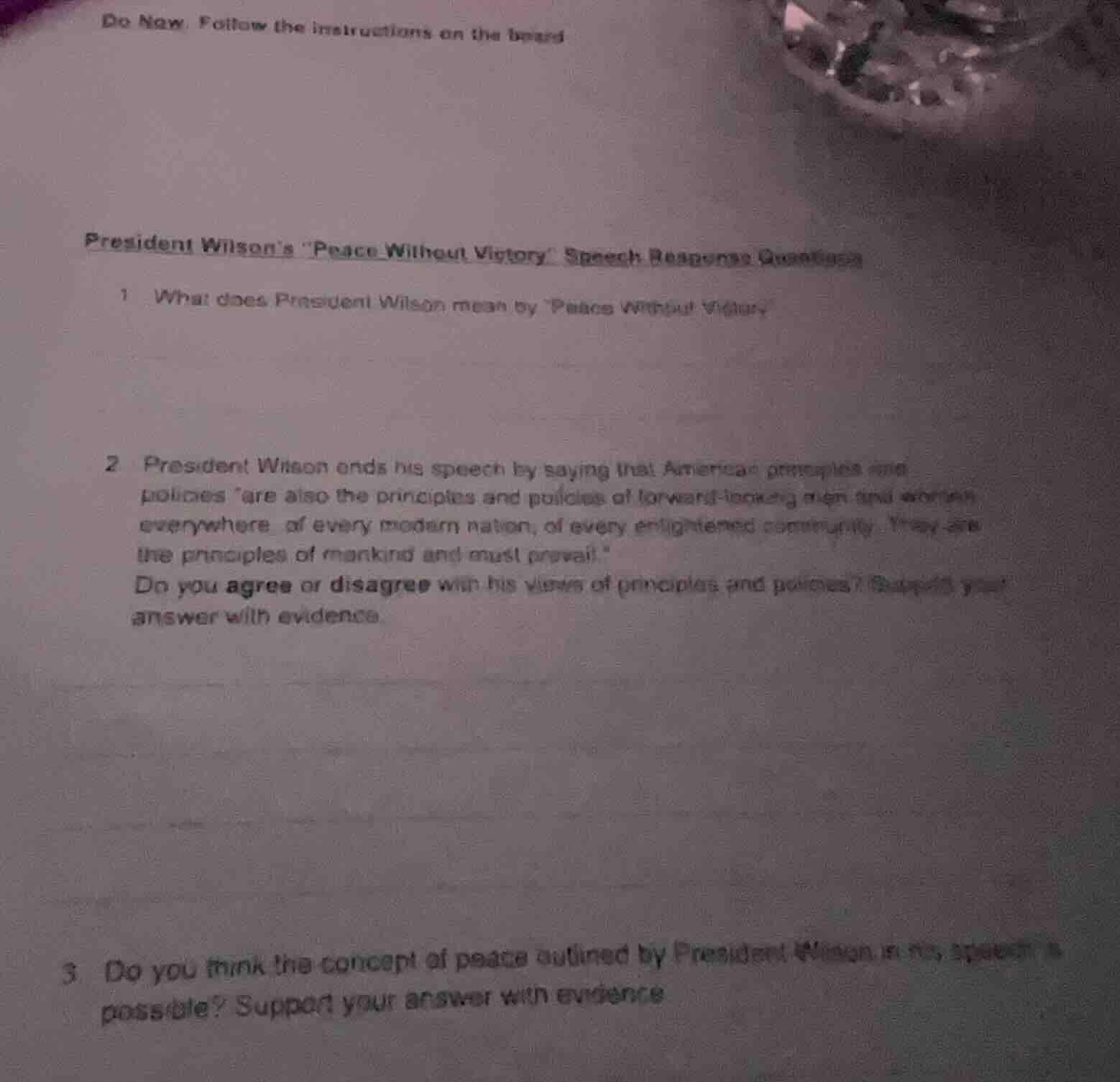
do now: follow the instructions on the board
president wilsons peace without victory speech response questions
- what does president wilson mean by peace without victory?
- president wilson ends his speech by saying that american principles and policies are also the principles and policies of forward-looking men and women everywhere, of every modern nation, of every enlightened community. they are the principles of mankind and must prevail.
do you agree or disagree with his views of principles and policies? support your answer with evidence.
- do you think the concept of peace outlined by president wilson in his speech is possible? support your answer with evidence
Brief Explanations
- For the first question: Wilson's "Peace Without Victory" refers to a peace settlement after WWI that did not impose harsh, humiliating penalties on the defeated Central Powers. He argued that a peace built on one side's total victory would breed resentment and future conflict, so the treaty should be fair, based on mutual respect rather than punishing the losing nations.
- For the second question (agreement take): Wilson's view reflected idealistic internationalism, but it overlooked the differing national interests and historical tensions of other nations. For example, Allied powers like France had suffered massive destruction and wanted reparations from Germany, so they rejected the idea that American principles were universally shared. However, his ideas laid groundwork for the League of Nations, a global body meant to enforce collective security, which showed his principles had global appeal among some groups.
- For the third question: Wilson's concept was not fully possible in his time, but elements have been realized. The harsh Treaty of Versailles (which ignored "Peace Without Victory") led to WWII, proving his concern about punitive peace was valid. However, post-WWII institutions like the United Nations and the European Union, which prioritize cooperative, non-punitive relations between nations, embody parts of his vision, showing the concept can work when nations commit to collective interests over individual victory.

Snap & solve any problem in the app
Get step-by-step solutions on Sovi AI
Photo-based solutions with guided steps
Explore more problems and detailed explanations
- President Wilson meant a fair, non-punitive peace settlement after World War I, where no nation was forced to accept humiliating, resentment-fueling terms; he believed a peace built on one side's total victory would only lead to future conflict.
- (Example agreement with nuance): I partially agree. Wilson's idealistic principles laid the groundwork for modern collective security efforts like the League of Nations, but his assumption that American principles were universal ignored the differing national traumas and interests of other nations—for instance, France's demand for German reparations after massive wartime destruction showed not all "enlightened communities" shared his rejection of punitive peace.
- Wilson's concept was not fully achievable in his immediate context, but elements of it have been realized. The failure of his vision in WWI (replaced by the punitive Treaty of Versailles, which contributed to WWII) shows it requires broad international cooperation, but post-WWII institutions like the United Nations and the European Union, which prioritize cooperative, non-punitive interstate relations, demonstrate that his core idea of a peace without victor/victim can work when nations commit to collective interests.