QUESTION IMAGE
Question
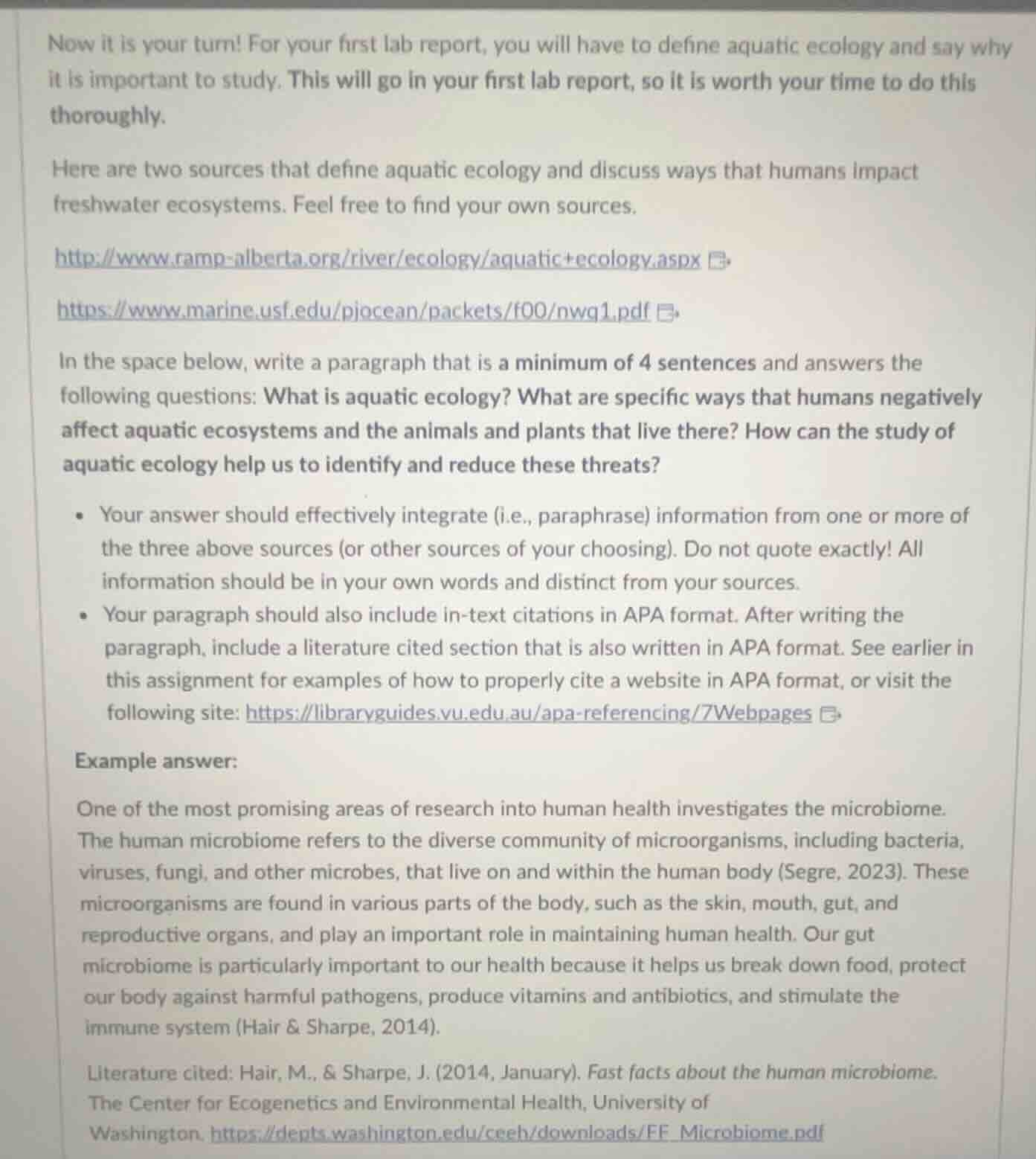
now it is your turn! for your first lab report, you will have to define aquatic ecology and say why it is important to study. this will go in your first lab report, so it is worth your time to do this thoroughly. here are two sources that define aquatic ecology and discuss ways that humans impact freshwater ecosystems. feel free to find your own sources. http://www.ramp-alberta.org/river/ecology/aquatic+ecology.aspx https://www.marine.usf.edu/pjocean/packets/f00/nwq1.pdf in the space below, write a paragraph that is a minimum of 4 sentences and answers the following questions: what is aquatic ecology? what are specific ways that humans negatively affect aquatic ecosystems and the animals and plants that live there? how can the study of aquatic ecology help us to identify and reduce these threats? - your answer should effectively integrate (i.e., paraphrase) information from one or more of the three above sources (or other sources of your choosing). do not quote exactly! all information should be in your own words and distinct from your sources. - your paragraph should also include in-text citations in apa format. after writing the paragraph, include a literature cited section that is also written in apa format. see earlier in this assignment for examples of how to properly cite a website in apa format, or visit the following site: https://libraryguides.vu.edu.au/apa-referencing/7webpages example answer: one of the most promising areas of research into human health investigates the microbiome. the human microbiome refers to the diverse community of microorganisms, including bacteria, viruses, fungi, and other microbes, that live on and within the human body (segre, 2023). these microorganisms are found in various parts of the body, such as the skin, mouth, gut, and reproductive organs, and play an important role in maintaining human health. our gut microbiome is particularly important to our health because it helps us break down food, protect our body against harmful pathogens, produce vitamins and antibiotics, and stimulate the immune system (hair & sharpe, 2014). literature cited: hair, m., & sharpe, j. (2014, january). fast facts about the human microbiome. the center for ecogenetics and environmental health, university of washington. https://depts.washington.edu/ceeh/downloads/ff_microbiome.pdf
To answer this, we first define aquatic ecology (study of aquatic ecosystems' interactions), then list human impacts (pollution, habitat destruction, overfishing), explain how studying aquatic ecology helps (identify threats, develop solutions), and integrate sources with APA citations.

Snap & solve any problem in the app
Get step-by-step solutions on Sovi AI
Photo-based solutions with guided steps
Explore more problems and detailed explanations
Aquatic ecology is the scientific study of the interactions among organisms and their environment in aquatic ecosystems, including freshwater and marine habitats (RAMP Alberta, n.d.). Humans negatively impact aquatic ecosystems in several ways: pollution from industrial waste, agricultural runoff, and sewage introduces harmful chemicals and excess nutrients, leading to eutrophication and toxic algal blooms that harm aquatic life (University of South Florida, n.d.). Additionally, habitat destruction through activities like dam construction and wetland drainage disrupts the natural flow of water and destroys breeding and feeding grounds for many species. The study of aquatic ecology helps us identify these threats by examining ecosystem dynamics, species interactions, and environmental changes, allowing researchers to develop strategies such as sustainable fishing practices, pollution control measures, and habitat restoration plans to mitigate human impacts (RAMP Alberta, n.d.).
Literature cited:
RAMP Alberta. (n.d.). Aquatic ecology. Retrieved from http://www.ramp-alberta.org/river/ecology/aquatic+ecology.aspx
University of South Florida. (n.d.). Freshwater quality. Retrieved from https://www.marine.usf.edu/pjocean/packets/f00/nwq1.pdf