QUESTION IMAGE
Question
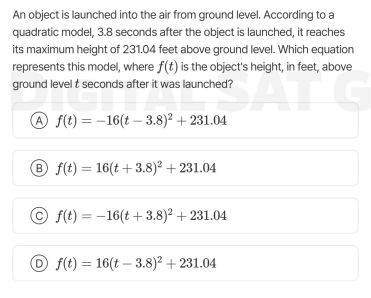
an object is launched into the air from ground level. according to a quadratic model, 3.8 seconds after the object is launched, it reaches its maximum height of 231.04 feet above ground level. which equation represents this model, where ( f(t) ) is the objects height, in feet, above ground level ( t ) seconds after it was launched?
(a) ( f(t) = -16(t - 3.8)^2 + 231.04 )
(b) ( f(t) = 16(t + 3.8)^2 + 231.04 )
(c) ( f(t) = -16(t + 3.8)^2 + 231.04 )
(d) ( f(t) = 16(t - 3.8)^2 + 231.04 )
Step1: Recall vertex form of projectile
The vertex form for a height function of a projectile launched from ground level is $f(t) = a(t - h)^2 + k$, where $(h,k)$ is the vertex (maximum height point), and $a$ is negative (since gravity pulls downward, the parabola opens downward).
Step2: Identify vertex values
The maximum height occurs at $t=3.8$ seconds with height $231.04$ feet, so $h=3.8$ and $k=231.04$.
Step3: Determine sign of $a$
Since the object is launched upward and falls due to gravity, the coefficient $a$ must be negative. The standard gravitational coefficient for such problems is $-16$.
Step4: Substitute values into form
Substitute $a=-16$, $h=3.8$, $k=231.04$ into the vertex form:
$f(t) = -16(t - 3.8)^2 + 231.04$

Snap & solve any problem in the app
Get step-by-step solutions on Sovi AI
Photo-based solutions with guided steps
Explore more problems and detailed explanations
A. $f(t) = -16(t - 3.8)^2 + 231.04$