QUESTION IMAGE
Question
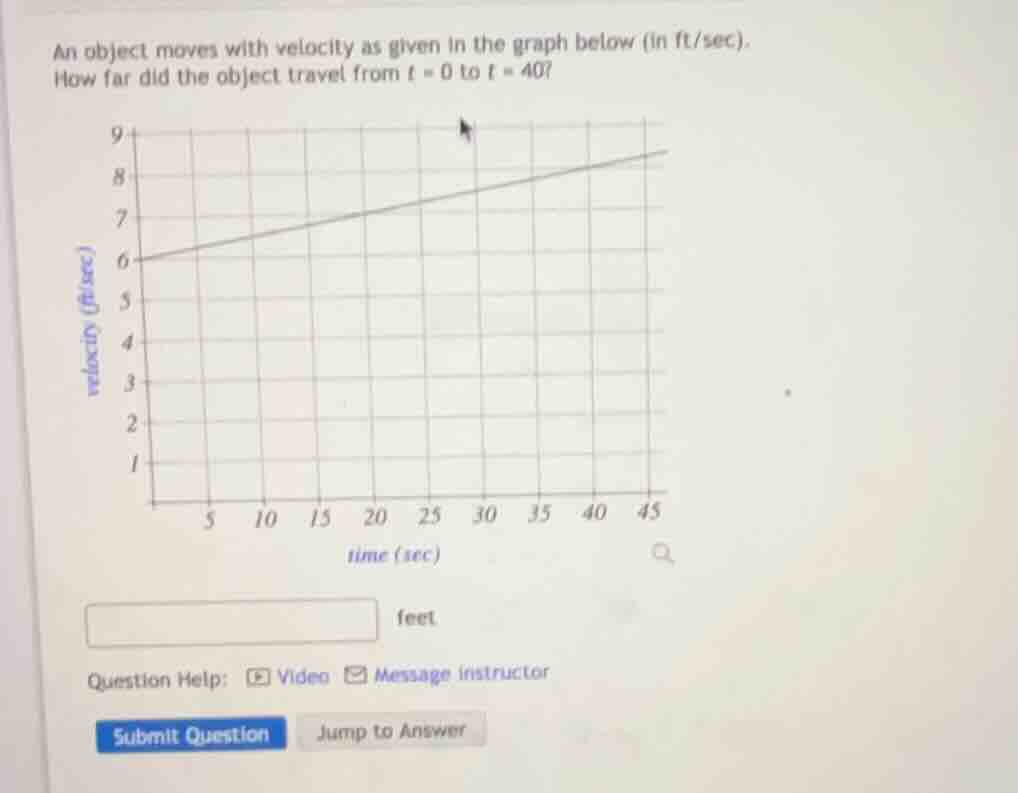
an object moves with velocity as given in the graph below (in ft/sec). how far did the object travel from t = 0 to t = 40? velocity (ft/sec) time (sec) feet question help: video message instructor submit question jump to answer
Step1: Identify the shape of the velocity - time graph
The velocity - time graph is a straight line, so the motion is with constant acceleration (uniformly accelerated motion), and the distance traveled is the area under the velocity - time graph. The graph is a trapezoid or a triangle - like shape? Wait, at \(t = 0\), velocity \(v_0=6\) ft/s, and at \(t = 40\) s, let's find the velocity \(v\) at \(t = 40\). The slope of the line: from \(t = 0\) (\(v = 6\)) to \(t = 30\) (\(v = 8\))? Wait, looking at the graph, the x - axis (time) has grid lines, and the y - axis (velocity) has grid lines. Let's assume the velocity at \(t = 40\) is \(v = 8+\frac{8 - 6}{30-0}\times10\)? Wait, no, better to see the graph as a straight line. The formula for the area under a velocity - time graph (which is the distance) when it's a straight line (linear velocity function) is the area of a trapezoid, which is \(\frac{(v_0 + v_t)}{2}\times t\), where \(v_0\) is the initial velocity, \(v_t\) is the velocity at time \(t\), and \(t\) is the time interval.
From the graph, at \(t = 0\), \(v_0 = 6\) ft/s. Let's find the velocity at \(t = 40\) s. Looking at the graph, the line goes from \((0,6)\) to, let's see, at \(t = 30\), the velocity is 8? Wait, the y - axis: at \(t = 0\), \(y = 6\); at \(t = 30\), \(y = 8\); at \(t = 40\), let's calculate the slope \(m=\frac{8 - 6}{30-0}=\frac{2}{30}=\frac{1}{15}\) ft/s². Then at \(t = 40\), \(v=v_0+mt=6+\frac{1}{15}\times40=6+\frac{8}{3}=\frac{18 + 8}{3}=\frac{26}{3}\)? Wait, no, maybe the graph is a straight line from \((0,6)\) to \((40,8)\)? Wait, looking at the grid, the x - axis: each grid is 5 units (5,10,15,...40). The y - axis: each grid is 1 unit (6,7,8,...). At \(t = 0\), \(v = 6\); at \(t = 40\), let's count the y - value. From \(t = 0\) (v = 6) to \(t = 40\), the line goes up. Let's check the points: at \(t = 20\), \(v = 7\); at \(t = 40\), \(v = 8\)? Wait, from \(t = 0\) (v = 6) to \(t = 20\) (v = 7), slope \(m=\frac{7 - 6}{20-0}=\frac{1}{20}\). Then at \(t = 40\), \(v=6+\frac{1}{20}\times40=6 + 2=8\) ft/s. Yes, that makes sense. So \(v_0 = 6\) ft/s, \(v_t=8\) ft/s, \(t = 40\) s.
Step2: Calculate the area (distance)
The area under the velocity - time graph (distance \(d\)) for a linear velocity function is the area of a trapezoid, which is given by the formula \(d=\frac{(v_0 + v_t)}{2}\times t\). Here, \(v_0 = 6\) ft/s, \(v_t = 8\) ft/s, and \(t = 40\) s.
Substitute the values into the formula: \(d=\frac{(6 + 8)}{2}\times40\)
First, calculate \(\frac{6 + 8}{2}=\frac{14}{2}=7\)
Then, \(7\times40 = 280\)

Snap & solve any problem in the app
Get step-by-step solutions on Sovi AI
Photo-based solutions with guided steps
Explore more problems and detailed explanations
280