QUESTION IMAGE
Question
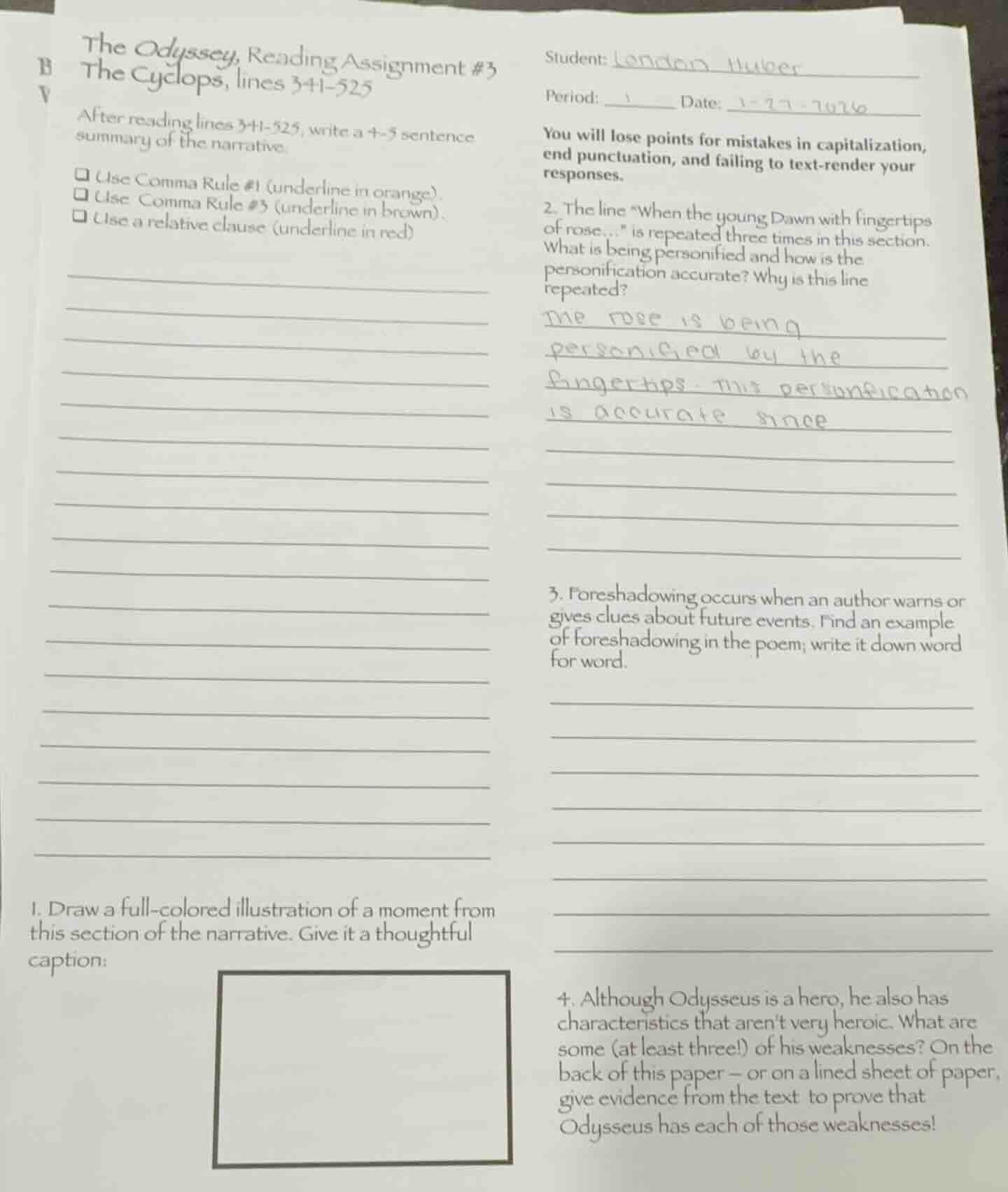
the odyssey, reading assignment #3
the cyclops, lines 341 - 525
after reading lines 341 - 525, write a 4 - 5 sentence summary of the narrative.
☑ use comma rule #1 (underline in orange).
☑ use comma rule #3 (underline in brown).
☑ use a relative clause (underline in red)
- draw a full - colored illustration of a moment from this section of the narrative. give it a thoughtful caption:
student:
period: date:
you will lose points for mistakes in capitalization, end punctuation, and failing to text - render your responses.
- the line “when the young dawn with fingertips of rose...” is repeated three times in this section. what is being personified and how is the personification accurate? why is this line repeated?
- foreshadowing occurs when an author warns or gives clues about future events. find an example of foreshadowing in the poem; write it down word for word.
- although odysseus is a hero, he also has characteristics that arent very heroic. what are some (at least three!) of his weaknesses? on the back of this paper – or on a lined sheet of paper, give evidence from the text to prove that odysseus has each of those weaknesses!
Question 2 (Personification and Repetition)
- Personification: The "young Dawn" is personified. Dawn is given the human - like quality of having "fingertips of rose" (treating Dawn as a person with hands/fingertips). This is accurate as dawn is a time of day, and by giving it human - like body parts, it makes the dawn seem more vivid and active, as if it is gently bringing light (like a person with fingertips might touch or spread something).
- Repetition Reason: The line is repeated three times to create a rhythmic structure, to emphasize the passage of time (each dawn marks a new day in the narrative), and to give a sense of the cyclical nature of the events or the passage of days during Odysseus' encounter with the Cyclops.
In "The Cyclops" section of "The Odyssey", an example of foreshadowing could be when Odysseus and his men enter the Cyclops' cave. The Cyclops is a one - eyed giant, and the fact that the cave is filled with the Cyclops' livestock and is a place of isolation foreshadows the danger and entrapment that Odysseus and his men will face. Another example (word - for - word) could be: "We lit a fire, and burnt an offering, and took some cheese to eat; then we sat waiting till the Cyclops should come in with his sheep." This foreshadows that the Cyclops' return will lead to a confrontation, as they are in his space and have taken his food, setting up the conflict that follows.
- Pride/Hubris: When Odysseus and his men escape the Cyclops, Odysseus shouts his name to the Cyclops, saying "Cyclops, if any man asks you who it was that put your eye out and spoiled your beauty, say it was Odysseus, son of Laertes, who lives in Ithaca." This shows his pride as he wants the Cyclops to know who defeated him, which then leads to Poseidon (the Cyclops' father) seeking revenge on him.
- Recklessness: Odysseus and his men stay in the Cyclops' cave even though it is the lair of a giant monster. They could have left earlier, but they chose to stay, which shows a reckless disregard for the potential danger. For example, "We lit a fire, and burnt an offering, and took some cheese to eat; then we sat waiting till the Cyclops should come in with his sheep." They stayed in a dangerous place instead of fleeing.
- Poor Leadership (in part): When his men want to take the Cyclops' sheep and leave immediately, Odysseus decides to wait for the Cyclops. This decision puts his men in danger. The text shows his men's desire to leave: (implied by their situation, though the exact quote about their desire to leave may be in the surrounding text) and Odysseus' choice to stay, showing a leadership decision that endangers his crew.

Snap & solve any problem in the app
Get step-by-step solutions on Sovi AI
Photo-based solutions with guided steps
Explore more problems and detailed explanations
- Personified: The "young Dawn" is personified. It is given the human - like feature of having "fingertips of rose", as if Dawn is a person who can touch or spread the light of dawn. This is accurate because dawn is a natural phenomenon, and by personifying it, the description makes the arrival of dawn more vivid and relatable, as if a person is gently bringing the new day.
- Repetition Reason: The line is repeated three times to establish a rhythmic pattern, to highlight the passage of time (each repetition marks a new day in the story), and to emphasize the cyclical nature of the days during Odysseus' interaction with the Cyclops.