QUESTION IMAGE
Question
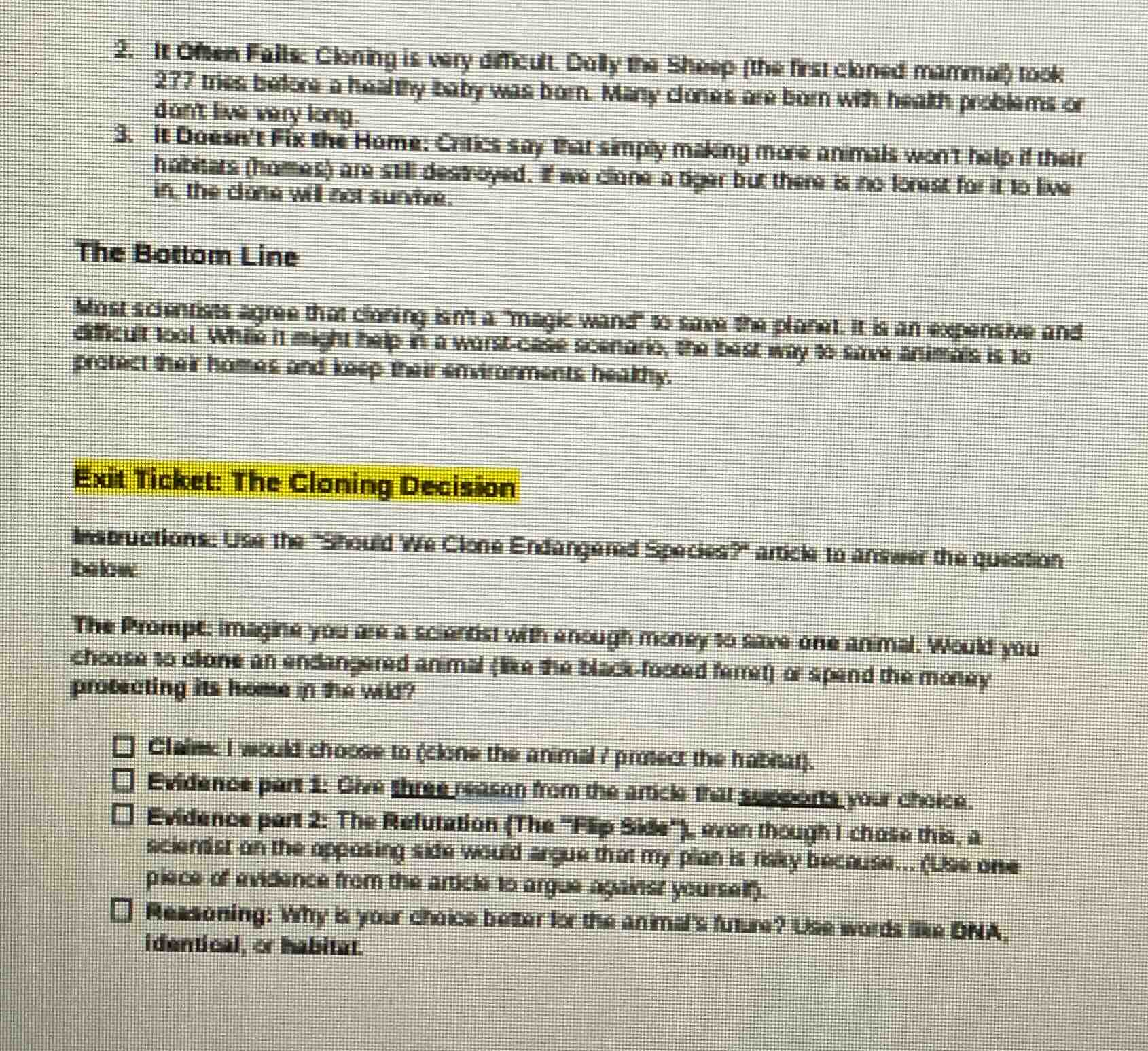
- it often fails: cloning is very difficult. dolly the sheep (the first cloned mammal) took 277 tries before a healthy baby was born. many clones are born with health problems or dont live very long.
- it doesnt fix the home: critics say that simply making more animals wont help if their habitats (homes) are still destroyed. if we clone a tiger but there is no forest for it to live in, the clone will not survive.
the bottom line
most scientists agree that cloning isnt a \magic wand\ to save the planet. it is an expensive and difficult tool. while it might help in a worst - case scenario, the best way to save animals is to protect their homes and keep their environments healthy.
exit ticket: the cloning decision
instructions: use the \should we clone endangered species?\ article to answer the question below.
the prompt: imagine you are a scientist with enough money to save one animal. would you choose to clone an endangered animal (like the black - footed ferret) or spend the money protecting its home in the wild?
□ claim: i would choose to (clone the animal / protect the habitat).
□ evidence part 1: give three reason from the article that supports your choice.
□ evidence part 2: the refutation (the \flip side\), even though i chose this, a scientist on the opposing side would argue that my plan is risky because... (use one piece of evidence from the article to argue against yourself).
□ reasoning: why is your choice better for the animals future? use words like dna, identical, or habitat.

Snap & solve any problem in the app
Get step-by-step solutions on Sovi AI
Photo-based solutions with guided steps
Explore more problems and detailed explanations
Claim: I would choose to protect the habitat.
Evidence part 1: 1. Cloning is very difficult and requires many attempts to get a healthy individual. 2. Many clones are born with health problems or have short lifespans. 3. Cloning doesn't help if the animal's habitat is destroyed, as the clone can't survive without it.
Evidence part 2: A scientist on the opposing side would argue that my plan is risky because habitat protection can be slow and may not reverse damage in time to save the species before it goes extinct.
Reasoning: Protecting the habitat ensures that animals with natural, diverse DNA have a healthy environment to thrive in, unlike identical clones which face health risks and still need a habitat to survive, making this choice better for the animal's long-term future.