QUESTION IMAGE
Question
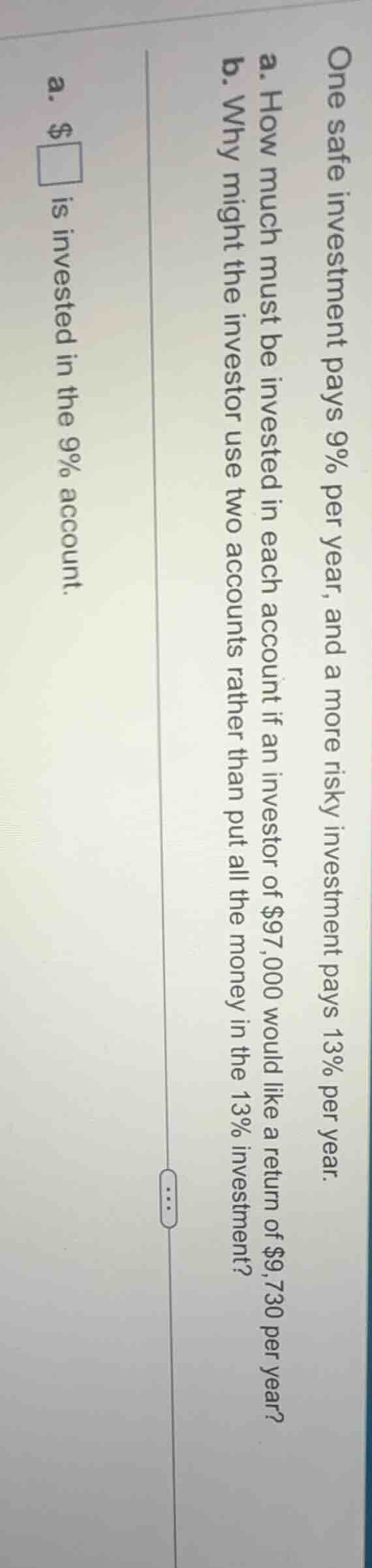
one safe investment pays 9% per year, and a more risky investment pays 13% per year.
a. how much must be invested in each account if an investor of $97,000 would like a return of $9,730 per year?
b. why might the investor use two accounts rather than put all the money in the 13% investment?
a. $\square$ is invested in the 9% account.
Step1: Define variables
Let $x$ = amount invested in 9% account, $97000 - x$ = amount invested in 13% account.
Step2: Set up return equation
Total return = sum of individual returns:
$$0.09x + 0.13(97000 - x) = 9730$$
Step3: Expand and simplify equation
$$0.09x + 12610 - 0.13x = 9730$$
$$-0.04x + 12610 = 9730$$
Step4: Isolate x term
$$-0.04x = 9730 - 12610$$
$$-0.04x = -2880$$
Step5: Solve for x
$$x = \frac{-2880}{-0.04} = 72000$$
Step6: Find 13% account amount
$$97000 - 72000 = 25000$$
(for part b):
Using two accounts balances risk and return. The 9% account provides stable, low-risk returns to avoid total loss if the 13% risky investment performs poorly, while the 13% account offers higher growth potential. This strategy reduces overall financial risk while still targeting a desired return.

Snap & solve any problem in the app
Get step-by-step solutions on Sovi AI
Photo-based solutions with guided steps
Explore more problems and detailed explanations
a. $72,000 is invested in the 9% account, and $25,000 is invested in the 13% account.
b. To balance risk and return: the safe 9% investment protects against total loss from the risky 13% option, while the risky account allows for higher growth, creating a more stable, targeted return strategy.