QUESTION IMAGE
Question
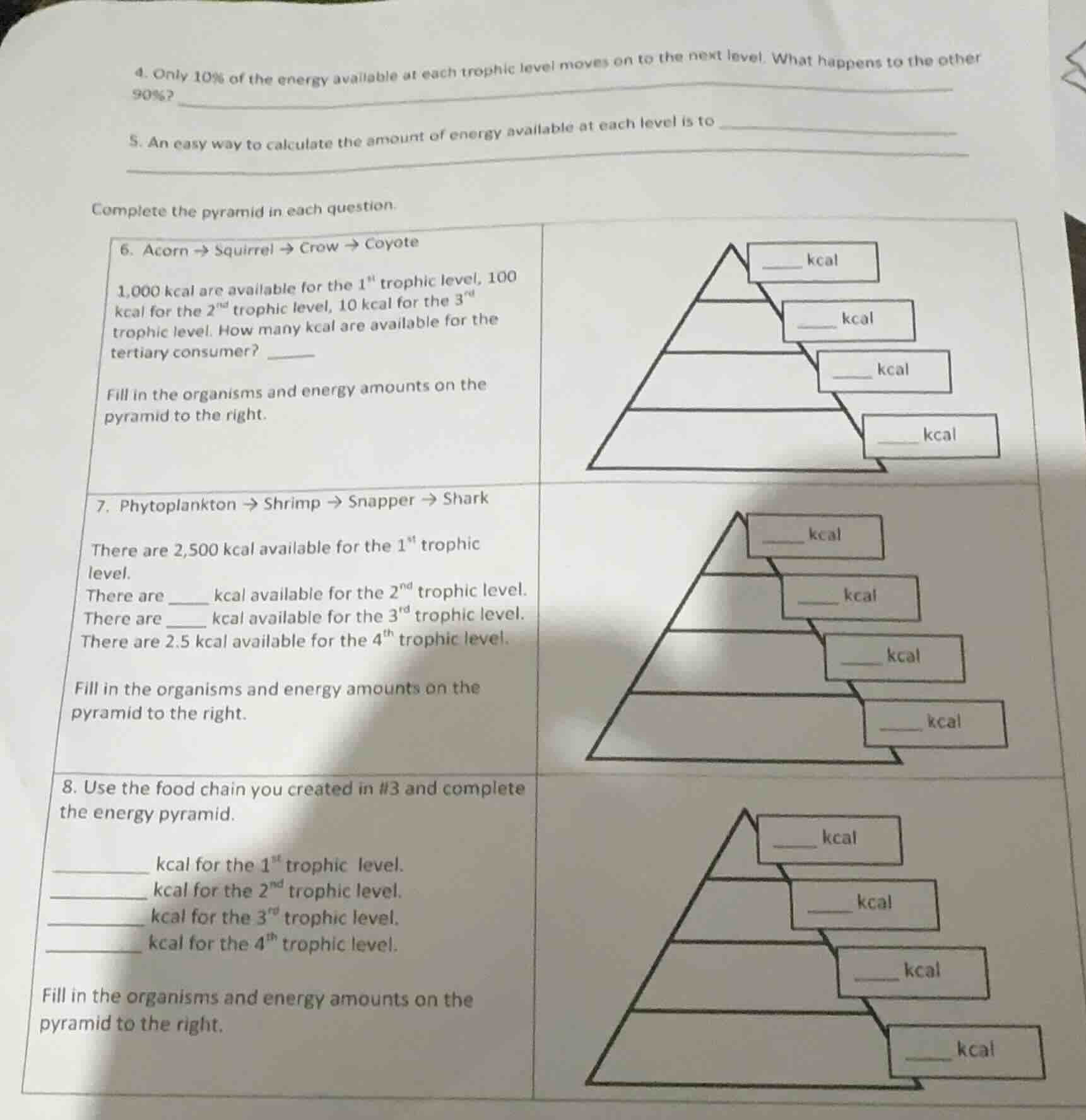
- only 10% of the energy available at each trophic level moves on to the next level. what happens to the other 90%?5. an easy way to calculate the amount of energy available at each level is tocomplete the pyramid in each question.6. acorn → squirrel → crow → coyote1,000 kcal are available for the 1st trophic level, 100 kcal for the 2nd trophic level, 10 kcal for the 3rd trophic level. how many kcal are available for the tertiary consumer?fill in the organisms and energy amounts on the pyramid to the right.7. phytoplankton → shrimp → snapper → sharkthere are 2,500 kcal available for the 1st trophic level.there are __ kcal available for the 2nd trophic level.there are kcal available for the 3rd trophic level.there are 2.5 kcal available for the 4th trophic level.fill in the organisms and energy amounts on the pyramid to the right.8. use the food chain you created in #3 and complete the energy pyramid.__ kcal for the 1st trophic level.__ kcal for the 2nd trophic level.__ kcal for the 3rd trophic level.____ kcal for the 4th trophic level.fill in the organisms and energy amounts on the pyramid to the right.
Step1: Answer question 4
The other 90% of energy is lost as heat (from cellular respiration), used by the organism for its life processes (growth, movement, reproduction), and is contained in waste products (feces, uneaten biomass) that do not transfer to the next trophic level.
Step2: Answer question 5
To calculate energy at each level, multiply the previous level's energy by 10% (or 0.1).
<Expression>
$\text{Energy at level } n = \text{Energy at level } n-1 \times 0.1$
</Expression>
Step3: Solve question 6
Identify tertiary consumer: Coyote (4th trophic level). Calculate energy:
<Expression>
$1000 \text{ kcal} \times 0.1 \times 0.1 \times 0.1 = 1 \text{ kcal}$
</Expression>
Pyramid (top to bottom): 1 kcal (Coyote), 10 kcal (Crow), 100 kcal (Squirrel), 1000 kcal (Acorn)
Step4: Solve question 7
Calculate 2nd level energy:
<Expression>
$2500 \text{ kcal} \times 0.1 = 250 \text{ kcal}$
</Expression>
Calculate 3rd level energy:
<Expression>
$250 \text{ kcal} \times 0.1 = 25 \text{ kcal}$
</Expression>
Pyramid (top to bottom): 2.5 kcal (Shark), 25 kcal (Snapper), 250 kcal (Shrimp), 2500 kcal (Phytoplankton)
Step5: Note question 8 limitation
Question 8 relies on a food chain from #3 (not provided), so we use a sample food chain: Grass → Rabbit → Fox → Eagle, with a starting 1000 kcal for the 1st level.
Calculate each level:
<Expression>
$1000 \times 0.1 = 100 \text{ kcal (2nd level)}$
$100 \times 0.1 = 10 \text{ kcal (3rd level)}$
$10 \times 0.1 = 1 \text{ kcal (4th level)}$
</Expression>
Pyramid (top to bottom): 1 kcal (Eagle), 10 kcal (Fox), 100 kcal (Rabbit), 1000 kcal (Grass)

Snap & solve any problem in the app
Get step-by-step solutions on Sovi AI
Photo-based solutions with guided steps
Explore more problems and detailed explanations
- It is lost as heat, used for the organism's life functions, and contained in waste/uneaten material that does not pass to the next trophic level.
- multiply the previous level's energy by 0.1 (or 10%)
- 1 kcal
Pyramid (top to bottom): 1 kcal (Coyote), 10 kcal (Crow), 100 kcal (Squirrel), 1000 kcal (Acorn)
- 250; 25
Pyramid (top to bottom): 2.5 kcal (Shark), 25 kcal (Snapper), 250 kcal (Shrimp), 2500 kcal (Phytoplankton)
- (Sample using Grass → Rabbit → Fox → Eagle): 1000; 100; 10; 1
Pyramid (top to bottom): 1 kcal (Eagle), 10 kcal (Fox), 100 kcal (Rabbit), 1000 kcal (Grass)
Note: Replace with the food chain from question #3 if available, using the 10% energy transfer rule to calculate values.