QUESTION IMAGE
Question
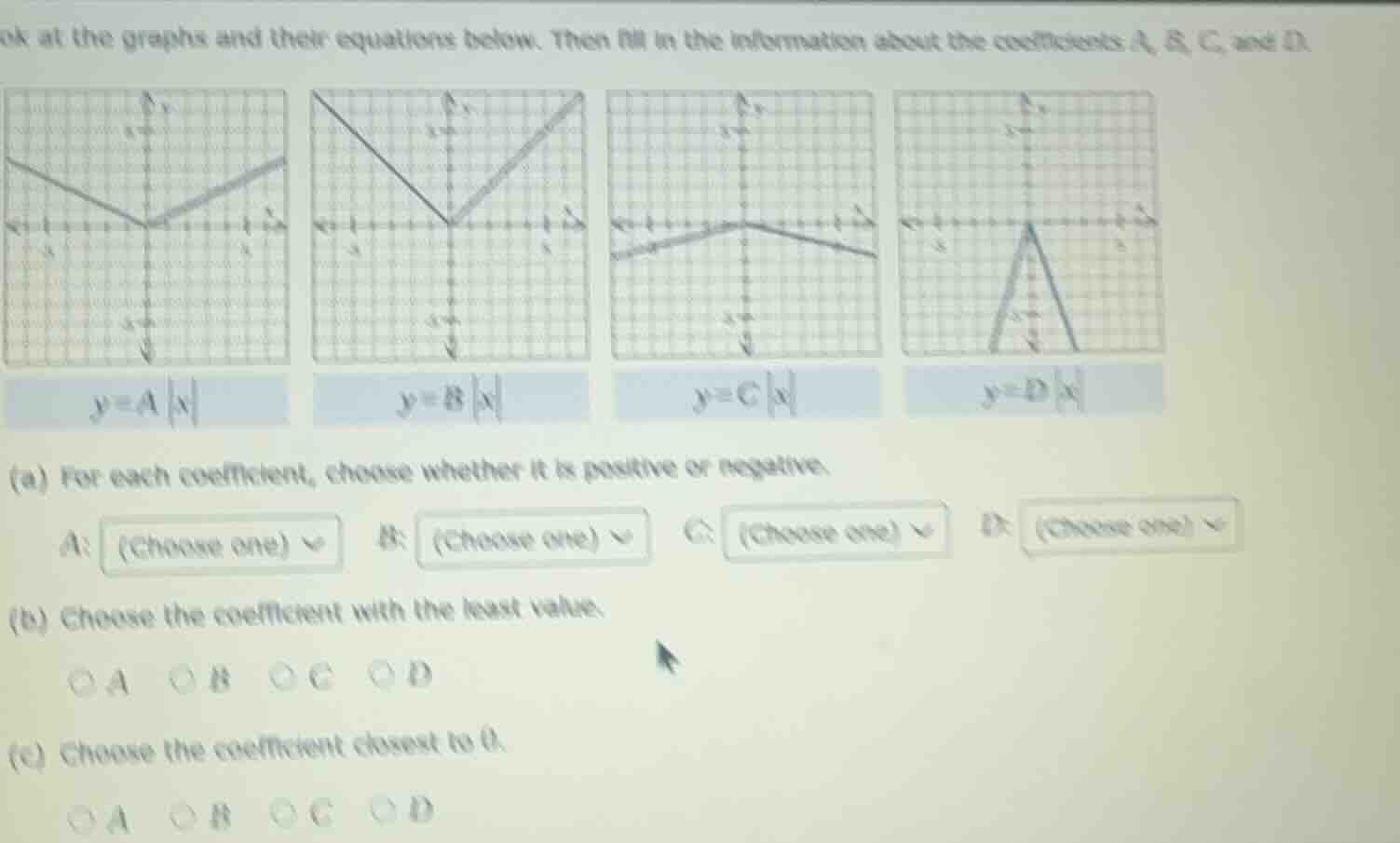
ook at the graphs and their equations below. then fill in the information about the coefficients a, b, c, and d.
( y = a|x| ) ( y = b|x| ) ( y = c|x| ) ( y = d|x| )
(a) for each coefficient, choose whether it is positive or negative.
a: (choose one) ( \boldsymbol{vee} ) b: (choose one) ( \boldsymbol{vee} ) c: (choose one) ( \boldsymbol{vee} ) d: (choose one) ( \boldsymbol{vee} )
(b) choose the coefficient with the least value.
( \bigcirc ) a ( \bigcirc ) b ( \bigcirc ) c ( \bigcirc ) d
(c) choose the coefficient closest to 0.
( \bigcirc ) a ( \bigcirc ) b ( \bigcirc ) c ( \bigcirc ) d
Part (a)
To determine the sign of the coefficient in \( y = k|x| \):
- If the graph opens upward (the "V" opens up), the coefficient \( k \) is positive.
- If the graph opens downward (the "V" opens down), the coefficient \( k \) is negative.
- For \( y = A|x| \): The graph opens upward, so \( A \) is positive.
- For \( y = B|x| \): The graph opens upward, so \( B \) is positive.
- For \( y = C|x| \): The graph opens downward, so \( C \) is negative.
- For \( y = D|x| \): The graph opens downward, so \( D \) is negative.
Part (b)
The "steepness" of the \( |x| \) graph is determined by the absolute value of the coefficient. A larger absolute value means a steeper graph, and a smaller absolute value means a less steep graph. To find the least value, we consider the absolute values:
- \( A \) and \( B \) are positive, \( C \) and \( D \) are negative. But we compare the absolute values.
- The graph of \( y = C|x| \) is less steep than \( y = D|x| \) (since \( D \)’s graph is steeper downward), and \( A \) is less steep than \( B \) (since \( B \)’s graph is steeper upward). Among all, \( C \) has the smallest absolute value (since its graph is the least steep among all), so the coefficient with the least value is \( C \).
Part (c)
The coefficient closest to 0 is the one with the smallest absolute value (least steep graph). The graph of \( y = C|x| \) is the least steep (since it’s the most "flat" among all), so \( C \) is closest to 0.
Final Answers
(a)
\( A \): Positive
\( B \): Positive
\( C \): Negative
\( D \): Negative
(b)
\( \boldsymbol{C} \)
(c)
\( \boldsymbol{C} \)

Snap & solve any problem in the app
Get step-by-step solutions on Sovi AI
Photo-based solutions with guided steps
Explore more problems and detailed explanations
Part (a)
To determine the sign of the coefficient in \( y = k|x| \):
- If the graph opens upward (the "V" opens up), the coefficient \( k \) is positive.
- If the graph opens downward (the "V" opens down), the coefficient \( k \) is negative.
- For \( y = A|x| \): The graph opens upward, so \( A \) is positive.
- For \( y = B|x| \): The graph opens upward, so \( B \) is positive.
- For \( y = C|x| \): The graph opens downward, so \( C \) is negative.
- For \( y = D|x| \): The graph opens downward, so \( D \) is negative.
Part (b)
The "steepness" of the \( |x| \) graph is determined by the absolute value of the coefficient. A larger absolute value means a steeper graph, and a smaller absolute value means a less steep graph. To find the least value, we consider the absolute values:
- \( A \) and \( B \) are positive, \( C \) and \( D \) are negative. But we compare the absolute values.
- The graph of \( y = C|x| \) is less steep than \( y = D|x| \) (since \( D \)’s graph is steeper downward), and \( A \) is less steep than \( B \) (since \( B \)’s graph is steeper upward). Among all, \( C \) has the smallest absolute value (since its graph is the least steep among all), so the coefficient with the least value is \( C \).
Part (c)
The coefficient closest to 0 is the one with the smallest absolute value (least steep graph). The graph of \( y = C|x| \) is the least steep (since it’s the most "flat" among all), so \( C \) is closest to 0.
Final Answers
(a)
\( A \): Positive
\( B \): Positive
\( C \): Negative
\( D \): Negative
(b)
\( \boldsymbol{C} \)
(c)
\( \boldsymbol{C} \)