QUESTION IMAGE
Question
open - ended questions:
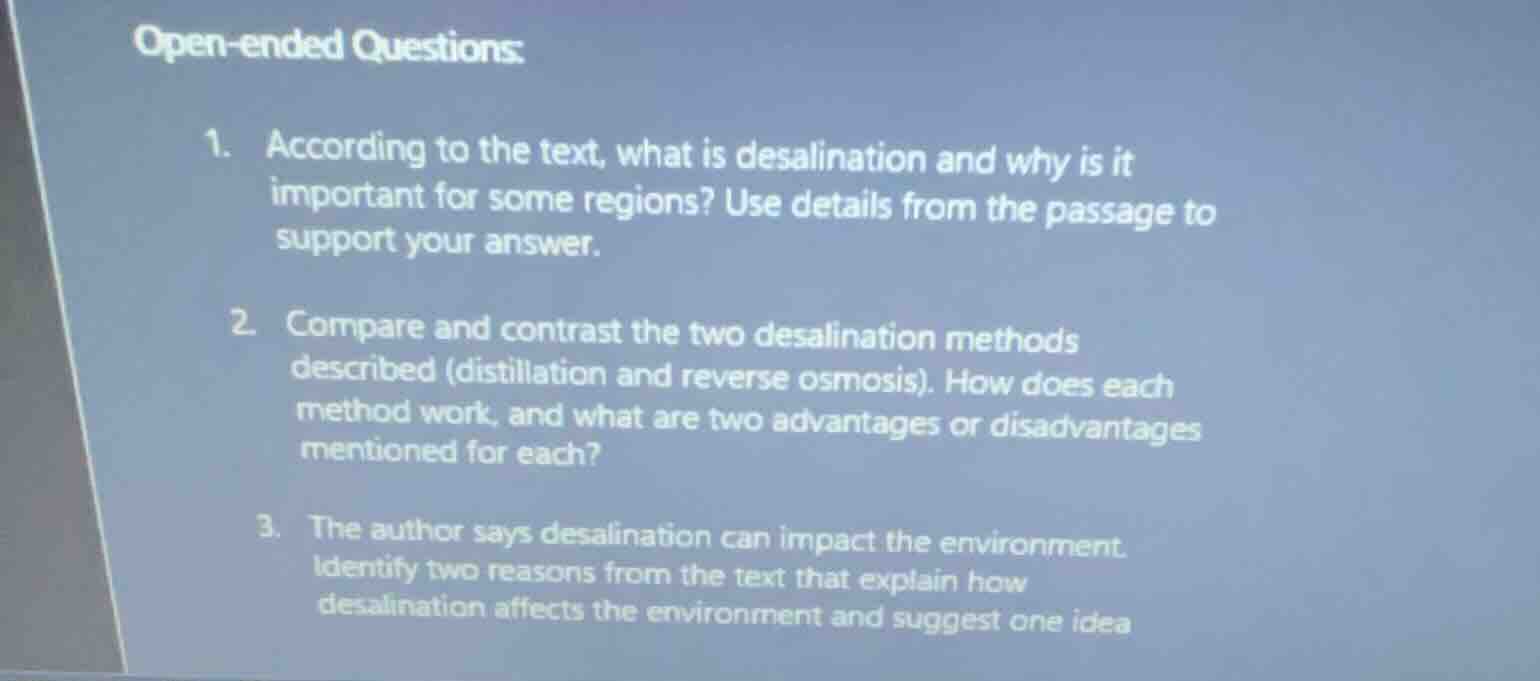
- according to the text, what is desalination and why is it important for some regions? use details from the passage to support your answer.
- compare and contrast the two desalination methods described (distillation and reverse osmosis). how does each method work, and what are two advantages or disadvantages mentioned for each?
- the author says desalination can impact the environment. identify two reasons from the text that explain how desalination affects the environment and suggest one idea
To answer these questions, we would need the actual text/passage that discusses desalination. Since the passage is not provided, here's a general guide on how to approach each question once you have the text:
Question 1: What is desalination and why is it important for some regions?
- Find the definition of desalination in the text: Look for sentences that explain what desalination is (e.g., a process to remove salt from seawater or brackish water to make it usable for drinking, agriculture, etc.).
- Find reasons for its importance in some regions: Look for details about regions with water scarcity, lack of freshwater sources, or high demand for water (e.g., arid regions, coastal areas with limited freshwater, regions with growing populations or agricultural needs). Quote or paraphrase these details to support your answer.
Question 2: Compare and contrast distillation and reverse osmosis desalination methods
- How each method works:
- Distillation: Find the text's description (e.g., heating seawater to create steam, then condensing the steam to get freshwater, leaving salt behind).
- Reverse Osmosis: Find the text's description (e.g., forcing seawater through a semi - permeable membrane under high pressure to filter out salt and other impurities).
- Advantages/Disadvantages for each:
- For distillation, look for points about its efficiency, cost, energy use, or the quality of water produced.
- For reverse osmosis, do the same. Then, compare (find similarities) and contrast (find differences) these aspects.
Question 3: Environmental impacts of desalination and a solution idea
- Identify two environmental impact reasons from the text:
- Possible impacts could be related to energy consumption (e.g., if it uses a lot of fossil fuels, contributing to climate change), brine disposal (e.g., discharging concentrated saltwater back into the ocean, harming marine life), or impacts on coastal ecosystems during plant construction.
- Suggest one idea to mitigate the impact:
- If the text mentions issues like high energy use, you could suggest using renewable energy sources (solar, wind) for desalination. If brine disposal is an issue, suggest methods to dilute the brine before disposal or use the brine for other industrial purposes.
Please share the passage related to desalination so that more specific and accurate answers can be provided.

Snap & solve any problem in the app
Get step-by-step solutions on Sovi AI
Photo-based solutions with guided steps
Explore more problems and detailed explanations
To answer these questions, we would need the actual text/passage that discusses desalination. Since the passage is not provided, here's a general guide on how to approach each question once you have the text:
Question 1: What is desalination and why is it important for some regions?
- Find the definition of desalination in the text: Look for sentences that explain what desalination is (e.g., a process to remove salt from seawater or brackish water to make it usable for drinking, agriculture, etc.).
- Find reasons for its importance in some regions: Look for details about regions with water scarcity, lack of freshwater sources, or high demand for water (e.g., arid regions, coastal areas with limited freshwater, regions with growing populations or agricultural needs). Quote or paraphrase these details to support your answer.
Question 2: Compare and contrast distillation and reverse osmosis desalination methods
- How each method works:
- Distillation: Find the text's description (e.g., heating seawater to create steam, then condensing the steam to get freshwater, leaving salt behind).
- Reverse Osmosis: Find the text's description (e.g., forcing seawater through a semi - permeable membrane under high pressure to filter out salt and other impurities).
- Advantages/Disadvantages for each:
- For distillation, look for points about its efficiency, cost, energy use, or the quality of water produced.
- For reverse osmosis, do the same. Then, compare (find similarities) and contrast (find differences) these aspects.
Question 3: Environmental impacts of desalination and a solution idea
- Identify two environmental impact reasons from the text:
- Possible impacts could be related to energy consumption (e.g., if it uses a lot of fossil fuels, contributing to climate change), brine disposal (e.g., discharging concentrated saltwater back into the ocean, harming marine life), or impacts on coastal ecosystems during plant construction.
- Suggest one idea to mitigate the impact:
- If the text mentions issues like high energy use, you could suggest using renewable energy sources (solar, wind) for desalination. If brine disposal is an issue, suggest methods to dilute the brine before disposal or use the brine for other industrial purposes.
Please share the passage related to desalination so that more specific and accurate answers can be provided.