QUESTION IMAGE
Question
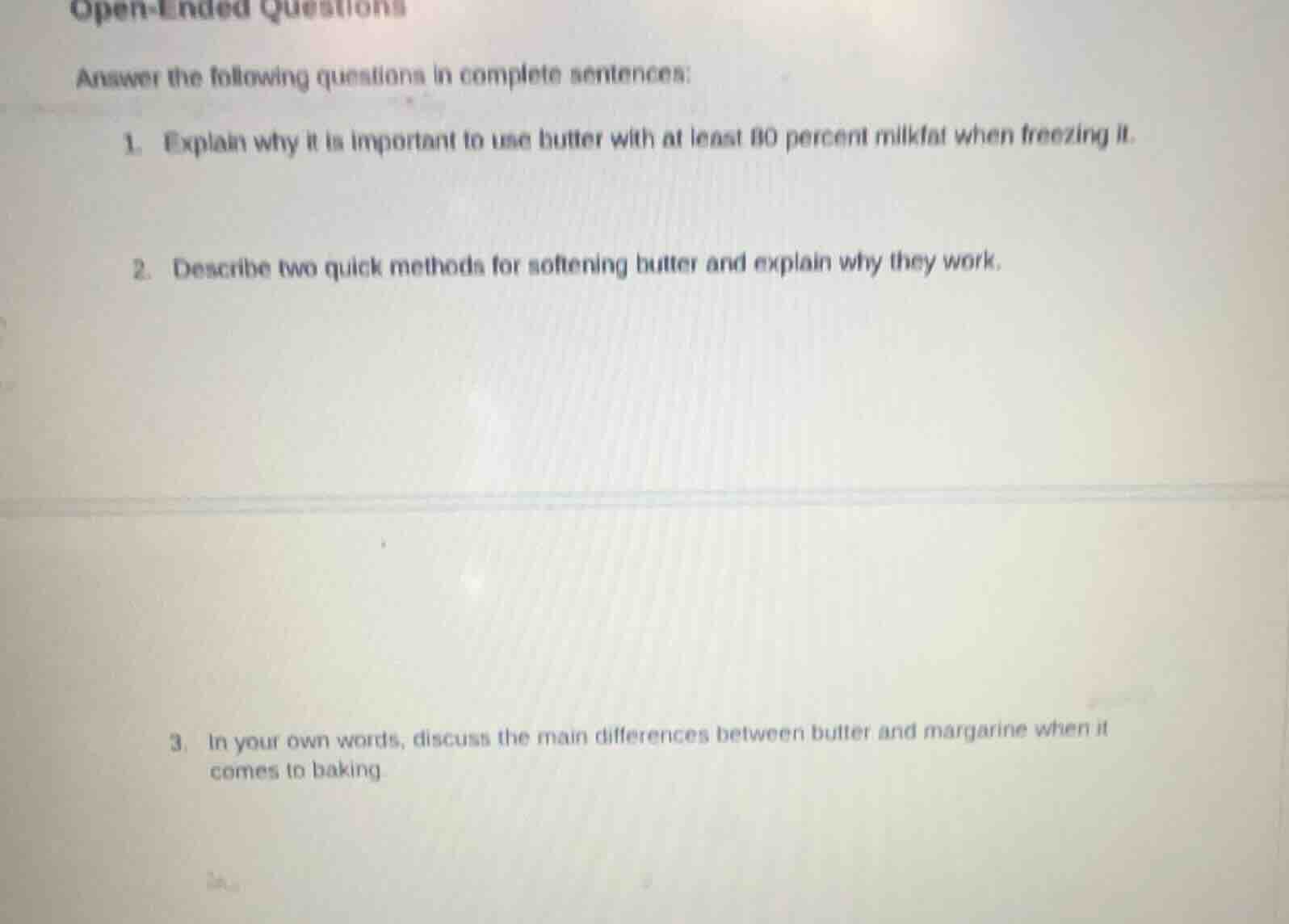
open - ended questions
answer the following questions in complete sentences:
- explain why it is important to use butter with at least 80 percent milkfat when freezing it.
- describe two quick methods for softening butter and explain why they work.
- in your own words, discuss the main differences between butter and margarine when it comes to baking.
Question 1
Butter with at least 80% milkfat has less water content (since the remaining ~20% is mostly water, salt, etc.). When freezing, water in butter can form ice crystals. Lower water content (from higher milkfat) means fewer ice crystals form. Ice crystals can damage the butter’s texture, making it grainy or separating fat and water when thawed. So higher milkfat butter freezes better, maintaining texture and quality.
- Method 1: Cutting butter into small pieces
When butter is cut into small pieces, its surface area increases. Heat transfer (from the surrounding air or a warm environment) occurs more quickly across a larger surface area. This speeds up the melting of the outer layers and softening of the butter.
- Method 2: Using a warm water bath (with the butter in a sealed container)
A warm water bath provides a source of heat. The sealed container allows heat to transfer to the butter via conduction. The warm temperature increases the kinetic energy of the butter’s fat molecules, causing them to move more and break the rigid structure of cold butter, thus softening it.
- Fat Content and Composition: Butter is made from milkfat (at least 80% typically) and has natural milk solids. Margarine is often made from vegetable oils, with added emulsifiers, flavorings, and sometimes milk - derived ingredients.
- Flavor: Butter has a rich, creamy, and distinct dairy - based flavor that contributes to the taste of baked goods. Margarine has a milder, more neutral (or sometimes artificially flavored) taste.
- Texture and Baking Properties: Butter, when creamed with sugar, traps air well, leading to light and fluffy textures in cakes and cookies. Margarine, due to its different fat structure (often more spreadable initially), can sometimes produce a softer or more dense texture, but modern margarines are formulated to mimic butter’s baking properties more closely.
- Melting and Smoking Points: Butter has a lower melting point and can smoke at moderate baking temperatures, affecting flavor if over - heated. Margarine (especially some types) may have a higher melting point, which can impact how it interacts with other ingredients during baking (e.g., in pie crusts or pastries).

Snap & solve any problem in the app
Get step-by-step solutions on Sovi AI
Photo-based solutions with guided steps
Explore more problems and detailed explanations
Using butter with at least 80 percent milkfat when freezing is important because it has a lower water content (as the remaining ~20% of butter is mostly water, salt, and other components). When butter freezes, water within it forms ice crystals. A lower water content (from higher milkfat) results in fewer ice crystals, which helps preserve the butter’s texture and quality. If there were more water (from lower - fat butter), the ice crystals formed during freezing could damage the butter’s structure, leading to a grainy texture or separation of fat and water when the butter is thawed.