QUESTION IMAGE
Question
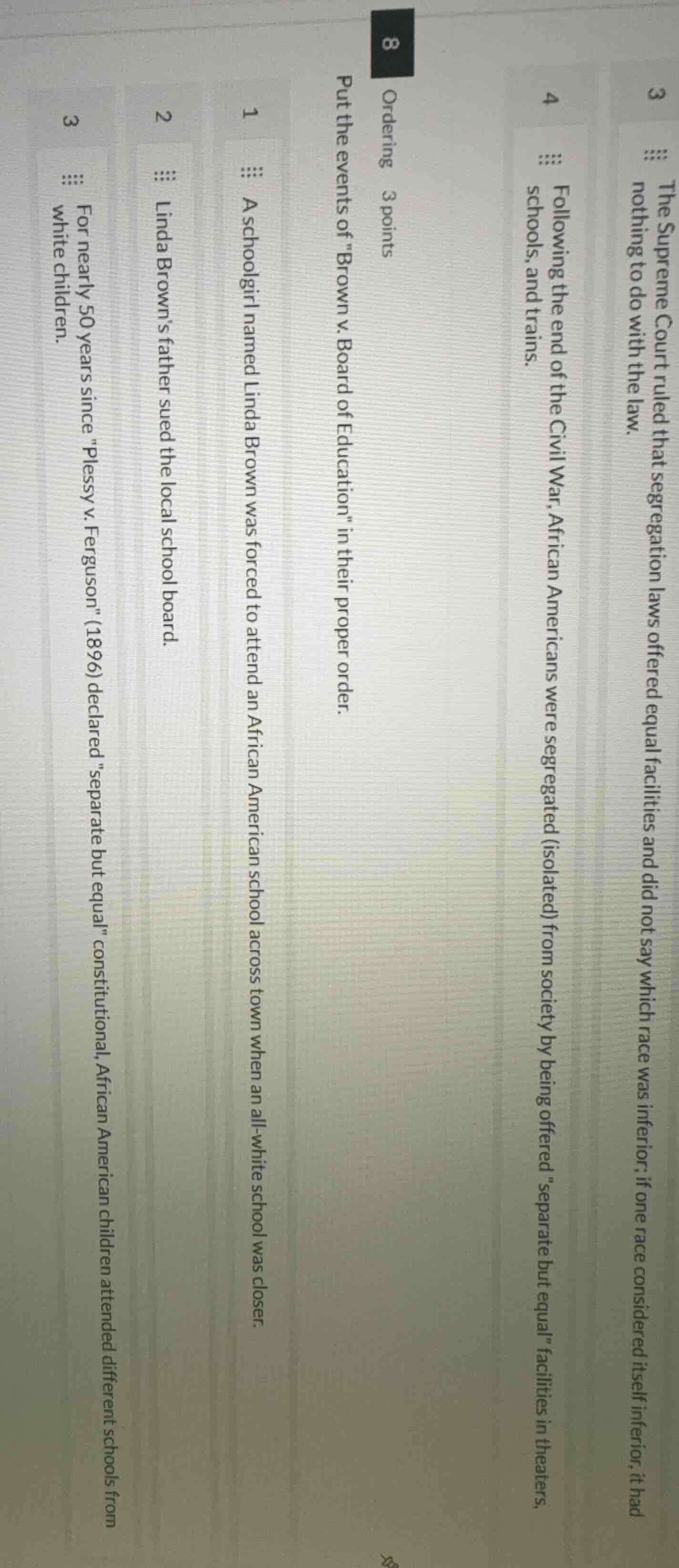
8 ordering 3 points put the events of \brown v. board of education\ in their proper order. 1 a schoolgirl named linda brown was forced to attend an african american school across town when an all - white school was closer. 2 linda browns father sued the local school board. 3 for nearly 50 years since \plessy v. ferguson\ (1896) declared \separate but equal\ constitutional, african american children attended different schools from white children. 4 following the end of the civil war, african americans were segregated (isolated) from society by being offered \separate but equal\ facilities in theaters, schools, and trains. 3 the supreme court ruled that segregation laws offered equal facilities and did not say which race was inferior; if one race considered itself inferior, it had nothing to do with the law.
First, establish the post-Civil War segregation context set by Plessy v. Ferguson. Then outline the specific incident with Linda Brown, her father's legal action, and finally the Supreme Court's ruling in Brown v. Board of Education that overturned the earlier doctrine.

Snap & solve any problem in the app
Get step-by-step solutions on Sovi AI
Photo-based solutions with guided steps
Explore more problems and detailed explanations
- 4. Following the end of the Civil War, African Americans were segregated (isolated) from society by being offered "separate but equal" facilities in theaters, schools, and trains.
- 3. For nearly 50 years since "Plessy v. Ferguson" (1896) declared "separate but equal" constitutional, African American children attended different schools from white children.
- 1. A schoolgirl named Linda Brown was forced to attend an African American school across town when an all-white school was closer.
- 2. Linda Brown's father sued the local school board.
- 3. The Supreme Court ruled that segregation laws offered equal facilities and did not say which race was inferior; if one race considered itself inferior, it had nothing to do with the law.