QUESTION IMAGE
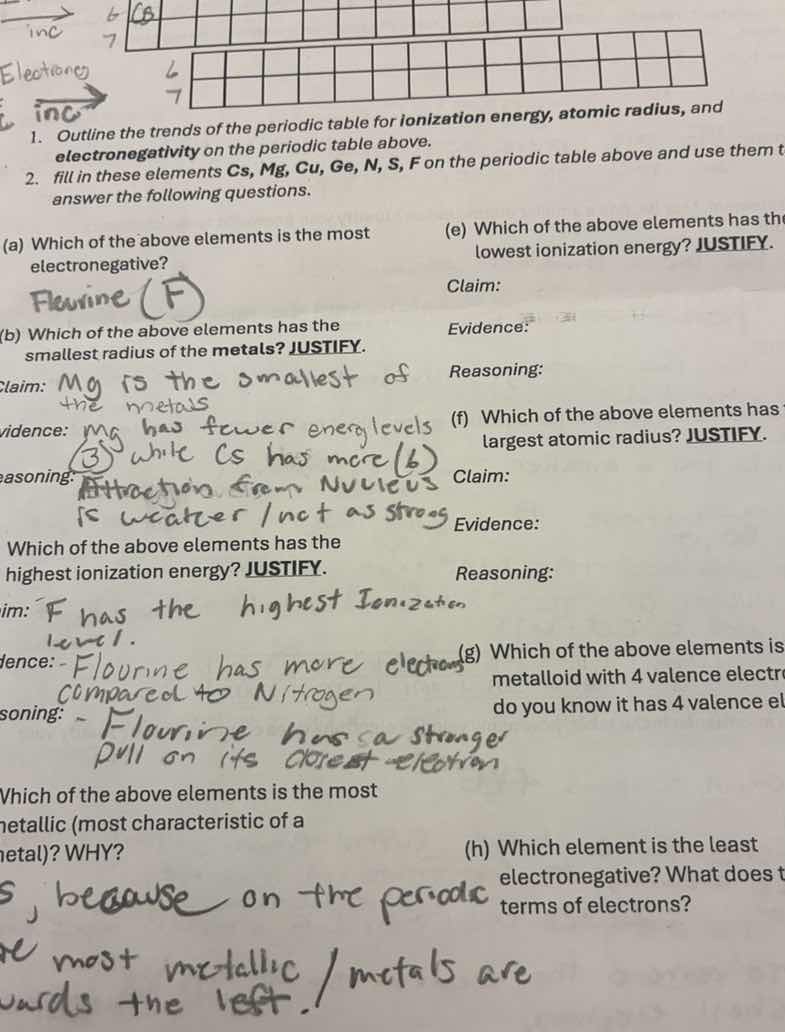
Question
- outline the trends of the periodic table for ionization energy, atomic radius, and electronegativity on the periodic table above.
- fill in these elements cs, mg, cu, ge, n, s, f on the periodic table above and use them t answer the following questions.
(a) which of the above elements is the most electronegative?
fluorine (f)
(b) which of the above elements has the smallest radius of the metals? justify.
claim: mg is the smallest of the metals
evidence: mg has fewer energy levels (3) while cs has more (6)
reasoning: attraction from nucleus is weaker / not as strong
which of the above elements has the highest ionization energy? justify.
claim: f has the highest ionization level.
evidence: - fluorine has more electrons compared to nitrogen
reasoning: - fluorine has a stronger pull on its closest electron
which of the above elements is the most metallic (most characteristic of a metal)? why?
, because on the periodic the most metallic / metals are towards the left.
(e) which of the above elements has the lowest ionization energy? justify.
claim:
evidence:
reasoning:
(f) which of the above elements has the largest atomic radius? justify.
claim:
evidence:
reasoning:
(g) which of the above elements is a metalloid with 4 valence electrons? how do you know it has 4 valence electrons?
(h) which element is the least electronegative? what does this mean in terms of electrons?
All answers are based on periodic table trends: ionization energy increases right/up, atomic radius increases left/down, electronegativity increases right/up; metallic character increases left/down; metalloids lie along the staircase, valence electrons match group number.

Snap & solve any problem in the app
Get step-by-step solutions on Sovi AI
Photo-based solutions with guided steps
Explore more problems and detailed explanations
(a) F (Fluorine)
(b) Claim: Mg (Magnesium) is the smallest metal radius.
Evidence: Mg has 3 energy levels; Cs has 6.
Reasoning: Fewer energy levels mean stronger nuclear attraction pulling electrons closer, reducing radius.
(c) Claim: F (Fluorine) has the highest ionization energy.
Evidence: F is in Period 2, Group 17 (rightmost/topmost of the set).
Reasoning: Smallest atomic radius means the outermost electron is held tightest by the nucleus, requiring the most energy to remove.
(d) Cs (Cesium) is the most metallic. Reason: Metallic character increases toward the bottom-left of the periodic table, and Cs is the bottom-left element in the set.
(e) Claim: Cs (Cesium) has the lowest ionization energy.
Evidence: Cs is in Period 6, Group 1 (bottom-left of the set).
Reasoning: Largest atomic radius means the outermost electron is farthest from the nucleus, held weakest, so the least energy is needed to remove it.
(f) Claim: Cs (Cesium) has the largest atomic radius.
Evidence: Cs has 6 energy levels; all other elements have fewer.
Reasoning: More energy levels increase the distance between the nucleus and outermost electrons, increasing atomic radius.
(g) Ge (Germanium) is the metalloid with 4 valence electrons. It is a metalloid (lies on the periodic table staircase), and it is in Group 14, which has 4 valence electrons.
(h) Cs (Cesium) is the least electronegative. This means it has the weakest attraction for electrons in a chemical bond, as its large atomic radius and low nuclear charge reduce its ability to pull shared electrons toward itself.