QUESTION IMAGE
Question
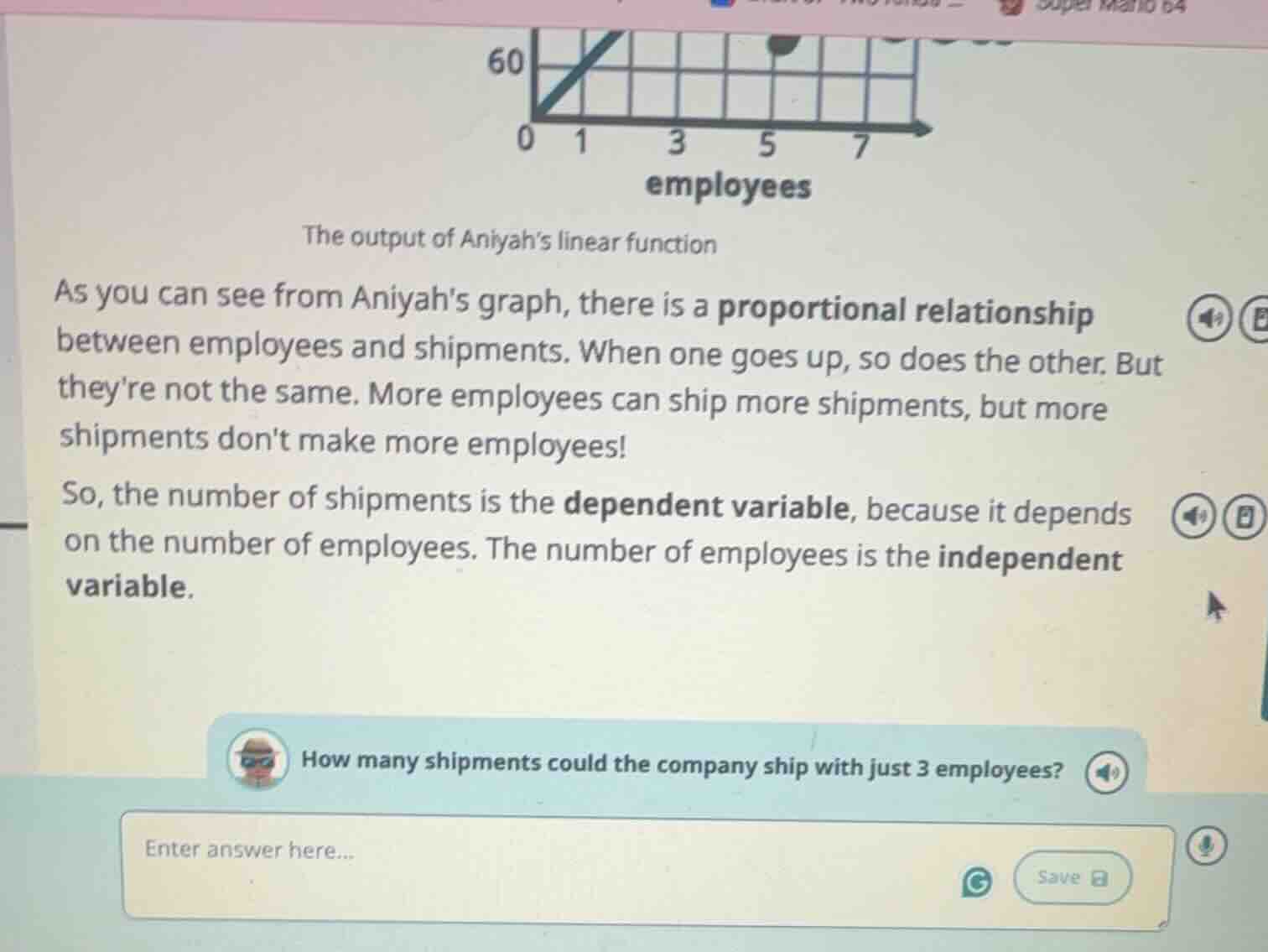
the output of aniyahs linear function
as you can see from aniyahs graph, there is a proportional relationship between employees and shipments. when one goes up, so does the other. but theyre not the same. more employees can ship more shipments, but more shipments dont make more employees!
so, the number of shipments is the dependent variable, because it depends on the number of employees. the number of employees is the independent variable.
how many shipments could the company ship with just 3 employees?
enter answer here...
Step1: Determine the rate of shipments per employee
From the graph, when there is 1 employee, the number of shipments is 60? Wait, no, looking at the graph, the line goes from (0,0) to (2, 60)? Wait, no, the x - axis is employees, with 0,1,3,5,7. Wait, the first point after (0,0) is at x = 1, and let's see the y - value. Wait, the problem says proportional relationship, so the equation is \(y=kx\), where \(y\) is shipments and \(x\) is employees. From the graph, when \(x = 2\)? Wait, no, maybe when \(x = 1\), \(y = 30\)? Wait, no, let's re - examine. Wait, the graph: the x - axis is employees (0,1,3,5,7), y - axis is shipments (0,60? Wait, the top of the first square is 60? Wait, maybe the slope is calculated as follows. Let's assume that when \(x = 2\) employees, \(y = 60\) shipments? No, wait, the problem says proportional relationship, so let's find the unit rate. Let's take the point (1, 30)? No, wait, maybe the graph has a point at (2, 60)? Wait, no, the user's graph: the x - axis is employees with ticks at 0,1,3,5,7. The line starts at (0,0) and goes up. Let's calculate the slope. Let's say when \(x = 2\) employees, \(y = 60\) shipments? No, wait, maybe when \(x = 1\) employee, the number of shipments is 30? No, wait, the key is that it's a proportional relationship, so \(y=kx\). Let's find \(k\). Suppose when \(x = 2\) (since from 0 to 2 employees), \(y = 60\). Then \(k=\frac{y}{x}=\frac{60}{2}=30\)? No, wait, maybe the first segment is from (0,0) to (2, 60)? Wait, no, the x - axis has 1,3,5,7. Wait, maybe when \(x = 2\) employees, the number of shipments is 60? No, the question is about 3 employees. Wait, let's think again. If it's a proportional relationship, then the ratio of shipments to employees is constant. Let's assume that when there are 2 employees, there are 60 shipments? No, maybe the graph shows that for 1 employee, the shipments are 30? No, wait, the problem says "proportional relationship", so let's find the rate. Let's take the point (2, 60) (assuming that the first square is 30, but maybe the graph is such that when x = 2, y = 60). Then the rate \(k=\frac{60}{2}=30\) shipments per 2 employees? No, that doesn't make sense. Wait, maybe the graph is such that when x = 1, y = 30, x = 2, y = 60, etc. Wait, no, the question is: how many shipments with 3 employees. Let's calculate the slope. Let's say the line passes through (0,0) and (2, 60). Then the slope \(m=\frac{60 - 0}{2 - 0}=30\) shipments per employee? No, 60 shipments for 2 employees, so 30 shipments per employee. Wait, no, 60 shipments for 2 employees means 30 shipments per employee. Then for 3 employees, the number of shipments is \(3\times30 = 90\)? Wait, no, maybe the graph is such that when x = 2, y = 60, so the rate is 30 shipments per employee. Wait, no, let's check the x - axis: the ticks are 0,1,3,5,7. So the distance between 0 and 2 (since 1 and 3 are two units apart) is 2 employees. So if at x = 2 employees, y = 60 shipments, then the rate is \(k=\frac{60}{2}=30\) shipments per employee. Then for x = 3 employees, \(y = 30\times3=90\)? Wait, no, that can't be. Wait, maybe the graph is such that when x = 1 employee, y = 30 shipments, x = 2 employees, y = 60 shipments, x = 3 employees, y = 90 shipments? Wait, the problem is about a proportional relationship, so \(y = kx\). Let's find \(k\) from the graph. Let's assume that when x = 2 (the mid - point between 0 and 4? No, the x - axis is 0,1,3,5,7. So the first interval is 0 to 2 (from 0 to 2 employees), and the y - axis reaches 60. So \(k=\frac{60}{2}=30\) shipments per employee. Then for x = 3 e…

Snap & solve any problem in the app
Get step-by-step solutions on Sovi AI
Photo-based solutions with guided steps
Explore more problems and detailed explanations
90